

Concepts: atomic size, ionization enthalpy and electronegativity
Classification of Elements and Periodicity in Properties24 min readLesson 3 of 6
3.1 What decides the trends
Two quantities explain the whole page. The effective nuclear charge is the net positive charge that an outer electron actually feels after the inner electrons have cancelled part of the nuclear charge. The other is the size of the outer shell. An electron close to a larger effective charge is held tightly; an electron on a new, distant shell is held loosely.
Screening is not the same for every subshell. For electrons in the same shell, the order of screening is s greater than p greater than d greater than f. This is why an electron in an outer s orbital is held more tightly than an electron in an outer p orbital of the same shell, and it produces several of the anomalies met below.
3.2 Atomic and ionic radii
Chemists do not measure a free atom's radius directly. The radius is taken as half the distance between two identical bonded atoms, and the number depends on how the atoms are touching. The covalent radius uses a single bond, the metallic radius uses atoms packed in a metal, and the van der Waals radius uses non-bonded contacts; the van der Waals value is the largest of the three.
Across a period the radius falls steadily as Z rises. Down a group the radius rises as new shells are added. The transition series show only a small change across a period because the added d electrons shield the outer electrons fairly well.
Slideshow, slide 1 of 3. Use the left and right arrow keys to change slides and the space bar to play or pause.
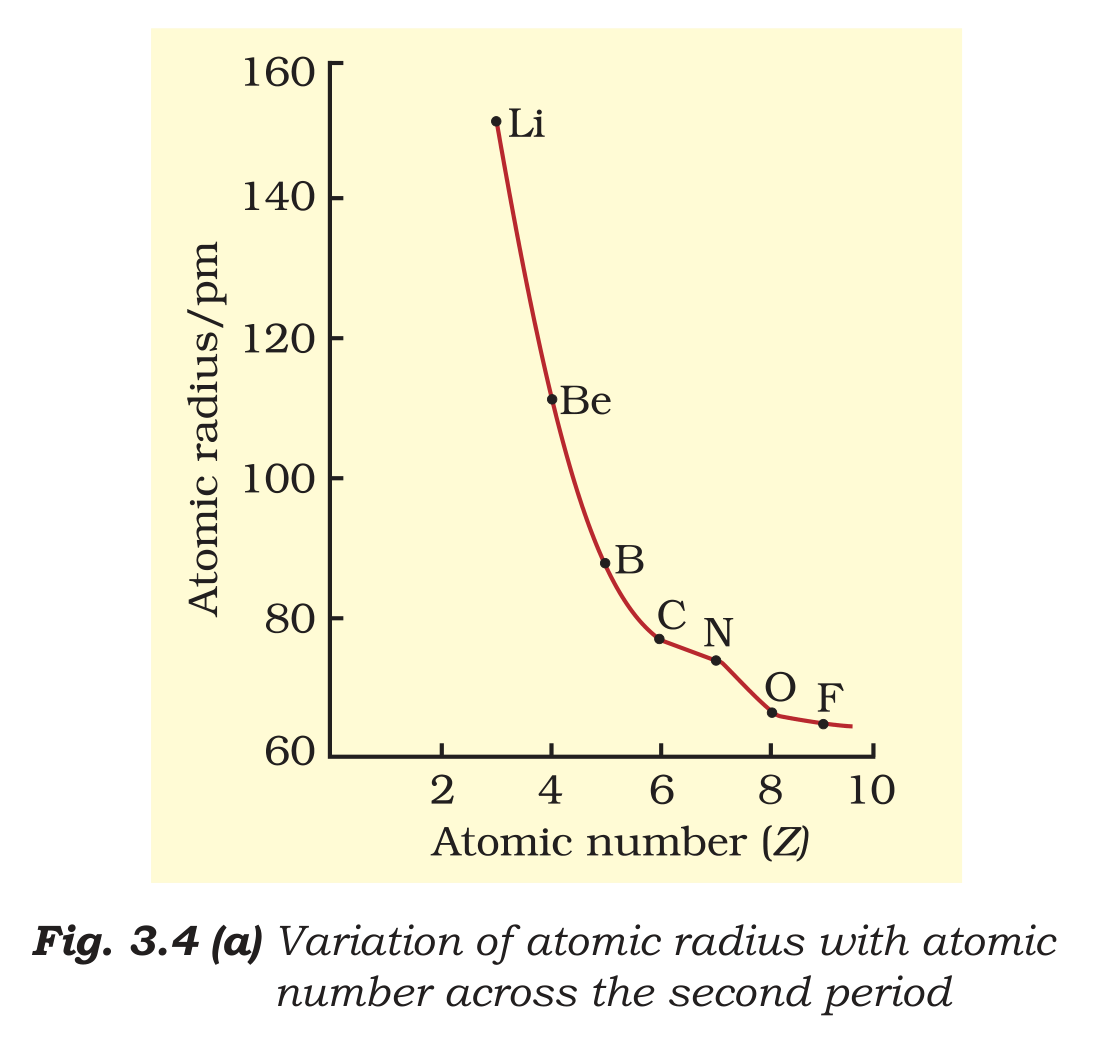
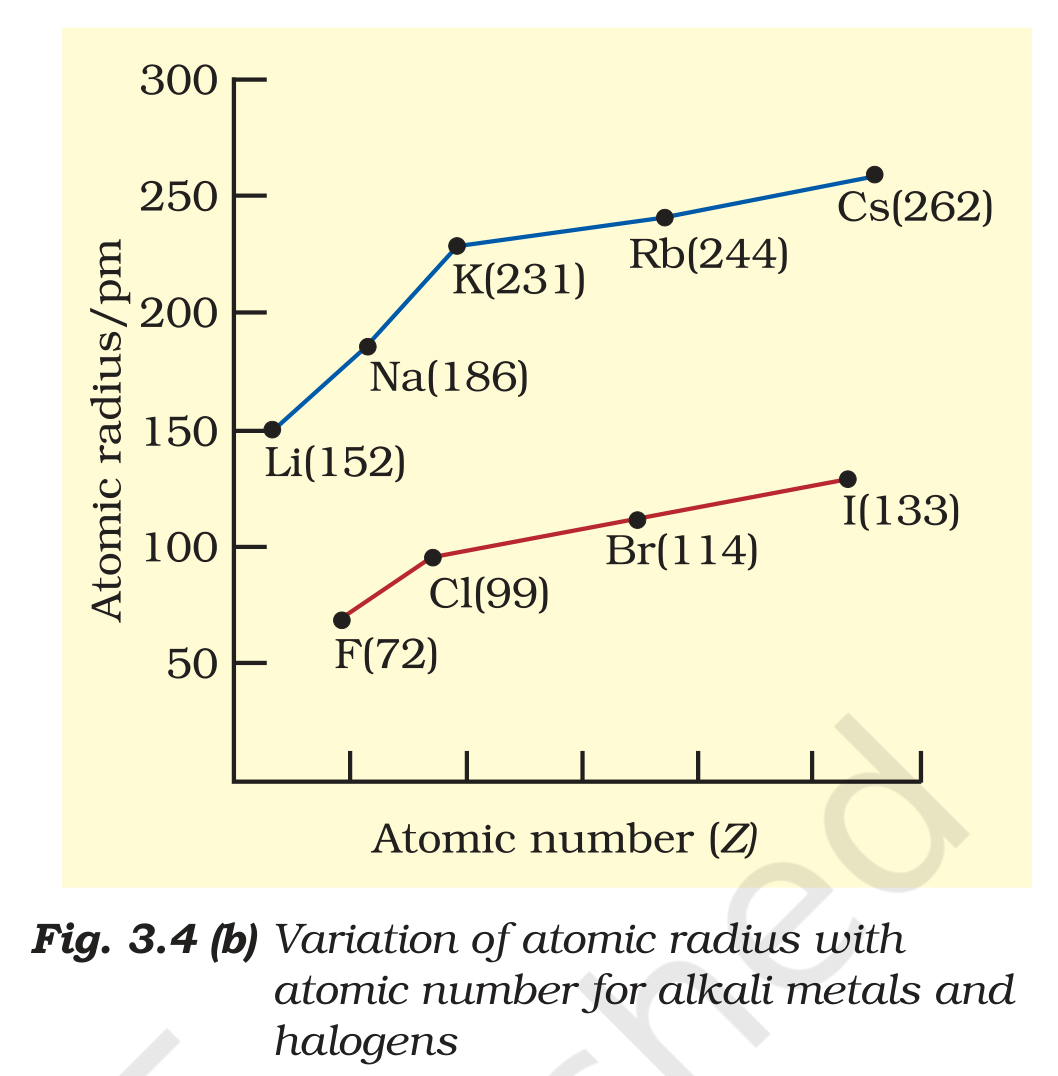
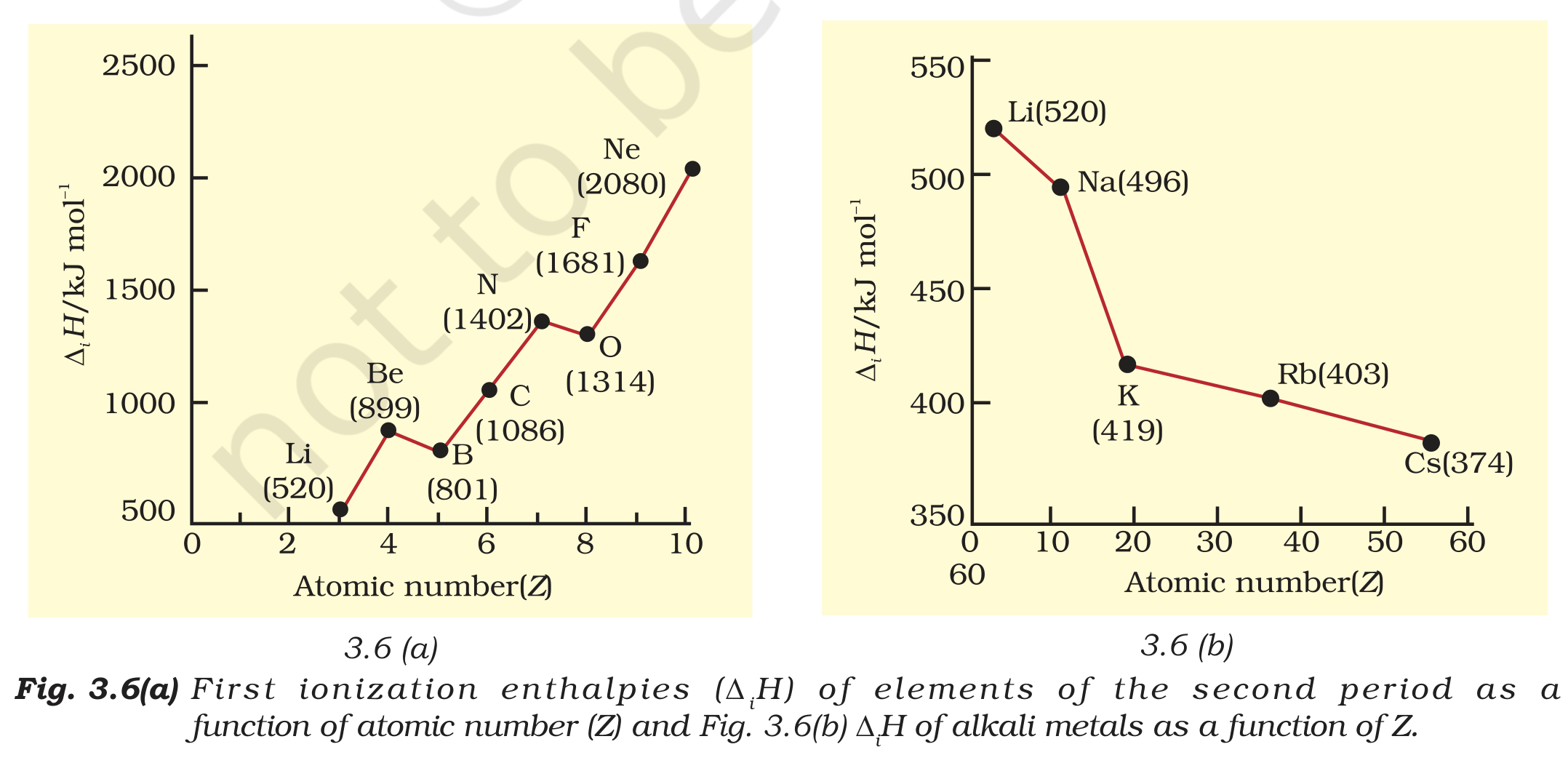
Graph of atomic radius against atomic number across the second period, falling from lithium to fluorine.
A cation forms when an atom loses electrons, so the nucleus now holds fewer electrons and the radius shrinks. An anion forms when electrons are gained, so repulsion among the extra electrons expands the cloud. The change is not small: the sodium atom has radius 186 pm while the sodium ion is about 95 pm, and the fluorine atom has radius 64 pm while the fluoride ion reaches 136 pm.
When two species have the same number of electrons they are isoelectronic, and their radii depend only on the nuclear charge. More protons pull the same electron cloud harder, so the species with the larger Z is smaller. In the set N3-, O2-, F-, Na+, Mg2+ and Al3-, all have ten electrons and the radius falls in that same order.
3.3 Ionization enthalpy
The first ionization enthalpy is the energy absorbed when one mole of atoms, each in the gaseous state and in its ground state, loses its most loosely bound electron. The positive sign is part of the definition. The second, third and later values are the energies for removing further electrons, and they are always larger than the previous value.
Down a group the first ionization enthalpy decreases because the outer electron sits farther from the nucleus and is better shielded. Across a period it rises as the effective nuclear charge grows, but the rise is not smooth. Beryllium has a higher value than boron because beryllium loses a 2s electron from a filled subshell while boron must give up a 2p electron that is higher in energy. Nitrogen has a higher value than oxygen because nitrogen's half-filled 2p subshell has extra exchange stability, while oxygen has a paired electron that repulsion makes easier to remove. The same two shapes appear in the third period between magnesium and aluminium and between phosphorus and sulphur.
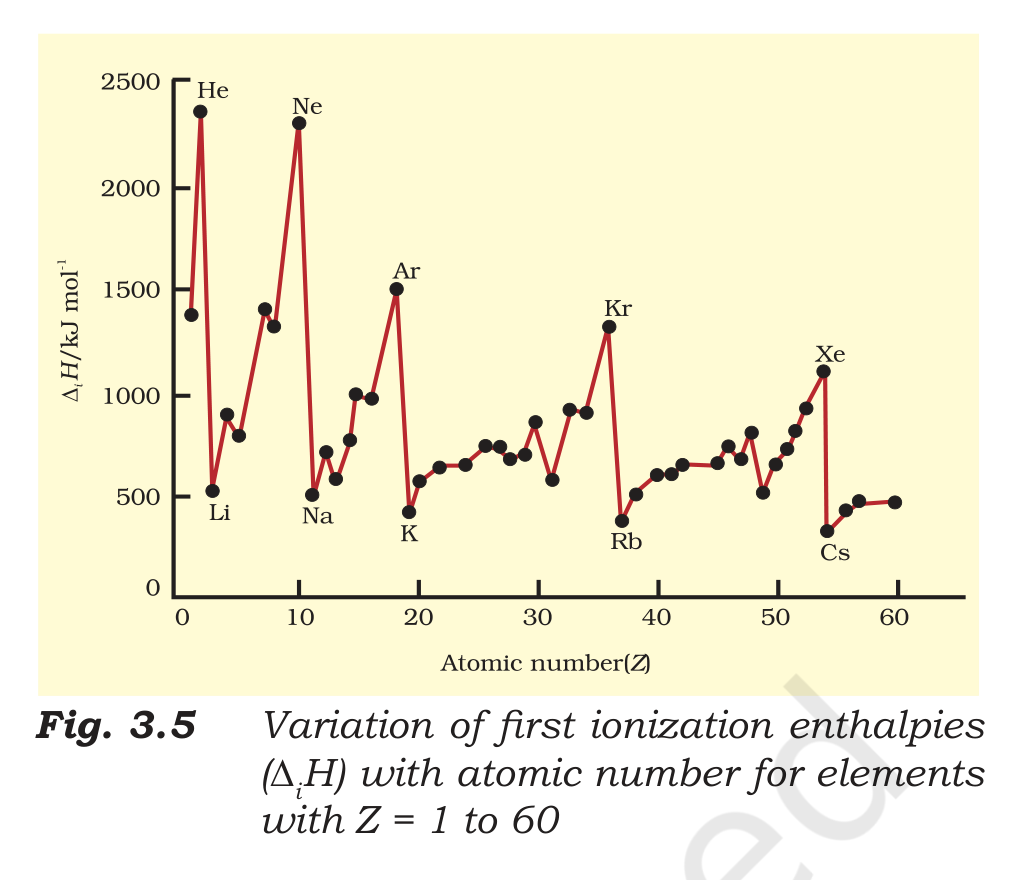
The graph of first ionization enthalpy against atomic number repeats the same sawtooth shape at every period. The peaks sit at the noble gases with their closed shells, and the troughs sit at the alkali metals, which lose one electron easily. A very large jump between two successive values marks the removal of an electron from a closed inner shell, so the number of valence electrons can be read from the position of the jump.
3.4 Electron gain enthalpy
Electron gain enthalpy is the enthalpy change when one mole of gaseous atoms each accepts an electron. When energy is released the value is negative, and the more negative the value the greater the tendency of the element to gain an electron. Halogens have large negative values, noble gases have positive values, and the second electron gain enthalpy of oxygen is positive because a second negative charge must be forced onto an already negative ion.
Chlorine has a more negative electron gain enthalpy than fluorine, even though fluorine is the more reactive halogen. Fluorine's 2p subshell is very small, so the incoming electron feels strong repulsion. Chlorine's 3p subshell is larger and the repulsion is smaller, so more energy is released.
3.5 Electronegativity
Electronegativity measures how strongly an atom in a chemical bond attracts the shared pair of electrons. It is a relative number, not an energy and not a measurable enthalpy. On the Pauling scale fluorine is the most electronegative element with a value of 4.0, and caesium and francium sit at the low end near 0.7.
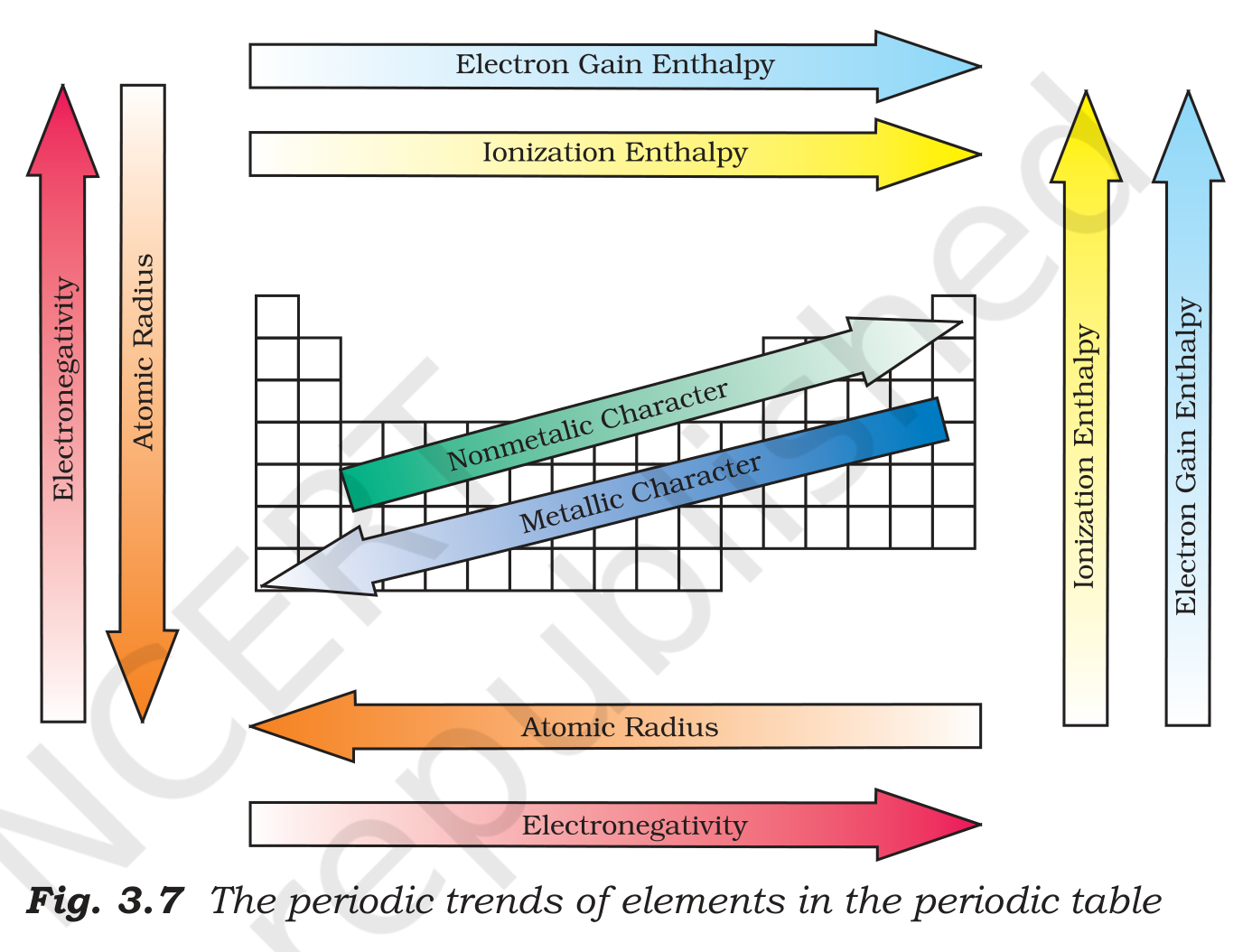
Across a period electronegativity rises because Z rises and the radius falls. Down a group it falls because the radius rises and the outer electrons are farther from the nucleus. These two rules let you place elements on a scale without memorising the whole table: an element up and to the right is more electronegative than one down and to the left.
Exam
When a question gives a graph or a set of values, do not trust the general trend blindly. Look for the configuration: a filled subshell, a half-filled subshell or a small size can reverse the expected order. The anomalies in ionization enthalpy and electron gain enthalpy come from exactly these effects.