

Concepts: classical and electron transfer views of redox
Redox Reactions20 min readLesson 2 of 6
2.1 The classical view
The idea of oxidation began with oxygen, because many reactions in which a substance burns or rusts involve addition of oxygen. Oxidation was defined as gain of oxygen or loss of hydrogen, and reduction as gain of hydrogen or loss of oxygen. When copper oxide is heated in a stream of hydrogen, the copper oxide loses oxygen and is reduced, while the hydrogen gains oxygen and is oxidised. Both changes happen in the same reaction, which is the key feature of redox chemistry.
This definition is still useful for identifying the changes in many organic and inorganic reactions. The oxidation of ethanol to ethanoic acid is a gain of oxygen, and the reduction of an alkene to an alkane is a gain of hydrogen. The definition is limited, however, because many redox reactions involve neither oxygen nor hydrogen, and because the assignment of gain and loss of oxygen can be ambiguous in complicated molecules.
The classical definition also covers reactions such as the burning of magnesium in steam and the reduction of metal oxides by carbon, which were the historical evidence for the idea. The more general view is based on electrons. Oxidation is the loss of electrons and reduction is the gain of electrons, and these definitions cover every redox reaction without exception. A species that loses electrons is oxidised and acts as a reducing agent; a species that gains electrons is reduced and acts as an oxidising agent. The reducing agent is itself oxidised, which is the point that examination questions test again and again.
2.2 Half reactions
Any redox reaction can be written as two half reactions, one showing the electrons lost and one showing the electrons gained. The number of electrons lost must equal the number gained, so the half reactions are multiplied by suitable integers before they are added. The electrons cancel, and the result is the balanced overall equation.
In the reaction between zinc and copper ions, zinc loses two electrons and becomes zinc ion, while copper ion gains two electrons and becomes copper metal. The overall change is the sum of the two half reactions, and the electron count matches without further multiplication. In the reaction between iron and chlorine, one iron atom loses three electrons but each chlorine molecule gains two, so the half reactions must be multiplied: two iron half reactions for three chlorine half reactions.
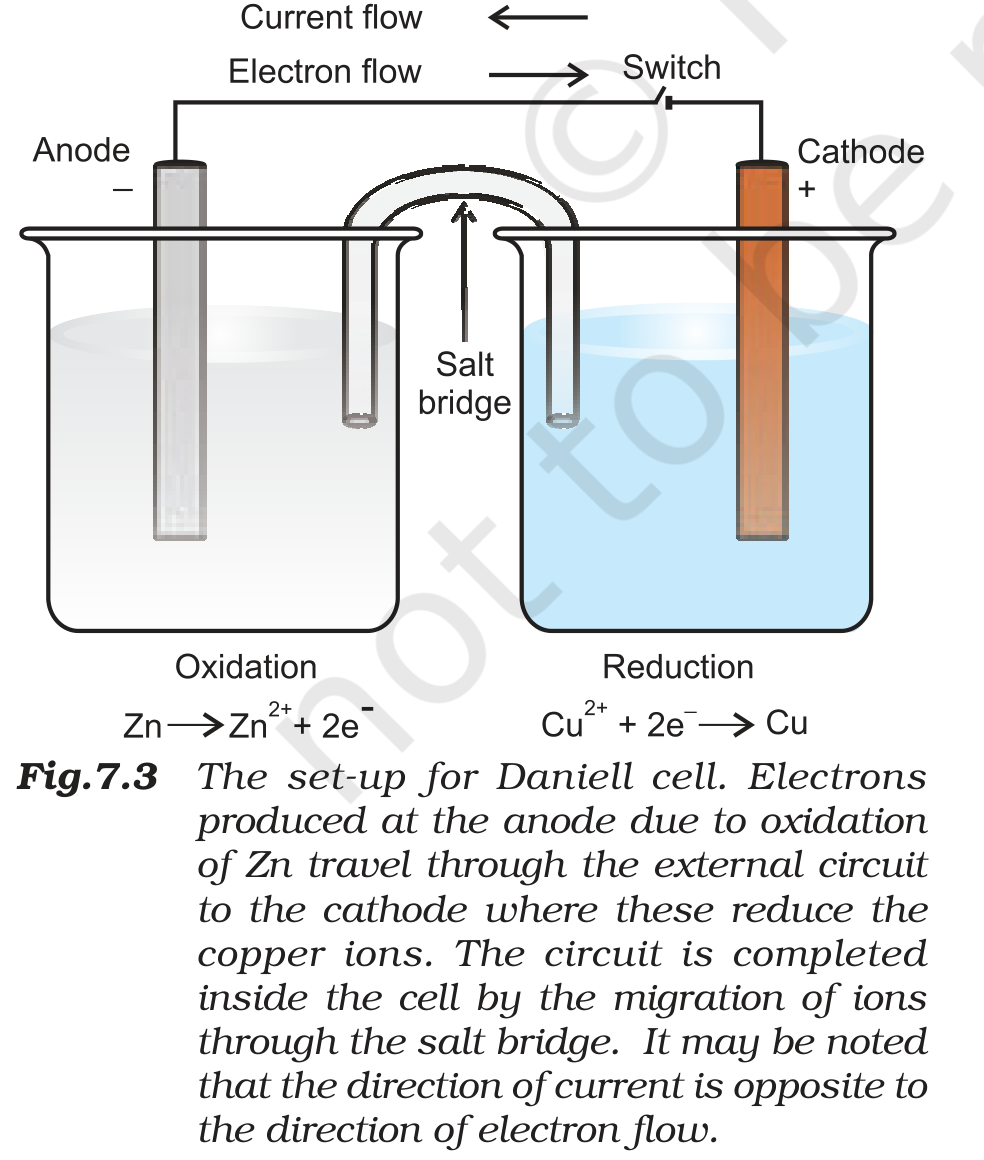
Half reactions also show which side is the anode and which is the cathode in electrochemical terminology. Oxidation occurs at the anode and reduction at the cathode, whatever the sign convention of the cell. The half reactions are therefore the natural bridge between redox chemistry and electrochemistry.
Common mistake
The oxidising agent is the species that gets reduced, not the species that gets oxidised. Students often label the reactant that loses electrons as the oxidising agent because of the word lost. Track the electrons, not the words.
Slideshow, slide 1 of 3. Use the left and right arrow keys to change slides and the space bar to play or pause.
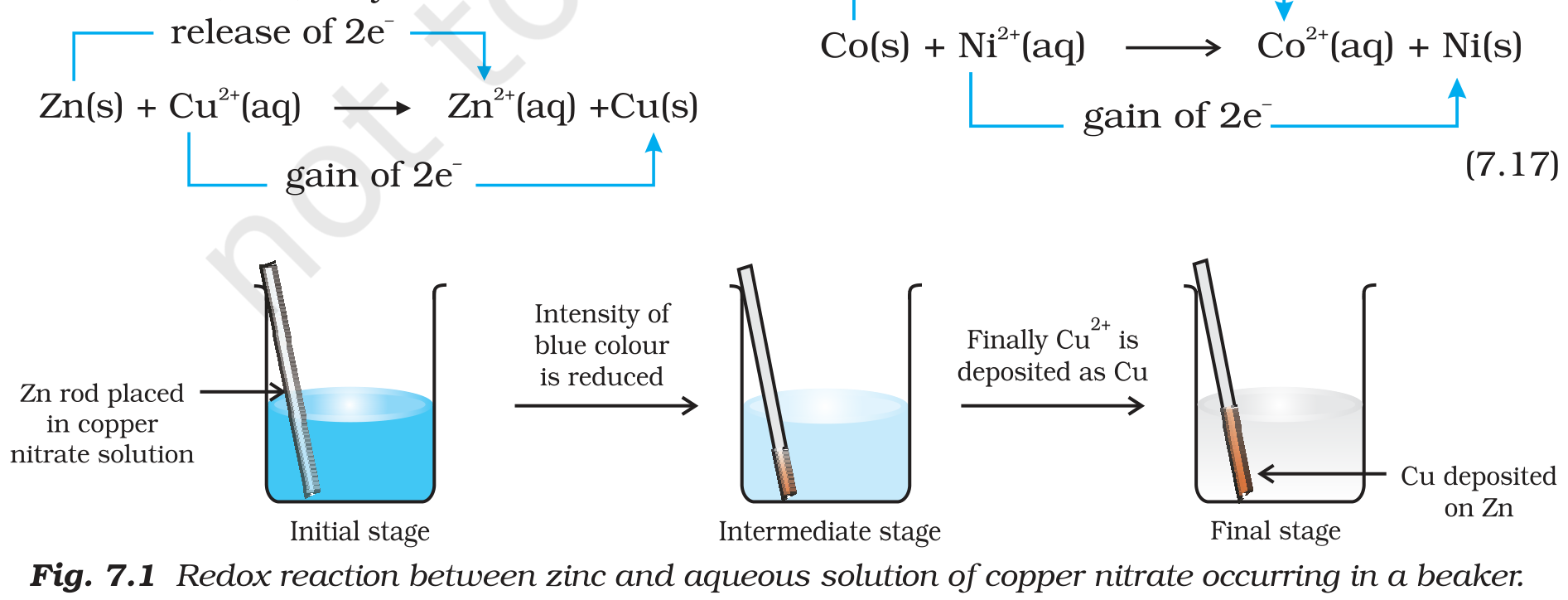
NCERT Figure 7.1: the redox reaction between zinc and aqueous copper nitrate solution in a beaker, shown at the initial, intermediate and final stages.
2.3 Competitive electron transfer
When a strip of zinc is placed in copper sulphate solution, the blue colour fades and a reddish deposit forms on the zinc. The zinc atoms enter the solution as zinc ions, and the copper ions leave the solution as copper metal. The reaction proceeds because zinc has a greater tendency than copper to lose electrons, and the electron transfer happens directly between the metal surface and the ions in solution.
The same reaction can be run in two separate vessels joined by a wire and a salt bridge, in which case the electron transfer happens through the wire and the cell delivers an electric current. The chemistry is the same, but the arrangement separates the oxidation and reduction so that the current can be used. This separation is the principle of the galvanic cell, and the Daniell cell is the standard example.
The figure below shows the direct reaction in a beaker at three stages, with the blue colour fading as copper ions are removed from solution and copper deposits on the zinc. The arrows show the release of electrons by zinc and the gain of electrons by copper ions.
2.4 The copper and silver system
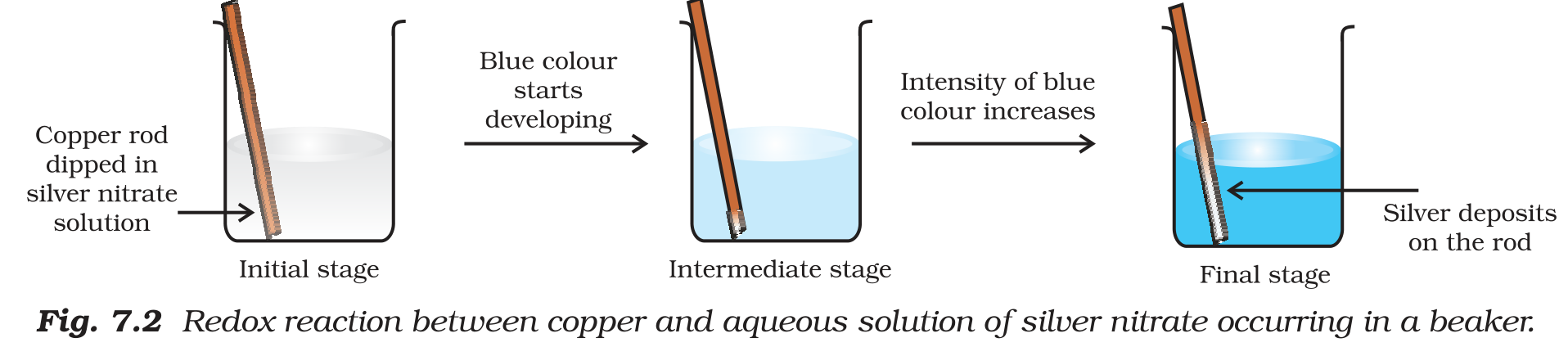
A copper rod in silver nitrate solution becomes coated with silver, and the solution turns blue as copper ions are formed. Here copper is oxidised and silver ions are reduced, so copper is a stronger reducing agent than silver. The reaction is another example of a displacement driven by the relative tendency to lose electrons.
The two experiments together give a ranking of the metals as reducing agents: zinc displaces copper, and copper displaces silver. This ranking is the practical content of the activity series, and it is also the ordering of the standard reduction potentials. Metals higher in the series lose electrons more readily and are better reducing agents.
The figure shows the same three-stage sequence for copper in silver nitrate solution, with the blue colour developing and silver depositing on the rod. Reading these diagrams carefully is worthwhile because examination questions often reproduce them and ask which species is oxidised.
Exam
To find the oxidising and reducing agents, assign oxidation numbers to every atom before and after. The atom whose number rises is oxidised and supplies the reducing agent; the atom whose number falls is reduced and supplies the oxidising agent.