

Concepts: binomial theorem and Pascal's triangle
Binomial Theorem24 min readLesson 2 of 5
2.1 From small powers to a general rule
The expansions of (a plus b) squared and cubed are familiar from earlier classes. The pattern continues for every positive integral index, and the binomial theorem states it in one line: the coefficient of the term with b to the power r is nCr. That is why the coefficients are called binomial coefficients.
Three observations record the pattern. The expansion has n plus 1 terms, one more than the index. The powers of the first quantity fall by one in each step while the powers of the second rise by one. And the two powers add to n in every term. These three facts let you write any expansion once the coefficients are known.
For (x plus 2) to the sixth, the coefficients from the sixth row are 1, 6, 15, 20, 15, 6, 1. Multiplying each by the right powers of x and 2 gives x to the sixth plus 12x to the fifth plus 60x to the fourth plus 160x cubed plus 240x squared plus 192x plus 64. Checking the last term, 2 to the sixth is 64, confirms the pattern.
2.2 Pascal's triangle
Write the coefficients of the expansions in rows, one row per index. Each row begins and ends with 1, and every interior entry is the sum of the two entries above it. The array that results is Pascal's triangle, known in the Indian tradition as Meru Prastara.
The addition rule of the triangle is the combination identity nCr plus nC(r minus 1) equal to (n plus 1)Cr, which is why the rows can be built without computing factorials. Reading the triangle in the other direction, the entries of row n are exactly nC0 through nCn, so the triangle is also a table of binomial coefficients.
Pascal's triangle is useful for small indices and for spotting patterns, but factorial formulas are faster for large n. A question that asks for a specific coefficient in a high power is a signal to use the general term rather than the triangle.
Slideshow, slide 1 of 3. Use the left and right arrow keys to change slides and the space bar to play or pause.
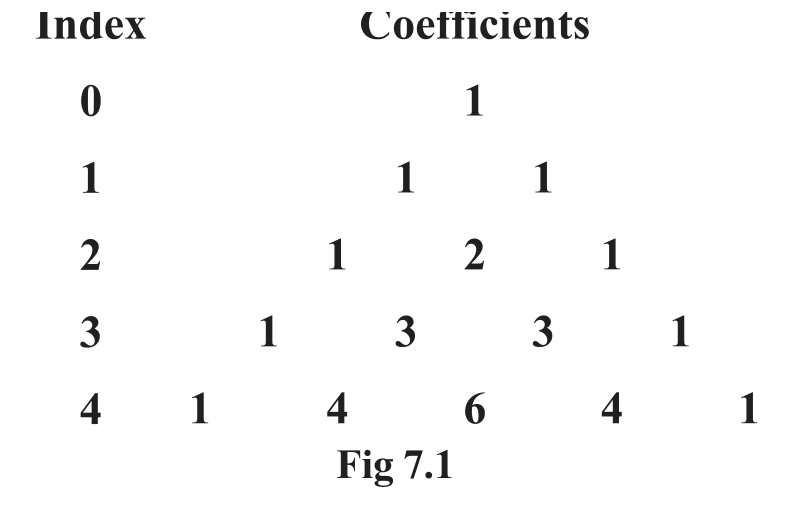
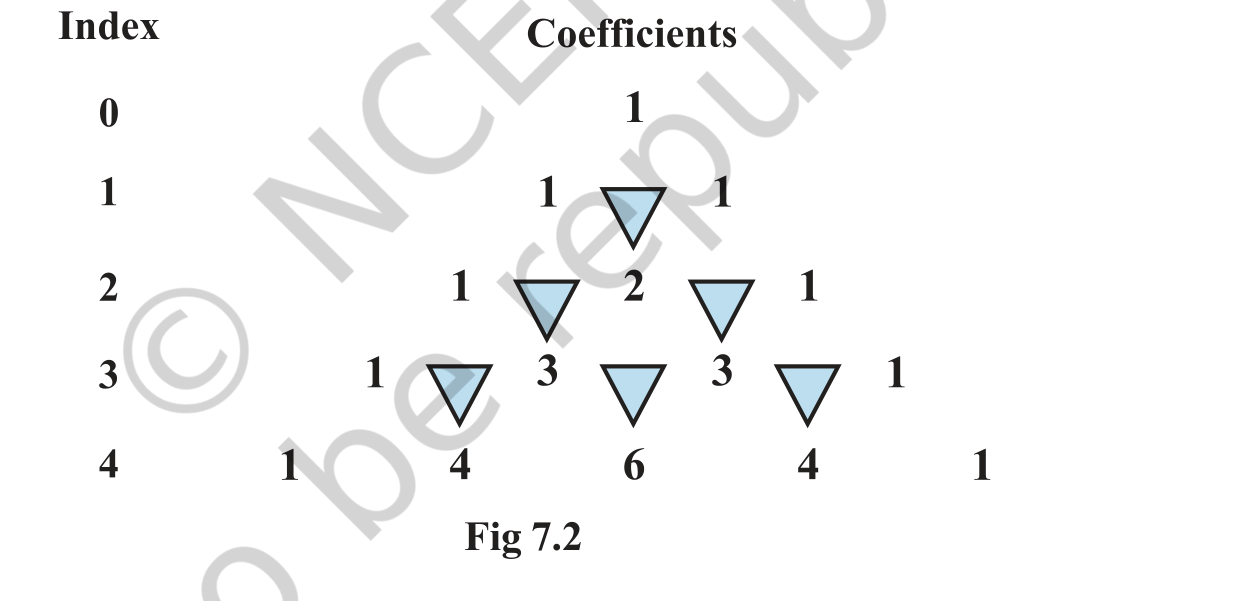
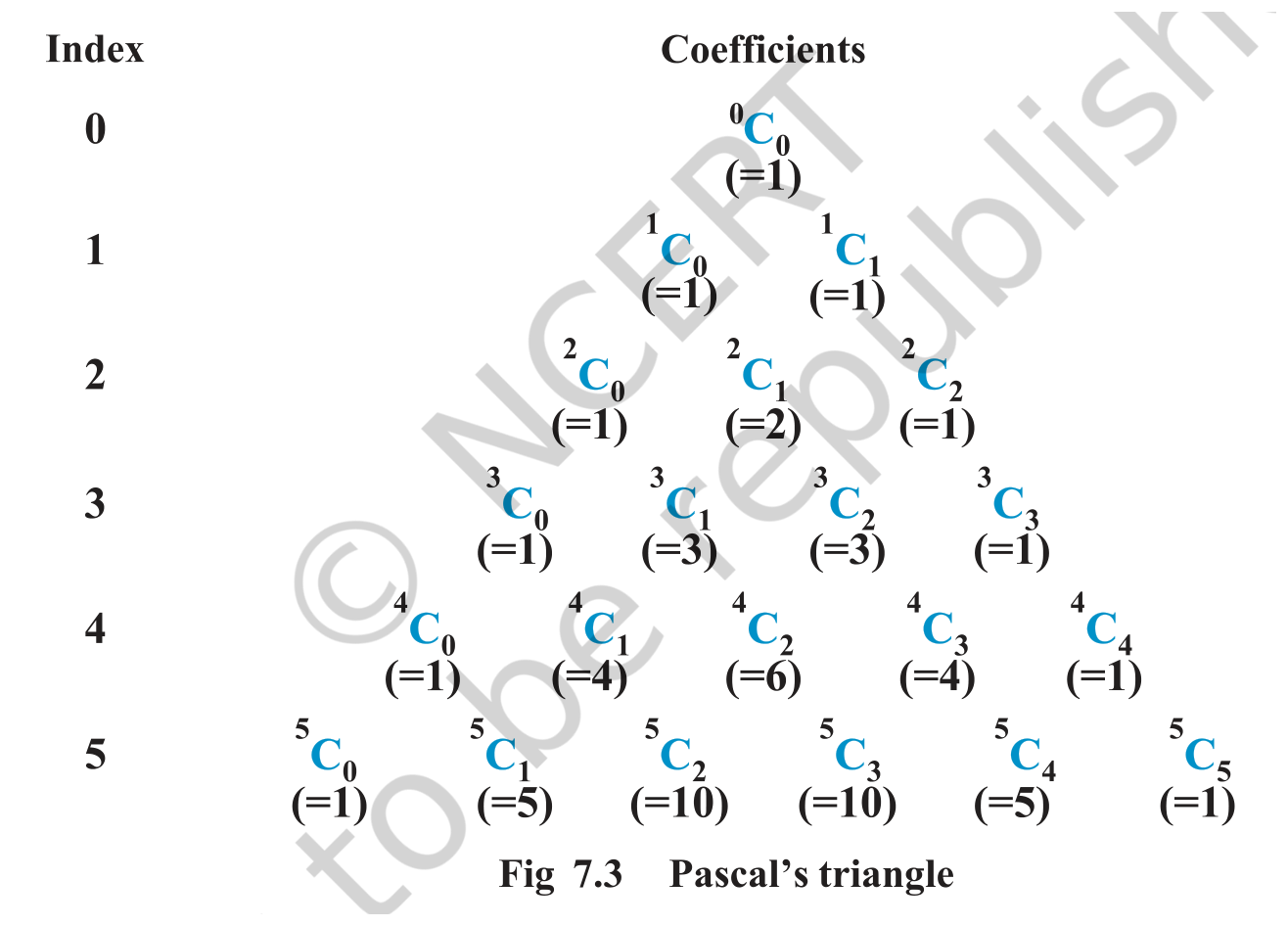
Rows of coefficients of the binomial expansions from index 0 to index 4, forming the top of Pascal's triangle
2.3 Expanding a difference and scaling the terms
When the second term is negative, replace b by minus b in the theorem. Each term with an odd power of b then carries a minus sign, so the expansion of (x minus 2y) to the fifth is x to the fifth minus 10 x to the fourth y plus 40 x cubed y squared minus 80 x squared y cubed plus 80 x y to the fourth minus 32 y to the fifth.
The coefficients are the same as in the sum expansion; only the signs change. A useful check is to put x equal to 1 and y equal to 1 in both sides: the difference expansion must give the same value as the original expression. For (2x plus 3y) to the fifth with x and y equal to 1, the expansion gives 5 to the fifth equal to 3125, which the coefficients 32, 240, 720, 1080, 810 and 243 confirm when added.
Scaling inside the bracket also follows the theorem. For (x squared plus 3 by x) to the fourth, write a as x squared and b as 3 by x, then each term pairs a power of x squared with a power of 3 by x. The exponents of x combine and the result is a polynomial plus one negative power term, which is exactly the kind of expression the exercises ask you to simplify.
2.4 Proving the theorem and using the special cases
The proof is by induction. The case n equal to 1 is the identity a plus b. Assuming the formula for some k, multiply by (a plus b) and group the coefficient of a to the (k plus 1 minus r) b to the r, which becomes kCr plus kC(r minus 1). The Pascal identity turns that sum into (k plus 1)Cr, which is the formula for the next index. This is why the combination identity sits at the centre of the proof.
The special cases follow by substitution. With a equal to 1 and b equal to x, the theorem becomes the expansion of (1 plus x) to the n. With b equal to minus x it becomes the alternating expansion of (1 minus x) to the n. Setting x equal to 1 in these two gives the two coefficient sums, 2 to the n and 0.
These substitutions are the fastest route for coefficient-sum questions. A question asking for the sum of coefficients with even powers is answered by adding the two expansions and dividing by 2; the odd powers are isolated by subtracting them.
Common mistake
The expansion of (a minus b) to the n has alternating signs, not all negative. The first term is positive and the signs alternate from there, so check the parity of r before writing each sign.