

Concepts: geometric progressions
Sequences and Series24 min readLesson 3 of 6
3.1 The general term
A geometric progression starts with a first term a and multiplies by a fixed ratio r at every step. The terms are a, ar, ar squared, ar cubed and so on, so the nth term is a times r to the (n minus 1). The ratio is found by dividing any term by the previous term, and it must be the same at every position, which is the test for a geometric progression.
The general term answers three standard questions. Finding a stated term is direct substitution. Finding which term equals a given value means solving a times r to the (n minus 1) equal to that value for n. Finding the first term or the ratio from two given terms means writing both terms with the general formula and dividing one equation by the other, which cancels a.
For the progression 2, 4, 8 and so on, the tenth term is 2 times 2 to the ninth, that is 1024. For a progression whose eighth term is 192 and whose ratio is 2, the first term is 192 divided by 2 to the seventh, which is 1.5.
3.2 Sum to n terms
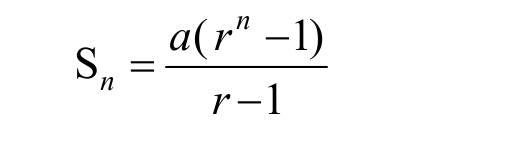
The sum of a geometric progression is obtained by multiplying the sum by r, subtracting, and solving. That derivation gives the formula a times (r to the n minus 1) by (r minus 1) when r is not 1. When r is 1 every term equals a, so the sum is n times a, and this case must be checked before using the general formula because the denominator would vanish.
Three quantities appear in the sum formula: a, r and n. Any three determine the fourth. A typical question gives the sum, the first term and the number of terms and asks for the ratio, which leads to an equation in r to the n. Another gives two sums and asks for a, r and n together.
A useful identity is that the sum of the terms from position n plus 1 to position 2n is the sum to 2n minus the sum to n. Ratio questions about these blocks reduce to powers of r, and the answer often simplifies to 1 by r to the n.
3.3 Three terms in geometric progression
When a question says three numbers are in geometric progression, write them as a by r, a and ar. This choice makes the product equal to a cubed, which cancels neatly. For four numbers, use a by r cubed, a by r, ar and ar cubed, which makes the product a to the fourth. These symmetric choices usually turn a two-condition question into one or two easy equations.
For example, if three numbers in geometric progression have sum 13 thirds and product 1, the product immediately gives a equal to 1, and the sum gives r plus 1 plus 1 by r equal to 13 by 3, which becomes a quadratic in r with roots 3 and 1 by 3. The two progressions are 4 by 3, 1, 3 by 4 and its reverse, and both are valid.
A progression is increasing when the ratio is above 1 with a positive first term, decreasing when it is between 0 and 1, and alternating when it is negative. Stating this in a word problem avoids losing a valid case.
3.4 Geometric mean
For two positive numbers a and b, the geometric mean is obtained by multiplying the numbers and taking the square root of the product. It is the middle number of the three-term geometric progression a, G, b, because G squared equals ab. Questions that ask you to insert one geometric mean between two numbers are asking for exactly this value.
Inserting two geometric means between a and b means forming the four-term progression a, a times r, a times r squared, b, where b equals a times r cubed. The ratio is the cube root of b by a, and the two inserted means follow. The same pattern works for n inserted means: the ratio is the (n plus 1)th root of b by a.
Geometric means are used in growth problems. A quantity growing by a fixed percentage each year forms a geometric progression, and the average annual growth factor is the geometric mean of the yearly factors, not their arithmetic mean. This is why population and depreciation questions use powers rather than simple averages.
A quick check on any geometric mean answer is to verify that the three numbers share a constant ratio. For 4, 10 and 25 the ratios are 5 by 2 both times, which confirms the answer; if the two ratios differ, the middle value is wrong.
Tip
When three numbers are in geometric progression, write them as a by r, a and ar. The product becomes a cubed, and most conditions simplify at once.