

Concepts: solving linear inequalities in one variable
Linear Inequalities22 min readLesson 2 of 5
2.1 From a statement to an inequality
Many statements in words are naturally inequalities rather than equations. A student with 200 rupees buying rice packets at 30 rupees each can afford only as many packets as the money allows, so the number of packets satisfies 30x less than 200 rather than 30x equal to 200. A shopper with 120 rupees buying registers and pens is bounded by 40x plus 20y at most 120. Neither situation fixes an exact number, and that is exactly what an inequality expresses.
The inequality 30x less than 200 is solved in two lines. Divide both sides by the positive number 30, keeping the sign, to get x less than 20 by 3. Now read the universe. If x counts packets, it is a natural number, and the solution set is {1, 2, 3, 4, 5, 6}. If x is only assumed to be an integer, the solution set includes 0 and the negative values as well, so it becomes {..., -2, -1, 0, 1, 2, 3, 4, 5, 6}.
The reading of the universe is the step students skip. The algebra gives a bound, but the question's wording decides whether the answer is a finite list, a full interval or something in between.
2.2 Working rule by rule
The first rule allows adding or subtracting the same number on both sides. Solving 5x minus 3 less than 3x plus 1 means adding 3 to both sides and then subtracting 3x, which gives 2x less than 4. Dividing by 2 keeps the sign, so x less than 2.
The second rule allows multiplying or dividing by a positive number without change, and requires a flip for a negative number. Solving 4x plus 3 less than 6x plus 7 gives minus 2x less than 4 after collecting terms. Dividing by minus 2 flips the sign to get x greater than minus 2. The solution set is the interval from minus 2 to infinity, open at the left.
A fraction needs one extra step: clear the denominator by multiplying by its lowest common multiple, which is positive, so the sign stays. For 5 minus 2x over 3 at most x minus 5 over 2, multiplying by 6 gives 2(5 minus 2x) at most 3(x minus 5). Expanding, collecting and dividing gives x at least 8. The solution set is the closed interval from 8 to infinity.
A double inequality is solved as one chain, doing the same operation to all three parts. For minus 8 at most 5x minus 3 less than 7, add 3 throughout to get minus 5 at most 5x less than 10, then divide by 5 to get minus 1 at most x less than 2. The result is a half open interval.
2.3 Systems of inequalities
When two inequalities must hold together, solve each one separately and take the overlap. The single variable makes this easy: the first gives an upper bound and the second a lower bound, so the answer is a single interval.
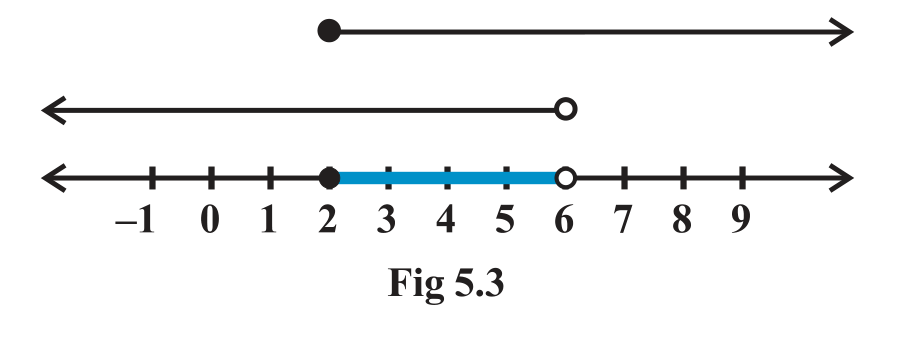
For the system 3x minus 7 less than 5 plus x and 11 minus 5x at most 1, the first gives x less than 6 and the second gives x at least 2. The common part is the half open interval from 2 to 6, including 2 and excluding 6. On the number line, shade the left part for the first bound and the right part for the second; the overlap is the answer.
The overlap method also handles questions where one inequality alone is empty. If the first says x less than 2 and the second says x greater than 5, no value satisfies both, and the solution set is the empty set. State that conclusion explicitly rather than shading something impossible.
Slideshow, slide 1 of 3. Use the left and right arrow keys to change slides and the space bar to play or pause.
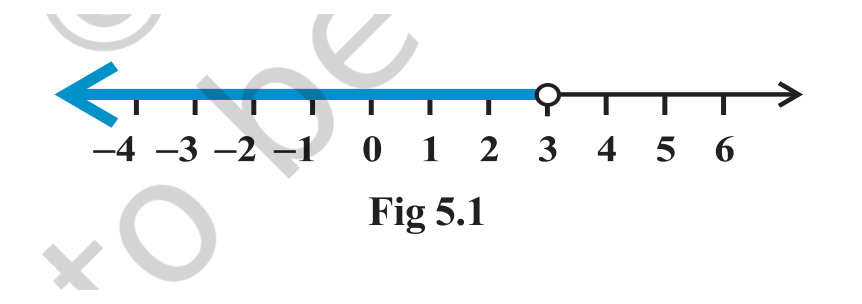

Number line showing the solution of 7x + 3 less than 5x + 9 as all real numbers less than 3, with an open circle at 3
2.4 Word problems and translation
The real skill in this chapter is turning a sentence into an inequality. Look for the words that signal a bound: at least, at most, minimum, maximum, more than, less than. Those words decide the sign and whether the endpoint is included.
For the average mark question, a student with 62 and 48 marks needs a third score x so that the average of three examinations is at least 60. The translation is (62 plus 48 plus x) by 3 at least 60, which gives x at least 70. The word at least produces a closed lower bound, and the answer is the minimum mark, not a range, because marks are whole numbers.
For the consecutive odd numbers question, take the smaller as x and the other as x plus 2. Both must exceed 10, and their sum must be below 40. Combining gives 10 less than x less than 19, and the odd values in that range are 11, 13, 15 and 17. The pairs follow by adding 2, and the final answer lists them explicitly.
For a geometry word problem, the triangle inequality and the perimeter condition usually give two or three bounds at once. Write each condition as its own inequality, then intersect the solution sets.
Common mistake
A strict inequality has an open endpoint and a slack inequality has a closed endpoint. Mixing the two in the final interval is the most frequent error in number line questions, so check the bracket against the sign before writing the answer.