

Concepts: variation of g, gravitational field and potential
Gravitation22 min readLesson 3 of 6
3.1 g at the surface and above it
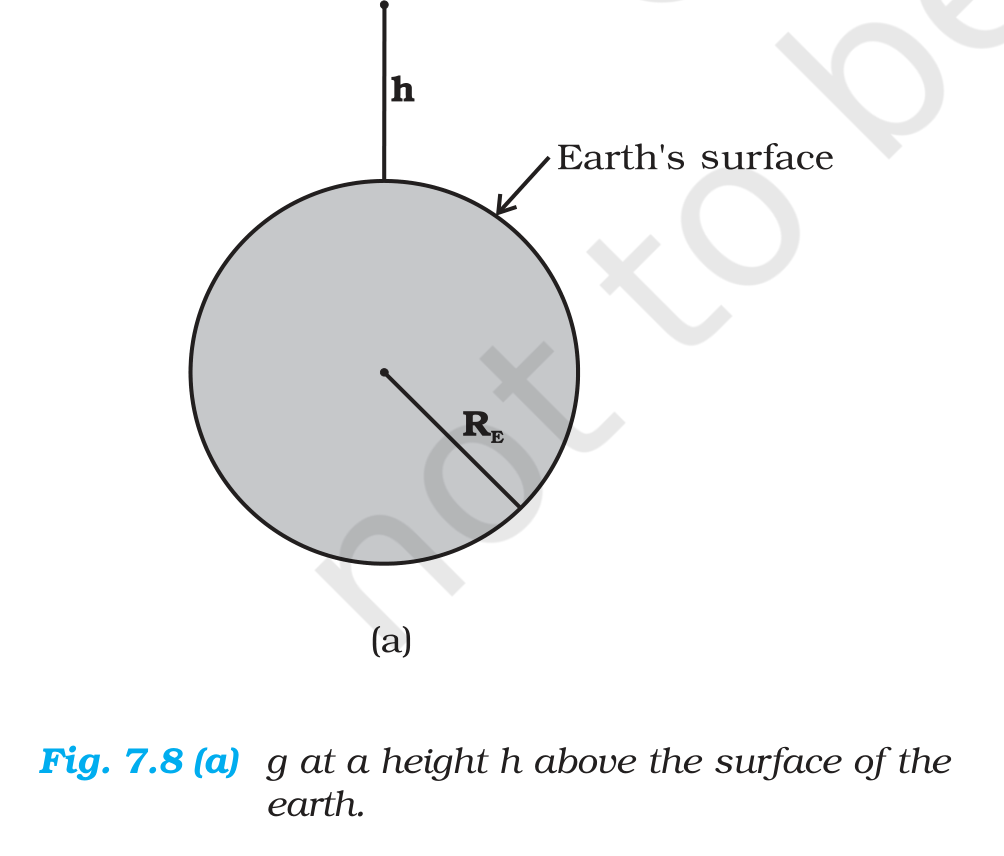
The acceleration due to gravity at the Earth's surface is G M over R squared, where M is the mass and R the radius of the Earth. Above the surface the distance from the centre becomes R plus h, so the value falls as the inverse square of that distance. At heights small compared with R the binomial expansion gives a fractional decrease of about 2h over R.
The figure shows the geometry for a point at a height h above the surface, with the Earth treated as a uniform sphere. Treating the whole mass as concentrated at the centre is justified by the shell theorem, which states that a uniform spherical shell attracts an external point as if all its mass were at the centre and exerts no force on a point inside it.
At very large heights, comparable with or larger than the radius, the approximation of a constant g fails completely, and the full inverse square form must be used. The acceleration due to gravity at the Moon's distance is far smaller than at the surface, which is why the Moon takes about 27 days for one orbit.
Slideshow, slide 1 of 3. Use the left and right arrow keys to change slides and the space bar to play or pause.
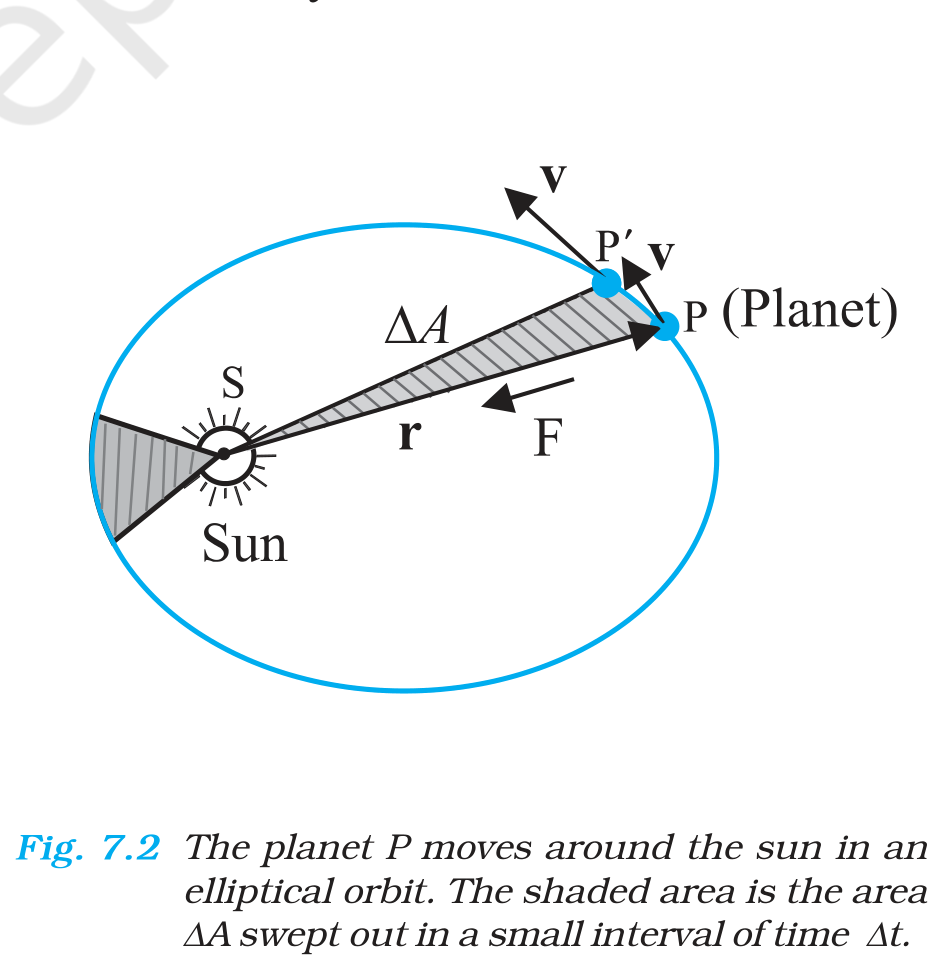
NCERT Figure 7.2: a planet P in an elliptical orbit around the sun, with the shaded area swept out in a small time interval.
3.2 g inside the Earth
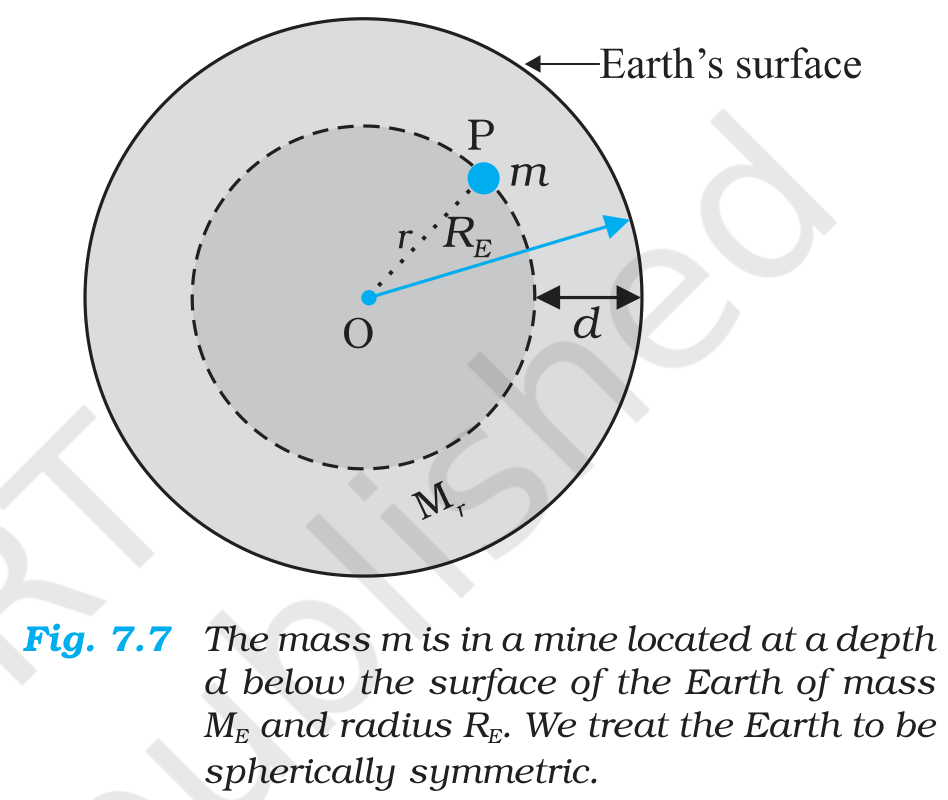
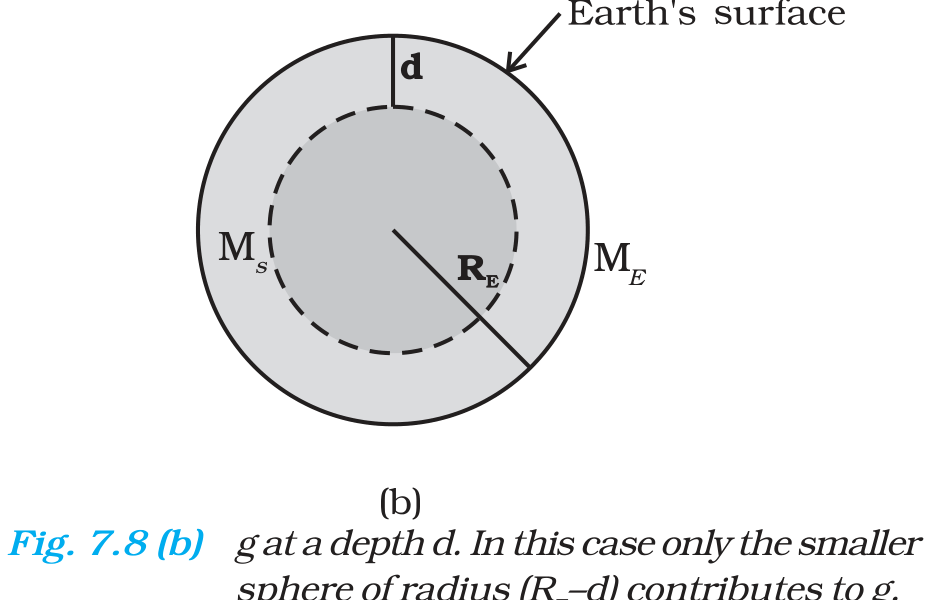
Inside a uniform spherical Earth the acceleration due to gravity is proportional to the distance from the centre. At a depth d the point is at radius R minus d, and only the mass within that radius attracts it; the shell outside exerts no net force. The enclosed mass scales with the cube of the radius, so the field falls linearly from the surface to zero at the centre.
The figure shows a point in a mine at a depth d below the surface, with the inner sphere used for the enclosed mass. The result is that g at the centre is zero, while the potential is not zero there. This is another case where the field and the potential are not simply related, and the field being zero at a point does not mean the potential is zero.
A graph of g against distance from the centre therefore rises linearly from zero to the surface value and then falls as the inverse square outside. The maximum is at the surface, which is a useful check on any numerical answer.
3.3 Gravitational field and potential
The gravitational field at a point is the force per unit mass on a small test mass placed there, and its direction is toward the attracting body. For a point mass it has magnitude G M over r squared and points toward the mass. The field of a uniform sphere outside it is the same as that of a point mass at the centre.
The gravitational potential is the work per unit mass in bringing a small mass from infinity to the point, and it is negative because gravity is attractive. For a point mass it equals minus G M over r, and it rises toward zero as the distance increases. The potential is a scalar, so contributions from several masses add directly, which is often easier than adding the field vectorially.
The field is the negative gradient of the potential. Moving in the direction of the field lowers the potential, and surfaces of constant potential are perpendicular to the field. Around a point mass the equipotential surfaces are spheres, and in a uniform field they are planes perpendicular to the field.
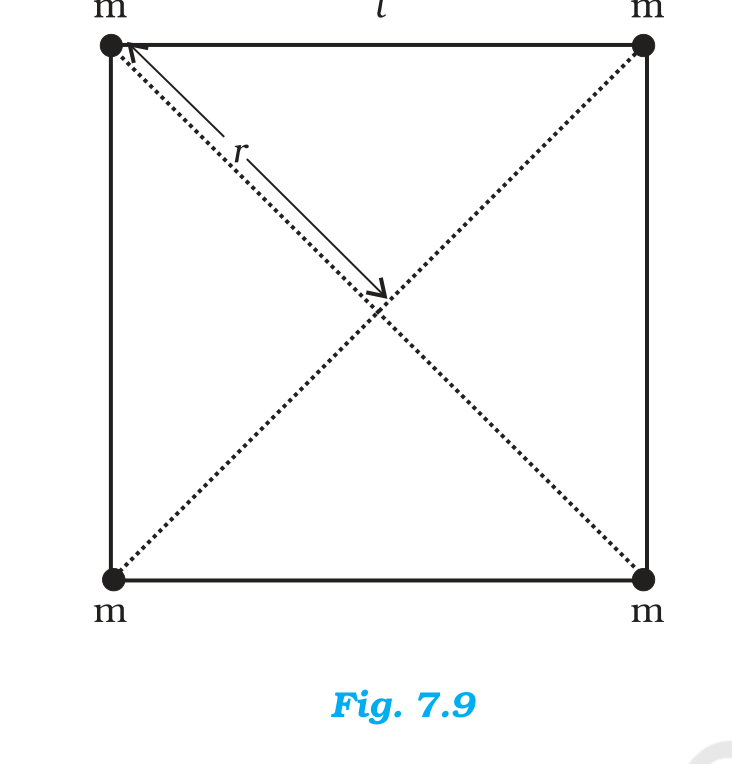
The figure below shows the geometry of a square of side l with a point at distance r from one corner, the configuration used when four equal masses sit at the corners and the potential at the centre is wanted. The potential there is the sum of four equal terms, each computed from its own distance, and no vector addition is needed.
3.4 Potential energy of a system
The potential energy of two masses separated by r is minus G m1 m2 over r, taken as zero at infinite separation. It is negative for a bound system, and more negative as the masses come closer. The escape condition for a body at the surface follows by setting the total energy, kinetic plus potential, to zero.
For a system of several masses the total potential energy is the sum over all pairs, each computed from its own separation. The factor of one half is not needed if each pair is counted once. For a configuration such as three equal masses at the corners of an equilateral triangle, the total is three times the energy of one pair.
The work needed to move a mass from the surface to a height h is the difference of the potential energies, which for small heights reduces to m g h. The exact expression is G M m times the difference of the reciprocals of the two distances, and the approximation m g h holds while h is much smaller than the radius.
Exam
When the question compares g at two heights, use the ratio form g1/g2 = (R+h2)^2/(R+h1)^2 instead of computing both values. The ratio cancels G M and avoids rounding errors.