

Preparations, reactions and mechanisms
Alcohols, Phenols and Ethers24 min readLesson 3 of 6
3.1 Preparing alcohols
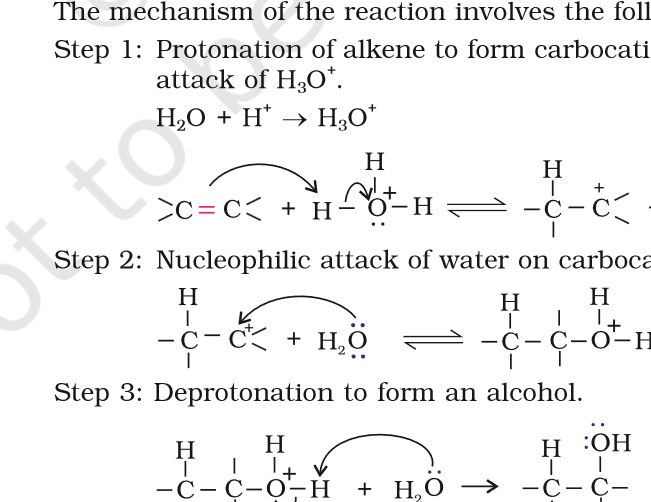
Acid catalysed hydration adds water across a double bond. The mechanism has three steps. First the acid protonates the double bond so that the alkene becomes a carbocation, with the proton going to the carbon that already has more hydrogen so that the more stable cation forms. Second, a water molecule uses its oxygen lone pair to attack that carbocation. Third, a proton is lost from the attached water to leave the alcohol and regenerate the acid. Unsymmetrical alkenes follow Markovnikov's rule, so propene gives propan-2-ol.
Hydroboration with diborane followed by hydrogen peroxide in aqueous sodium hydroxide gives the opposite orientation. Boron adds to the carbon carrying more hydrogens, so the OH ends up on the other carbon and the product looks like anti-Markovnikov hydration. The yield is good, which is why this route is used to make primary alcohols from terminal alkenes.
Carbonyl compounds reduce to alcohols. Catalytic hydrogenation with H2 over platinum, palladium or nickel, or treatment with sodium borohydride or lithium aluminium hydride, turns an aldehyde into a primary alcohol and a ketone into a secondary alcohol. Carboxylic acids and esters also reduce to primary alcohols; lithium aluminium hydride is the strong reagent for this, while industry converts the acid to an ester and hydrogenates it because the hydride reagent is expensive.
Grignard reagents build new carbon chains. The reagent attacks the carbonyl carbon, pushing the pi electrons onto oxygen to give an alkoxide adduct, and hydrolysis of that adduct gives the alcohol. Methanal gives a primary alcohol, any other aldehyde gives a secondary alcohol, and a ketone gives a tertiary alcohol.
3.2 Preparing phenols and ethers
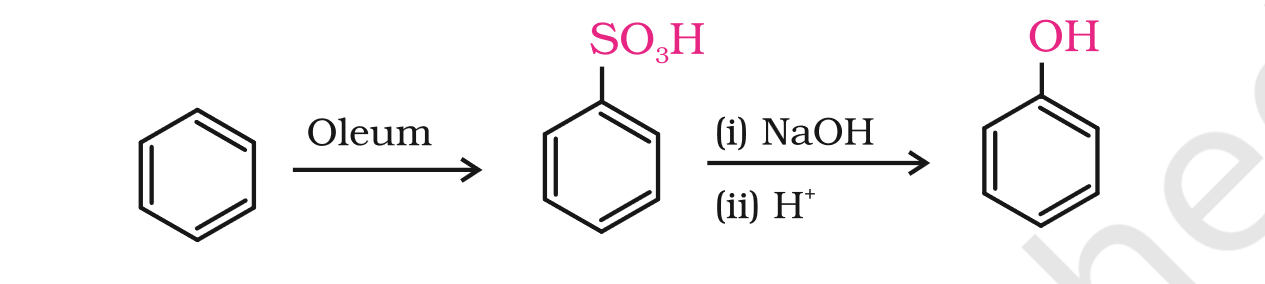
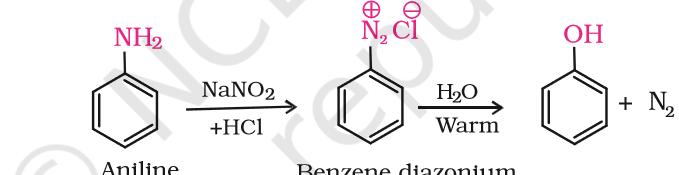
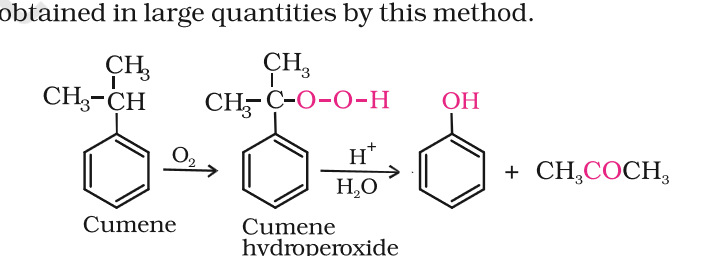
Phenol comes from four standard routes. Fusing chlorobenzene with sodium hydroxide at 623 K and high pressure and then acidifying the sodium phenoxide gives phenol. Sulphonating benzene with oleum and then heating the sulphonic acid with molten sodium hydroxide works too, again with an acid work up. A diazonium salt made from aniline with sodium nitrite and hydrochloric acid at 273 to 278 K hydrolyses to phenol on warming with water. The industrial route starts from cumene, which is oxidised by air to cumene hydroperoxide and then split by dilute acid into phenol and acetone.
Ethers come from alcohols by dehydration at a lower temperature, 413 K for ethoxyethane, or from the Williamson synthesis. In the Williamson route a sodium alkoxide attacks a primary alkyl halide and displaces the halide. It works best with primary halides. A tertiary halide gives only the alkene, because the alkoxide acts as a strong base and elimination takes over. To make a tert-butyl ether, you therefore put the tertiary group in the alkoxide and use a primary halide.
Slideshow, slide 1 of 4. Use the left and right arrow keys to change slides and the space bar to play or pause.
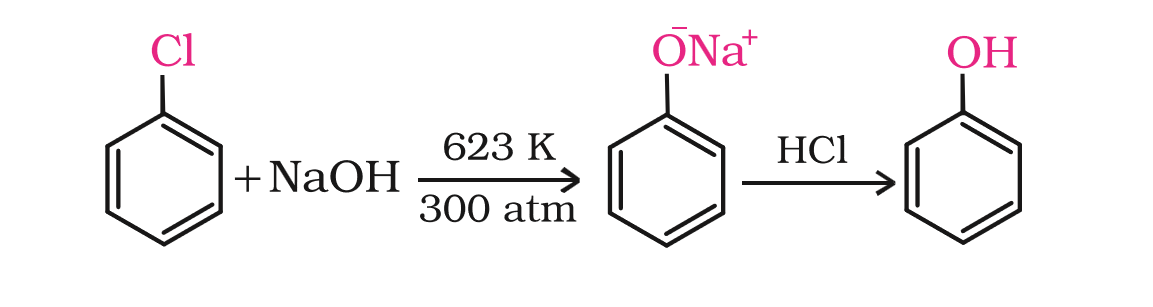
Fusion of chlorobenzene with sodium hydroxide at 623 K and 300 atmospheres followed by acidification to give phenol.
3.3 Reactions that break the C-O bond
Alcohols react with hydrogen halides to give alkyl halides, and the Lucas test uses this reaction. Concentrated hydrochloric acid with anhydrous zinc chloride dissolves alcohols, but the alkyl chlorides that form are insoluble and appear as a cloud. A tertiary alcohol clouds the mixture at once, a secondary alcohol on warming, and a primary alcohol only with heat. The same reaction with phosphorus tribromide gives bromides, and thionyl chloride gives chlorides with sulphur dioxide and hydrogen chloride escaping as gases.
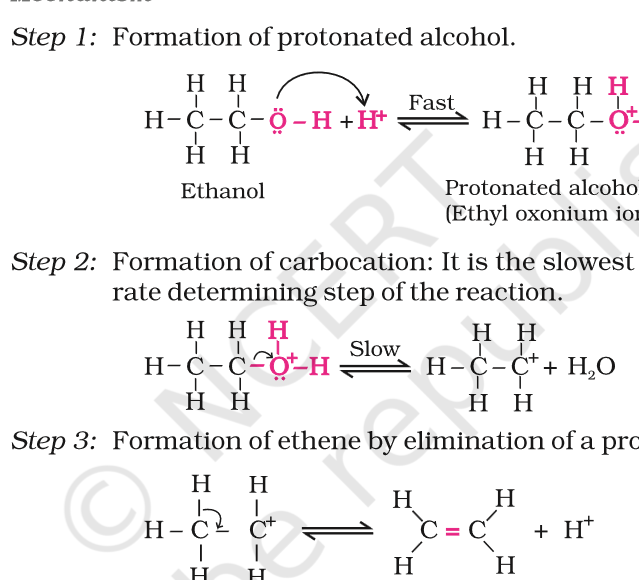
Dehydration removes water from an alcohol and leaves an alkene. The mechanism is the reverse of hydration: protonate the OH, lose water to form a carbocation in the slow step, then lose a proton from a neighbouring carbon to make the double bond. The ease follows carbocation stability, so tertiary alcohols dehydrate most easily and primary alcohols most stubbornly. Ethanol needs 443 K with concentrated sulphuric acid; at 413 K the ether is the main product instead.
Oxidation of an alcohol opens a carbon oxygen double bond. A primary alcohol gives an aldehyde and then a carboxylic acid, depending on the oxidising agent. Acidified permanganate pushes all the way to the acid, chromium trioxide in an anhydrous medium stops at the aldehyde, and pyridinium chlorochromate is the clean reagent for the aldehyde. A secondary alcohol gives a ketone. A tertiary alcohol has no hydrogen on the carbon bearing OH, so it resists oxidation until the conditions get violent enough to break carbon carbon bonds. Passing the vapour of a primary or secondary alcohol over hot copper at 573 K dehydrogenates it to the aldehyde or ketone.
3.4 Reactions that belong to phenols
The OH group of phenol activates the ring and directs new groups to ortho and para positions. Nitration with dilute nitric acid at 298 K gives a mixture of ortho and para nitrophenol, and the two separate by steam distillation because the ortho isomer hydrogen bonds within its own molecule and the para isomer hydrogen bonds between molecules. Concentrated nitric acid gives 2,4,6-trinitrophenol, picric acid. Bromine water gives a white precipitate of 2,4,6-tribromophenol without any catalyst, while bromine in a non-polar solvent at low temperature stops at monobromination.
Phenol also shows two named reactions. In Kolbe's reaction the phenoxide ion, which is more reactive than phenol itself, attacks carbon dioxide and the acid work up gives salicylic acid, with the new group at the ortho position. In the Reimer Tiemann reaction chloroform with aqueous sodium hydroxide introduces a CHO group at the ortho position and gives salicylaldehyde. Heating phenol with zinc dust strips the OH group and gives benzene. Strong oxidation with chromic acid opens the ring to a conjugated diketone, benzoquinone.
3.5 Ethers and their chemistry
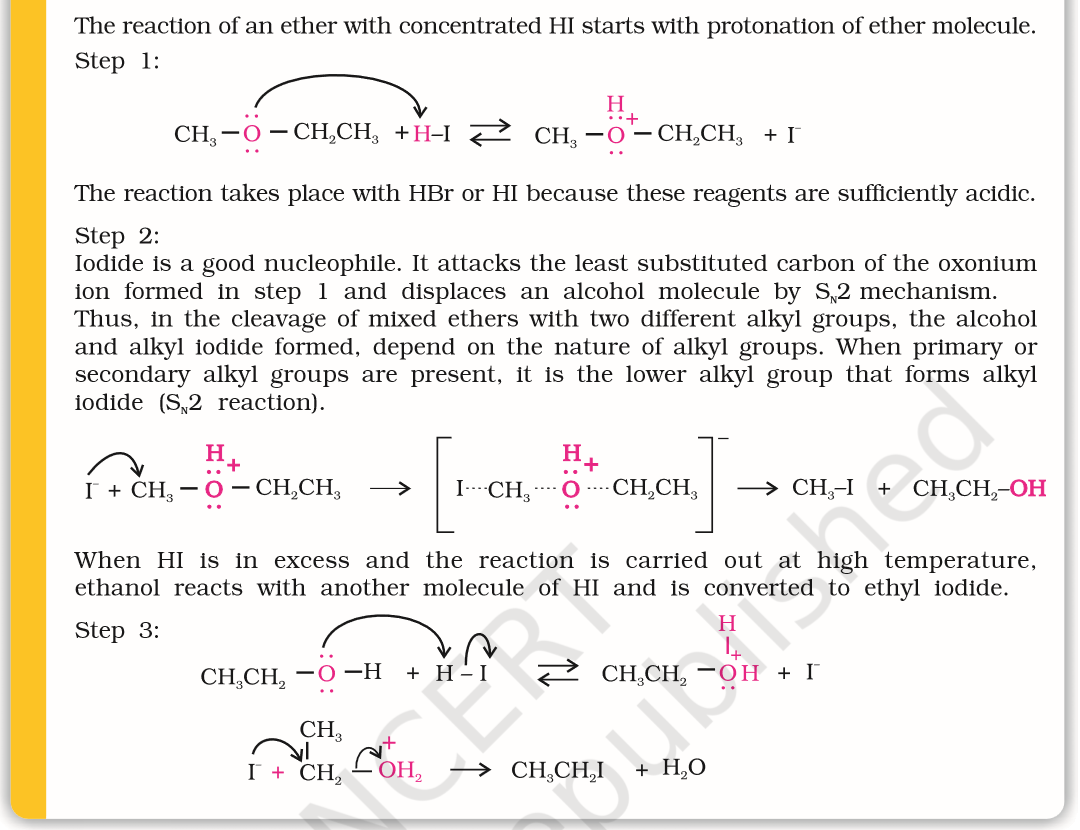
Ethers are the least reactive of the three families because there is no OH hydrogen to donate and no easily attacked carbon. The one reaction that matters is cleavage by concentrated HI or HBr at high temperature. The mechanism starts with protonation of the ether oxygen to give an oxonium ion. The iodide then attacks the less substituted carbon in an SN2 step and displaces an alcohol. With excess HI and heat, that alcohol is converted to the alkyl iodide as well. In an alkyl aryl ether the alkyl oxygen bond breaks, because the aryl oxygen bond is stronger, so phenol and an alkyl iodide are the products. When one group is tertiary, the reaction goes by SN1 and that tertiary group becomes the halide.
Anisole shows the usual electrophilic substitution of an activated ring. It brominates in ethanoic acid without a catalyst and gives mostly the para product, and Friedel Crafts alkylation and acylation and nitration all go to the ortho and para positions.
3.6 Two commercial alcohols
Methanol is made today by hydrogenating carbon monoxide at high pressure and temperature over a zinc oxide and chromium oxide catalyst. It is a colourless liquid boiling at 337 K, and it is poisonous: even a small amount causes blindness and a larger amount kills. It is used as a solvent and to make methanal. Enzymes in the body convert it to methanal and then to methanoic acid, and that acid is what harms the optic nerve. Ethanol is made by fermentation of sugars. Invertase turns sucrose into glucose and fructose, and zymase in yeast turns those sugars into ethanol and carbon dioxide. Fermentation is anaerobic and stops on its own once the alcohol reaches about 14 per cent, because zymase is inhibited. Ethanol boils at 351 K and is used as a solvent and as a starting material for many compounds.