

Concepts: principal value branches and graphs: Inverse Trigonometric Functions
Inverse Trigonometric Functions24 min readLesson 2 of 5
2.1 Why an inverse needs a restriction
A function has an inverse only when it is one-one and onto. Every trigonometric function fails that test on its full domain because values repeat: sin 0, sin pi and sin 2pi are all zero. The graph of sin x passes the same height again and again, so one output cannot be traced back to a single input.
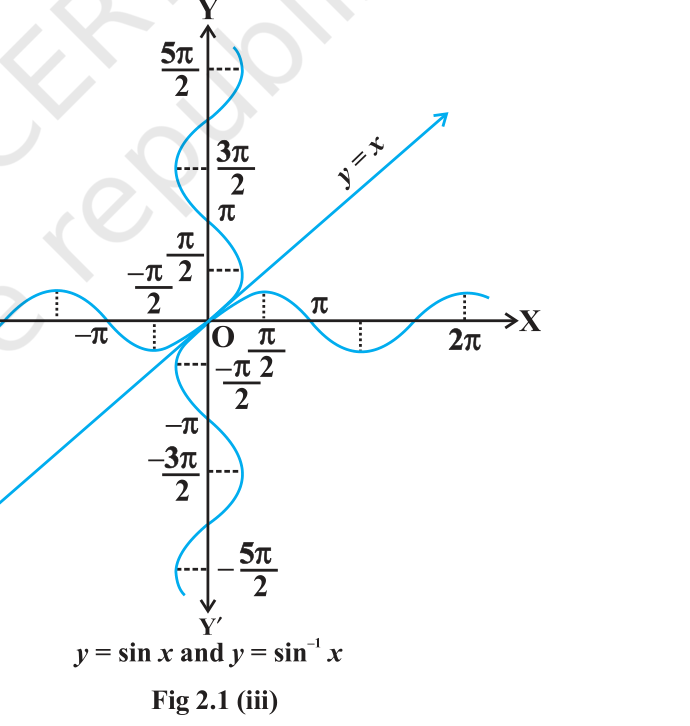
The fix is to cut the domain. Keep only one stretch where the function is one-one and its range covers every output once. For sine, the stretch from minus pi/2 to pi/2 is rising from -1 to 1, so the inverse exists there. That chosen range of the inverse is called the principal value branch.
The graphs make the geometry clear. Swapping the axes of the restricted curve gives the inverse curve, which is the original curve reflected in the line y = x. Mathematically the point (a, b) on y = sin x becomes (b, a) on y = sin inverse x.
2.2 The six principal branches and their graphs
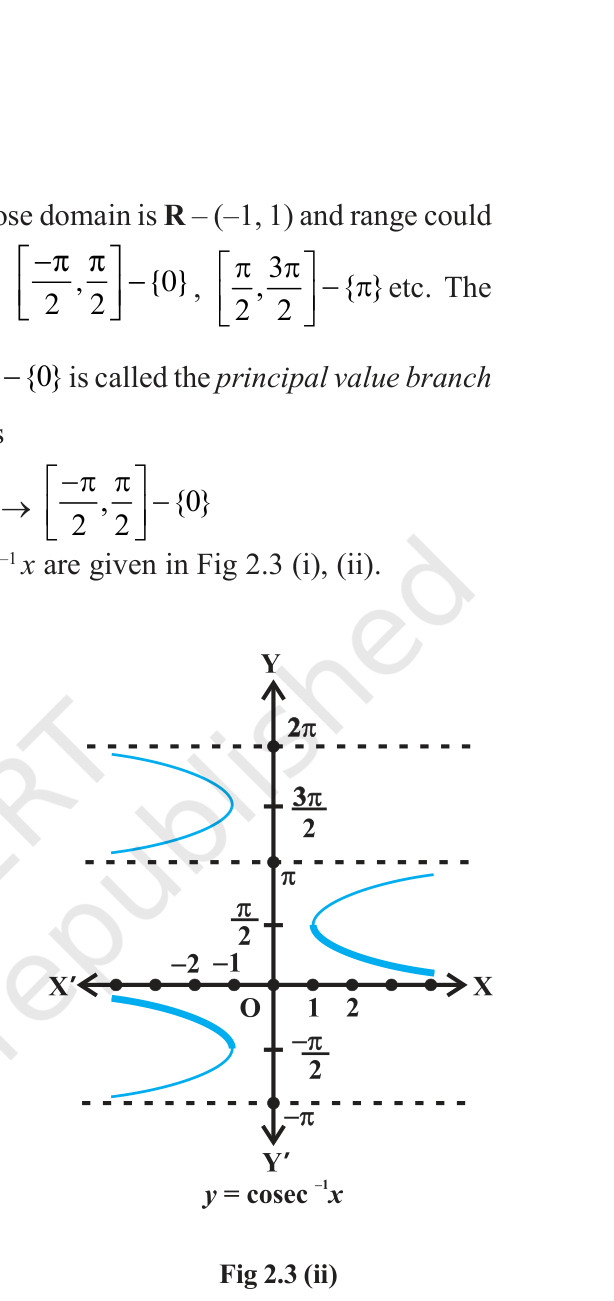
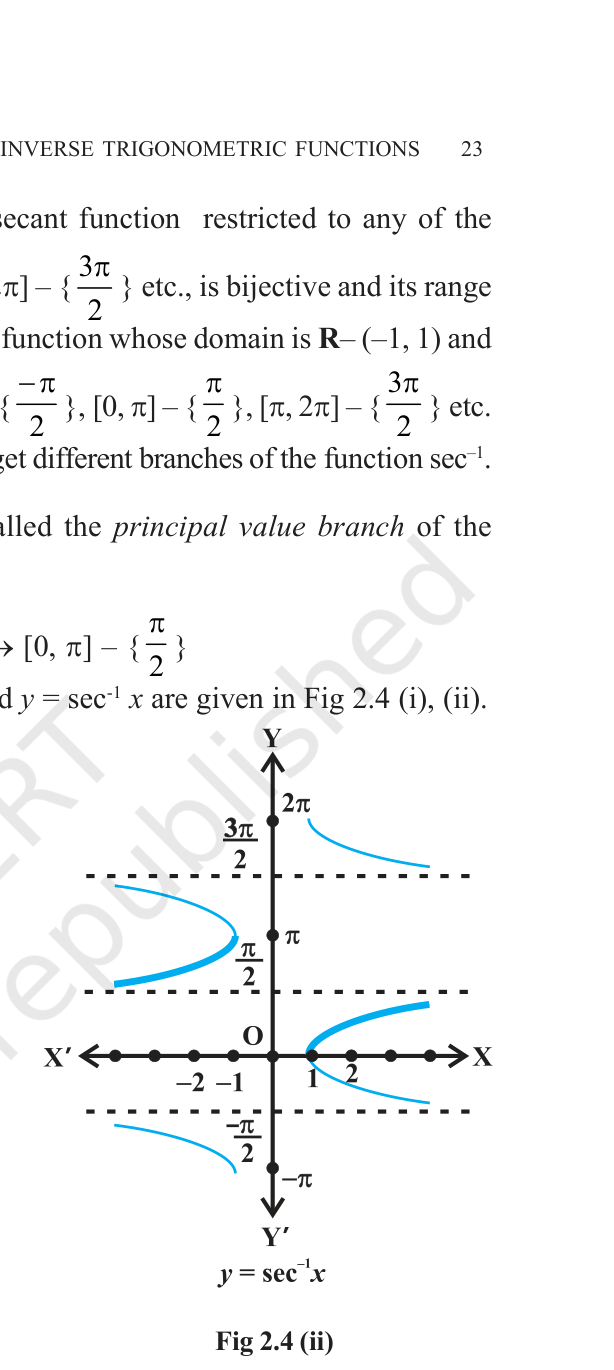
Each inverse function has its own chosen branch. Cosine falls from 1 to -1 on [0, pi], and that falling piece is kept, so the inverse has range [0, pi]. Tangent rises once across each interval of width pi; the branch between minus pi/2 and pi/2 is kept, and the inverse has that open interval as its range. Cotangent falls once on (0, pi), so its inverse uses (0, pi). Secant and cosecant are reciprocal functions with breaks, so their branches are the same intervals as cosine and sine but with the undefined point removed.
The arrows in the graphs are worth reading in order. The curve y = cos inverse x starts at (-1, pi) and ends at (1, 0), so it decreases. The curve y = tan inverse x runs from just above minus pi/2 to just below pi/2 and increases everywhere. The horizontal dotted lines in the NCERT figures mark these boundary values.
Slideshow, slide 1 of 5. Use the left and right arrow keys to change slides and the space bar to play or pause.
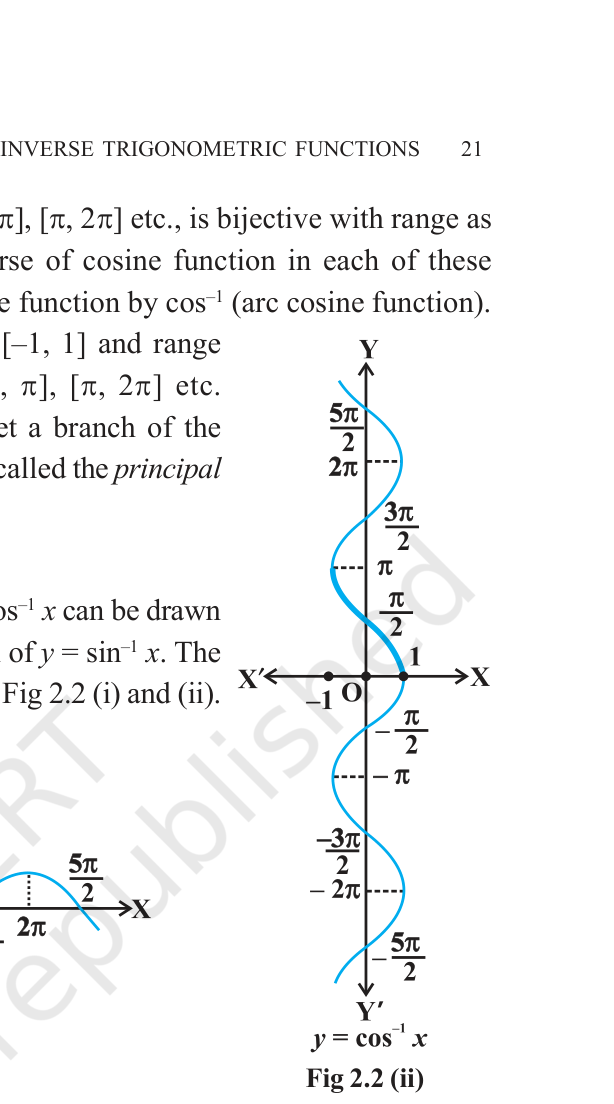
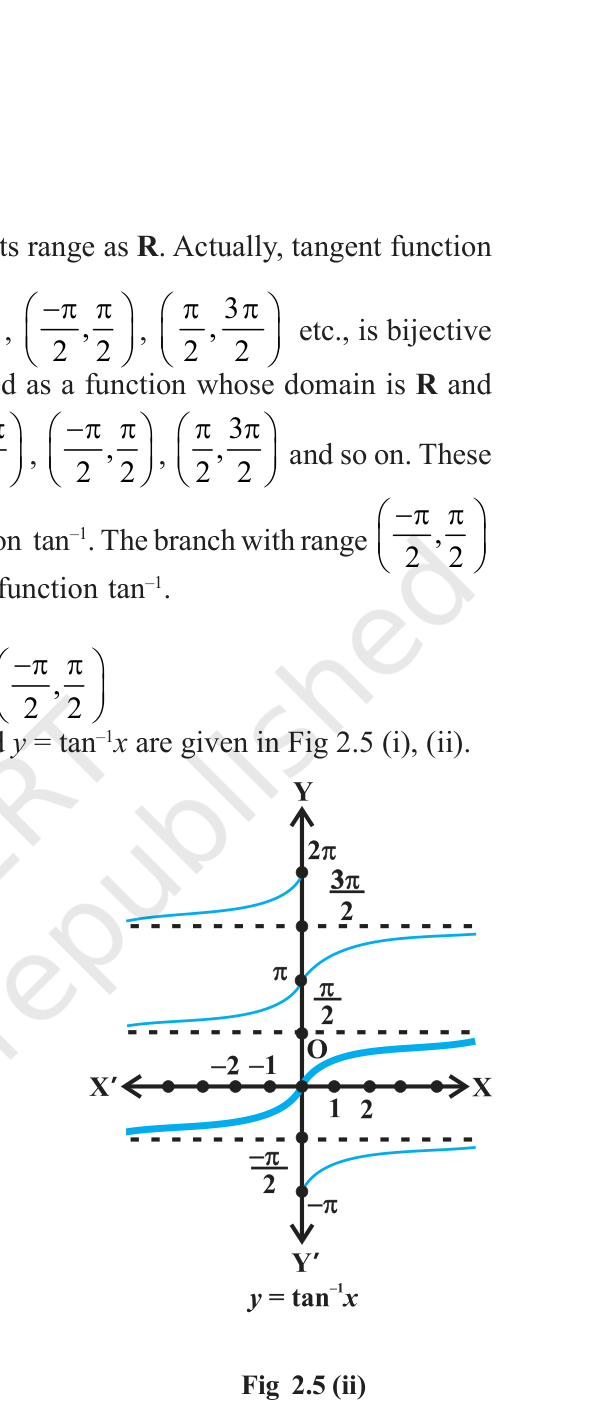
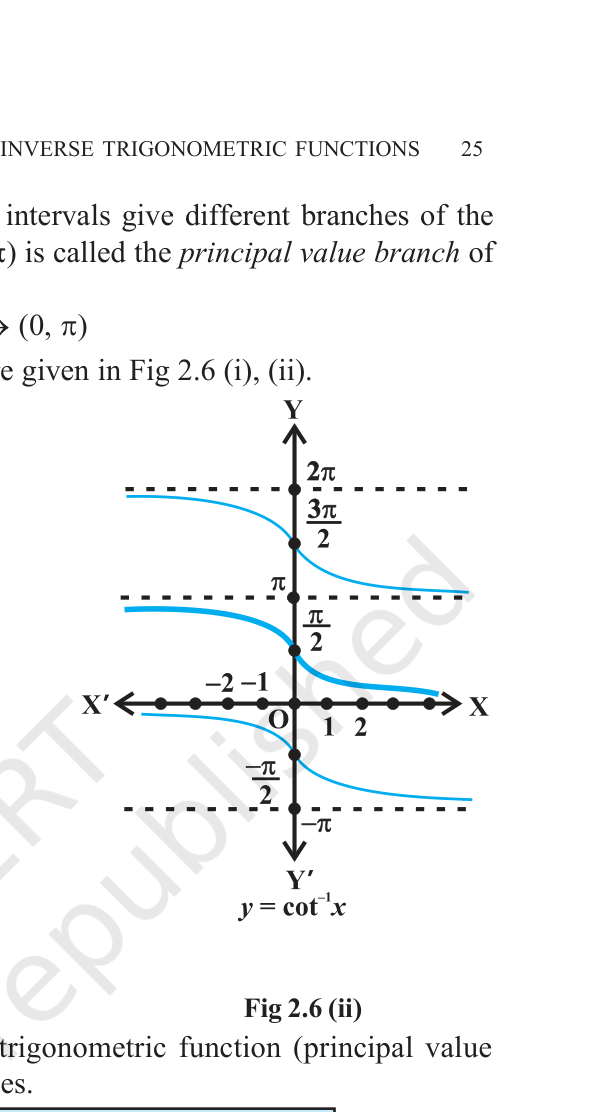
Graph of y = cos inverse x on the principal branch from 0 to pi
2.3 Reading a branch without confusing the angle
A common error is to evaluate sin inverse of a sine value and forget the restriction. The safe method has two steps. First write the inner value as the sine of an angle; second choose the angle that actually lies in the principal branch.
Take sin inverse of sin (3pi/4). The inner angle 3pi/4 is not inside [-pi/2, pi/2], so the answer is not 3pi/4. Since sin(3pi/4) equals sin(pi/4), and pi/4 lies inside the branch, the value is pi/4. The same idea answers cos inverse of cos (5pi/6): cos(5pi/6) equals cos(-5pi/6) but that is outside [0, pi], so reduce to cos(7pi/6) no, rather use cos(5pi/6) equals cos(5pi/6) and the angle in [0, pi] with that cosine is 5pi/6 itself, so the answer is 5pi/6. Checking the interval is the whole game.
For tan inverse of tan (3pi/4), the inner 3pi/4 lies outside (-pi/2, pi/2). Since tan(3pi/4) equals tan(-pi/4), and -pi/4 sits inside the branch, the value is -pi/4.
2.3.1 Domains when the argument is not x
Board questions also ask for the domain of expressions such as sin inverse of (3x - 1) or cos inverse of |x - 1|. Set the argument between -1 and 1 and solve the inequality. For sin inverse(1 - 2x^2), the double inequality -1 <= 1 - 2x^2 <= 1 gives 0 <= x^2 <= 1, so the domain is [-1, 1]. For cos inverse(|x - 1|), the chain -1 <= |x - 1| <= 1 reduces to 0 <= |x - 1| <= 1, giving the domain [0, 2].
2.3.2 Exercise map
Exercise 2.1 of the NCERT chapter is built exactly on evaluation and graphing: find the principal value, draw the graph, and write the domain for composite arguments. The worked examples on this page and the questions page cover that exercise section by section.
2.3.3 More practice patterns
Two more shapes appear in Exercise 2.1. The first asks for the value of an inverse at a negative reciprocal, such as cot inverse of minus 1 over square root 3. Reduce the negative sign first using the supplement rule, then evaluate the positive value inside the branch. The second gives a trigonometric value of an inverse, such as cos of tan inverse of x, and expects a square root expression from the triangle method. Write the triangle, name the angle, and keep the sign of the square root tied to the quadrant where the angle lies. A third pattern gives the domain of a composite expression and asks for its range at the same time; solve the inner inequality, then push the resulting interval through the outer inverse function.
Warning
Never write sin inverse as a fraction such as 1/sin. The inverse symbol means a different function, and its output is an angle. Similarly, sin inverse(sin x) equals x only when x already lies in the principal branch.