

Concepts: area under simple curves and between curves
Application of Integrals22 min readLesson 2 of 5
2.1 Area under a simple curve
The area between a curve y equal to f of x, the x-axis and the vertical lines x equal to a and x equal to b is the definite integral of f from a to b, provided the curve stays above the axis. The formula comes straight from the definition of the definite integral as a sum of thin rectangle areas, so the chapter is an application of the previous one rather than a new method.
For a curve that crosses the axis inside the interval, the integral adds the positive and negative pieces with signs. The geometric area is then obtained by splitting the interval at the crossing point and adding the absolute values of the pieces. A question that asks simply for the area always wants the geometric value, so this split is part of the method, not an optional extra.
2.2 Areas of the standard curves
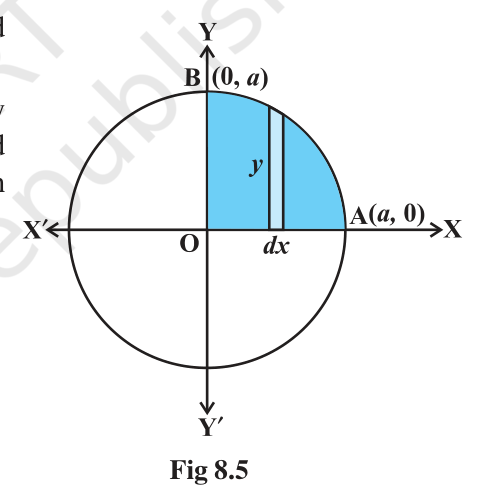
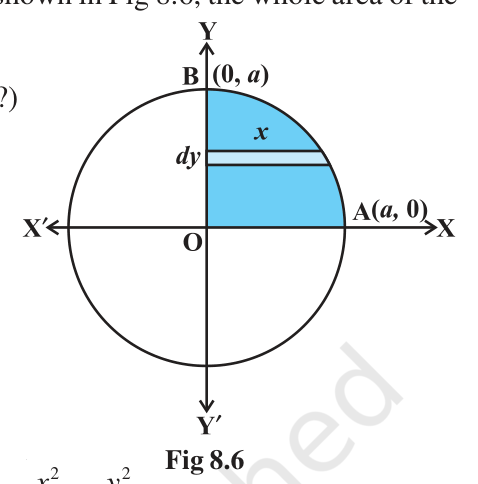
The line y equal to x, the parabola y squared equal to four a x and the circle x squared plus y squared equal to r squared all give areas computed directly from the formula. For the parabola, the area under the curve from zero to a with vertical strips is the integral of two root a x, and horizontal strips give the same answer. For the circle, integrating the upper semicircle from minus r to r reproduces pi r squared, which is a useful check that the method is consistent with geometry. The ellipse again gives pi a b.
Slideshow, slide 1 of 4. Use the left and right arrow keys to change slides and the space bar to play or pause.
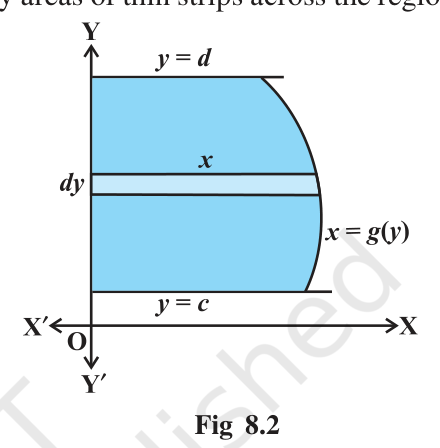
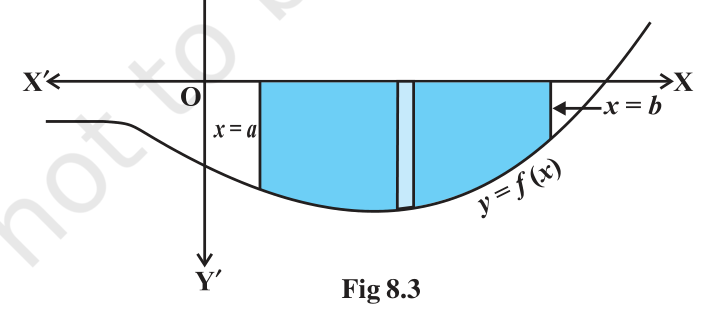
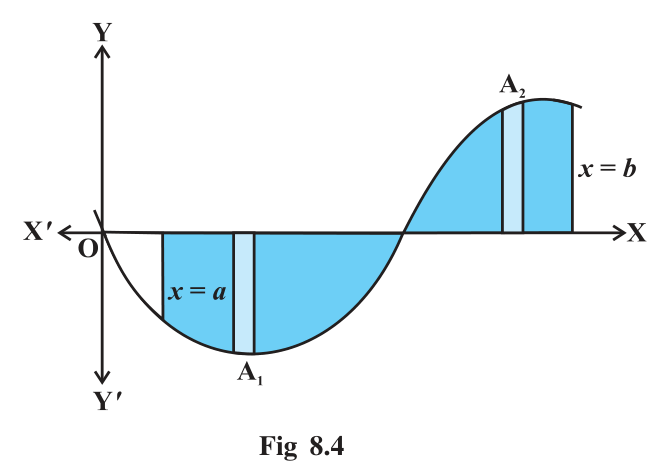
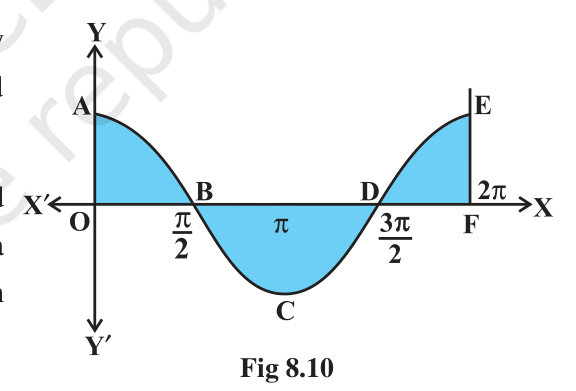
Official NCERT figure showing the area under a curve divided into thin vertical strips, printed as Fig 8.2.
2.3 Area between two curves
The area between two curves is found by writing the upper function minus the lower function and integrating between the common x-values. The curves must first be solved together to find where they meet, because those points are the limits. If the curves cross inside the interval, the order of upper and lower swaps, so the integral is split at the crossing point and the absolute difference is integrated piece by piece.
A useful sanity check is symmetry. If both curves are symmetric about the y-axis, the area from minus a to a is twice the area from zero to a. If one curve is the reflection of the other, the two pieces are equal. The check catches limits that are wrong by a factor of two.
2.4 Choosing horizontal strips
When a curve is given as x equal to a function of y, horizontal strips are natural. The area between the curve and the y-axis is the integral of that function with respect to y, and the area between two such curves is the integral of the right function minus the left function between the y-limits. The region enclosed by the parabola y squared equal to four a x and its latus rectum is the standard example: using horizontal strips the limits in y are constants and the integrand is simple, while vertical strips need a split at the vertex.
2.5 Worked examples
Example 1: line and axes. The area of the triangle formed by y equal to 2 x, the x-axis and x equal to 3 is the integral of 2 x from 0 to 3, which is 9 square units, matching the triangle formula.
Example 2: parabola and latus rectum. The area between y squared equal to 4 a x and the line x equal to a is twice the integral from 0 to a of the upper half, which is four root a x, and integrating gives eight a squared over three.
Example 3: between a parabola and a line. The curves y equal to x squared and y equal to x meet at x equal to 0 and x equal to 1. The line is above the parabola on that interval, and the area is the integral of x minus x squared from 0 to 1, which is one half minus one third, equal to one sixth.
2.6 Common mistakes and exam tip
Using the points where the curves meet as limits without checking that the region asked for lies between them is the first error. Forgetting the sign of a piece below the axis is the second, and writing the integrand as lower minus upper is the third. In an exam, mark the region on the sketch with a shading and label the upper and lower curves; the rest of the working follows mechanically.
2.7 A quick symmetry check
Before integrating, look for symmetry. If the region is symmetric about the y-axis, integrate over the right half and double. If it is symmetric about the x-axis, use strips parallel to the other axis or double the upper half. Symmetric regions give equal pieces, so the check catches a missing factor of two and also catches a limit that was halved by mistake. The check costs one line and saves the arithmetic.