

Concepts: Auxins and gibberellins
Plant Growth and Development24 min readLesson 3 of 7
3.1 The five groups of regulators
Plant growth regulators are small, simple molecules that act at very low concentration. The five main groups are auxins, gibberellins, cytokinins, abscisic acid and ethylene. Auxins are indole compounds, gibberellins are terpenes, cytokinins are adenine derivatives, abscisic acid is a carotenoid derivative and ethylene is a gas. Older books use the labels plant growth substances, plant hormones and phytohormones for the same five groups, while this chapter calls them plant growth regulators.
A regulator can promote or inhibit a process depending on the concentration, the tissue and the other regulators present. The same molecule may promote root formation at one dose and inhibit it at another. That is why no single hormone can be labelled only as a promoter or only as an inhibitor.
3.1.1 Discovery of auxin
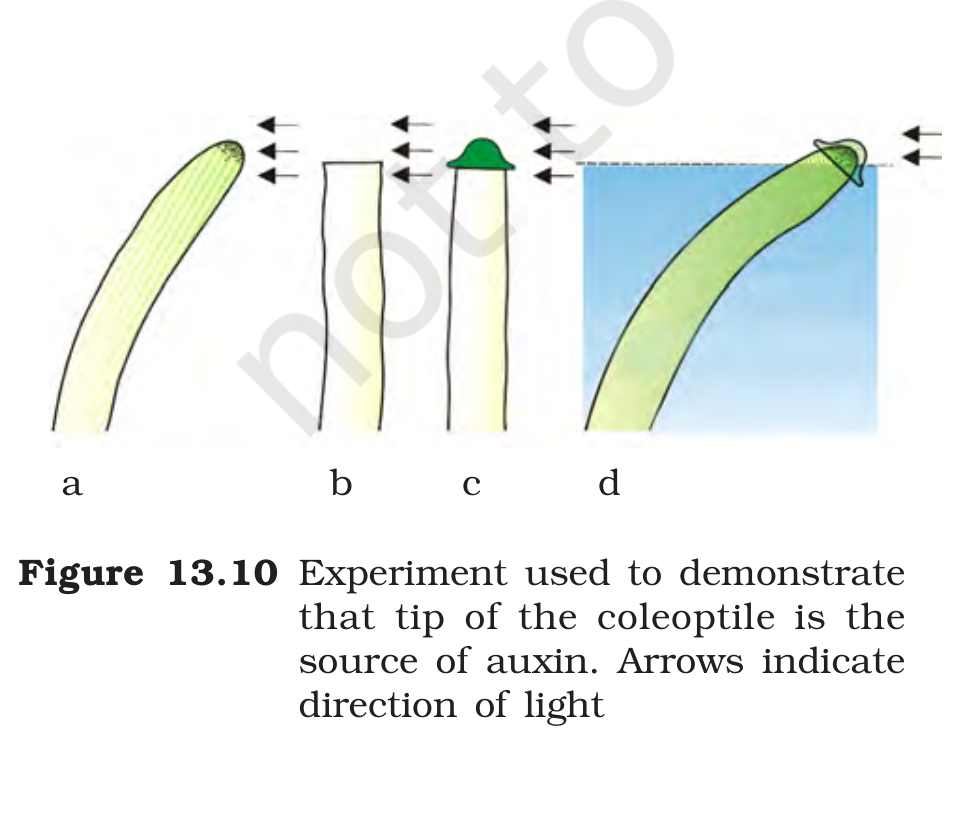
The story begins with Charles Darwin and his son Francis, who noticed that the coleoptile of a canary grass seedling bends towards light and that the tip of the coleoptile is the part that senses the light. F. W. Went later cut off coleoptile tips and used them to show that a chemical diffuses out of the tip and causes the bending. That chemical was named auxin. The experiment in figure 13.10 shows the standard version: the tip is the source of the auxin that makes the coleoptile bend towards light.
3.1.2 What auxins do
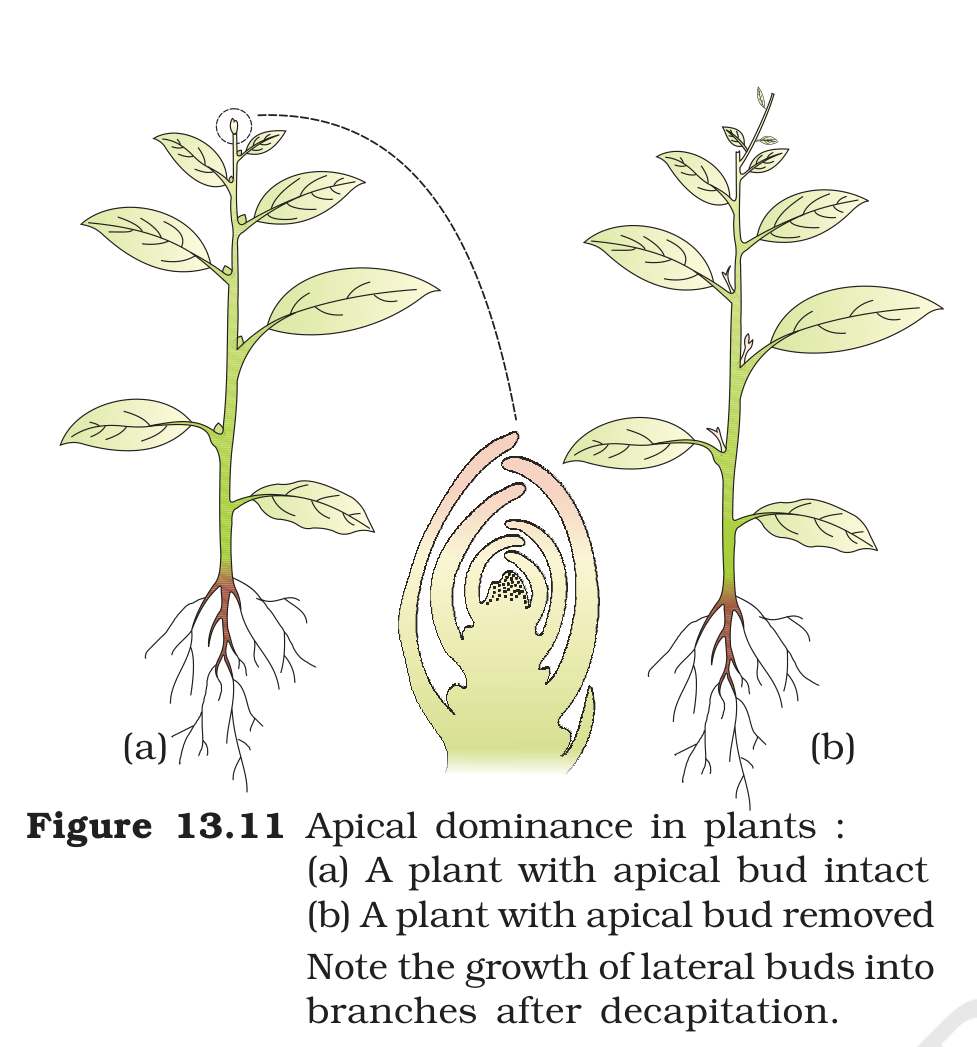
Auxin promotes cell elongation, which is why a stem treated with auxin grows longer. It also produces apical dominance: the growing apical bud suppresses the growth of the lateral buds lower down the stem. Removing the apex releases the lateral buds, and figure 13.11 compares an intact plant with a decapitated one. Auxin promotes rooting of cuttings and is used for that purpose in horticulture. It can induce parthenocarpy, so a tomato can develop without fertilisation. Synthetic auxins such as 2,4-D are used as weed killers because they act selectively on dicotyledonous plants, and auxin also helps in xylem differentiation and cell division. A low dose is used to root a cutting, while a high dose of a synthetic auxin clears broad-leaf weeds from a lawn.
3.1.3 Gibberellins
The gibberellins were discovered in Japan when rice plants infected with the fungus Gibberella fujikuroi grew unusually tall and weak, a condition called the foolish seedling disease. Scientists have since described over a hundred gibberellins across plants and fungi, and GA3 was among the earliest gibberellins to be found and is still studied the most.
In horticulture auxin is used for rooting cuttings, for producing seedless fruits such as tomato, and in the form of 2,4-D for making weed-free lawns, where it kills dicot weeds without harming the mature monocot grass. Gibberellins cause elongation of the axis, and they can make a rosette plant bolt, that is, produce a tall flowering stem. They delay senescence, so fruits stay on the tree longer. They are used in the malting industry to speed up the conversion of starch in barley. When sprayed on sugarcane, they increase stem length and raise the yield, and when sprayed on young conifers they shorten the time to seed production.
3.1.4 Two experiments and two lessons
Figure 13.10 is worth reading panel by panel. In the intact coleoptile the tip is present and the seedling bends towards the light. When the tip is removed the bending disappears, so the tip is needed for the response. The remaining panels show that the tip is the source of the substance that makes the coleoptile bend, which is why auxin was isolated from coleoptile tips by F. W. Went. The apical dominance picture in figure 13.11 makes the same point on a whole plant: the apical bud suppresses the lateral buds, and when it is removed the lateral buds grow into branches. Together the two figures show how a regulator made in one small region can control a response in a distant part of the plant.
3.1.5 Practice from the NCERT exercises, questions 4, 8 and 10(a)
Exercise 4. The five groups are auxins, gibberellins, cytokinins, abscisic acid and ethylene. A note on auxin: IAA was the first auxin to be discovered, it promotes cell enlargement, apical dominance, rooting of cuttings and parthenocarpy, and synthetic auxins such as 2,4-D are used as selective weed killers.
Exercise 8. (a) Rooting in a twig is induced by auxin. (b) Quick ripening of fruit is produced by ethylene. (c) Leaf senescence is delayed by cytokinin or gibberellin. (d) Growth of axillary buds is induced by cytokinin. (e) Bolting of a rosette plant is induced by gibberellin. (f) Immediate stomatal closure is induced by abscisic acid.
Exercise 10(a). Applying GA3 to rice seedlings makes them grow taller, because gibberellin promotes elongation of the stem.
Exam
For an auxin answer, write the discovery, then three functions, then two applications. Give apical dominance and decapitation as the standard experiment, and 2,4-D on dicot weeds and rooting of cuttings as the standard applications. For gibberellins, the bakanae disease of rice, bolting, delay of senescence and the sugarcane yield should appear in the answer.
Common mistake
Do not say that auxin only promotes growth. At high concentration it can inhibit elongation, and the same hormone can promote roots at one dose and inhibit them at another. Do not confuse gibberellin with cytokinin: gibberellin lengthens the stem and delays senescence, while cytokinin drives cell division and releases lateral buds.