

Concepts: Blood, its components and blood groups
Body Fluids and Circulation24 min readLesson 1 of 6
1.1 The fluid that carries everything
Blood is a fluid connective tissue in which cells are suspended in a liquid matrix. It carries oxygen, nutrients, hormones and waste products, distributes heat and defends the body against infection. The liquid part is plasma, which makes up about 55 per cent of blood volume, and the suspended cells are the formed elements, which make up the remaining 45 per cent.
Plasma is mostly water, about 90 to 92 per cent, with 6 to 8 per cent proteins and small amounts of minerals, sugars, hormones and waste products. The plasma proteins do three main jobs. Fibrinogen is needed for clotting, globulins include the antibodies and many transport proteins, and albumins help to keep the osmotic pressure of the blood at the right level. When the clotting factors are removed from plasma, the remaining fluid is called serum.
1.1.1 Formed elements
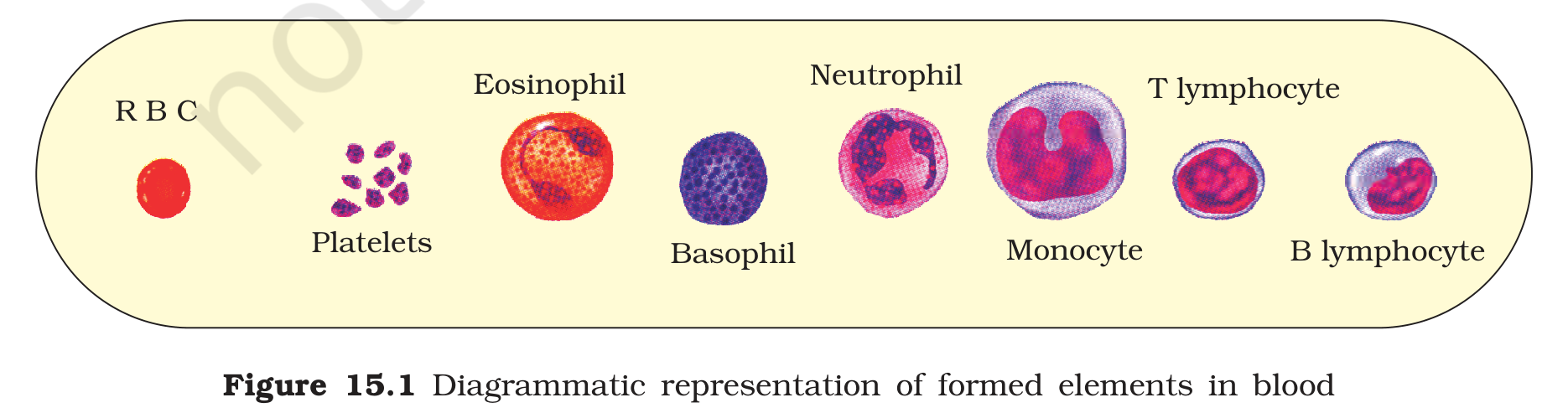
Red blood cells, or erythrocytes, are the most numerous formed elements, about 5 to 5.5 million per cubic millimetre of blood. A mature mammalian red blood cell has no nucleus, is biconcave in shape and is packed with haemoglobin, which gives the blood its red colour and carries oxygen. Haemoglobin level in a healthy adult is about 12 to 16 grams per 100 mL of blood. Red blood cells live for about 120 days, are produced in the bone marrow and are destroyed in the spleen.
White blood cells, or leucocytes, are far fewer, about 6000 to 8000 per cubic millimetre. They are nucleated and are grouped by their staining and their shape. Neutrophils form about 60 to 65 per cent of the total, lymphocytes about 20 to 25 per cent, monocytes 6 to 8 per cent, eosinophils 2 to 3 per cent and basophils 0.5 to 1 per cent. Neutrophils and monocytes are actively phagocytic, lymphocytes are involved in immunity, eosinophils are linked to allergic reactions and basophils are involved in inflammatory reactions.
Platelets, or thrombocytes, are cell fragments rather than complete cells, numbering about 1.5 to 3.5 lakh per cubic millimetre. They are essential for clotting, and a fall in their number leads to bleeding problems.
| Component | Typical number | Main function |
|---|---|---|
| Red blood cells | 5 to 5.5 million per cubic mm | Oxygen transport through haemoglobin |
| White blood cells | 6000 to 8000 per cubic mm | Defence against infection |
| Platelets | 1.5 to 3.5 lakh per cubic mm | Blood clotting |
| Plasma proteins | 6 to 8 per cent of plasma | Clotting, immunity and osmotic balance |
1.1.2 Blood groups and the Rh factor
Blood groups are based on two antigens, A and B, on the surface of red blood cells. A person may carry A only, B only, both or neither, which gives the four groups A, B, AB and O. The plasma carries antibodies against the antigens that the cells do not carry, so a group A person has anti-B antibodies and a group B person has anti-A antibodies. Group AB has no circulating antibodies and is called the universal recipient, while group O is called the universal donor because its cells carry neither antigen.
The Rh factor is another antigen, named after the rhesus monkey in which it was first studied. A person is Rh positive if the antigen is present and Rh negative if it is absent. If an Rh negative mother carries an Rh positive foetus, the mother may become sensitised during the first birth and her antibodies can attack the red cells of a later Rh positive foetus. This condition is erythroblastosis foetalis, and it is the reason a blood group and Rh type are recorded before any transfusion or pregnancy.
1.1.3 Coagulation
When a blood vessel is damaged, platelets collect at the site and release factors that start a chain of reactions among the clotting factors in the plasma. Calcium ions take part in several steps of this chain. The end result is that prothrombin is converted to thrombin, and thrombin converts soluble fibrinogen into insoluble fibrin threads that trap the cells into a clot. Vitamin K is needed by the liver to make several of the clotting factors, which is why a deficiency of vitamin K delays clotting.
1.1.4 What a blood test shows
The counts in the table are the ordinary reference values, and clinical reports compare a patient's count with the expected range. A low haemoglobin level points to anaemia, a high white cell count often points to infection or inflammation, and a low platelet count warns of a bleeding risk. The differential count, which gives the percentage of each type of white cell, is just as useful as the total, because a rise in neutrophils suggests a bacterial infection while a rise in eosinophils suggests an allergic reaction or a parasite. These connections turn the number table into a practical diagnostic tool.
1.1.5 Practice from the NCERT exercises, questions 1 to 4
Exercise 1. The formed elements are red blood cells, white blood cells and platelets. Red cells carry oxygen on haemoglobin, white cells defend the body and platelets take part in clotting.
Exercise 2. Plasma proteins are important for three reasons: fibrinogen is needed for clotting, globulins include antibodies and transport proteins, and albumins help maintain the osmotic pressure of blood.
Exercise 3. The matching pairs are eosinophils with resistance to infection, red cells with gas transport, the AB group with the universal recipient, platelets with coagulation and systole with contraction of the heart.
Exercise 4. Blood is called a connective tissue because its cells are suspended in a liquid matrix, the plasma, and because it connects different parts of the body by transporting materials between them.
Exam
For a blood composition answer, give three columns: component, number and function. Keep the phagocytic cells together (neutrophils and monocytes), the immunity cells together (lymphocytes) and the clotting cells separate (platelets). For blood groups, remember AB as universal recipient, O as universal donor, and Rh negative mother with Rh positive foetus as the setting for erythroblastosis foetalis.
Common mistake
Do not call serum the same as plasma. Serum is plasma without the clotting factors, so it will not clot. Do not say that red blood cells have a nucleus in humans; the mature mammalian red cell has none. Do not call platelets complete cells, because they are fragments of a large bone marrow cell. Do not mix up the two universal labels: AB is the universal recipient and O is the universal donor.