

Concepts: Meiosis and its significance
Cell Cycle and Cell Division26 min readLesson 3 of 5
3.1 Division that halves the chromosome number
Sexual reproduction joins two gametes. If each gamete carried a full diploid set, the offspring would have double the chromosomes of the parents and the number would grow every generation. Gametes are therefore made by a division that halves the chromosome number. That division is meiosis, also called reduction division. Meiosis happens in the germ cells of animals and in the spore mother cells of plants.
Meiosis has two rounds of nuclear and cell division, meiosis I and meiosis II, but the DNA is replicated only once, before meiosis I. The parental chromosomes are already duplicated as sister chromatids when meiosis I begins. During meiosis I the homologous chromosomes pair and exchange segments between non-sister chromatids. By the end of meiosis II, four haploid cells have been formed from one diploid cell.
3.1.1 Prophase I and its five sub-stages
Prophase I is far longer and more complex than the prophase of mitosis. It is split into five sub-stages.
Leptotene is the first sub-stage. Chromosomes start to become visible through the light microscope, and they keep shortening through this stage.
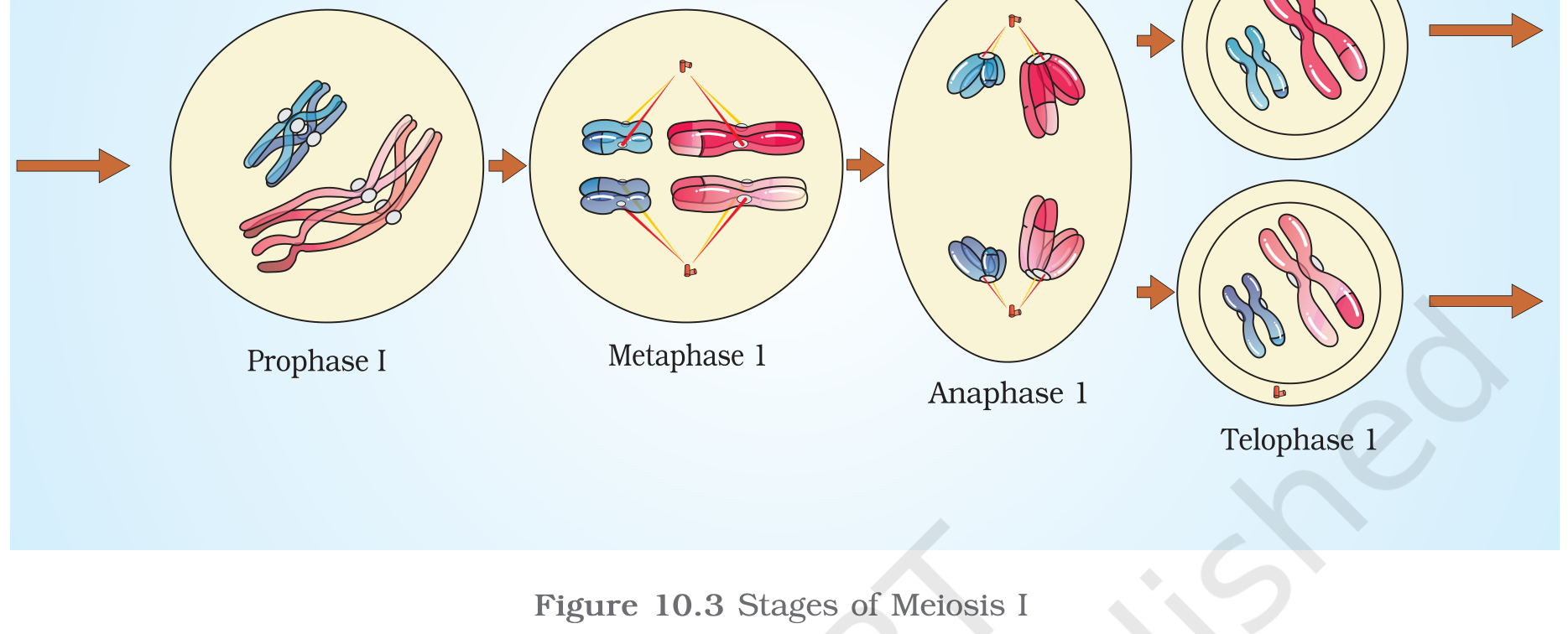
Zygotene is the pairing stage. Homologous chromosomes come together in a process called synapsis. Each pair is called a bivalent, and because it contains four chromatids it is also called a tetrad. Electron micrographs show a synaptonemal complex holding the pair together.
Pachytene is where the four chromatids of each bivalent become clearly distinct. Recombination nodules appear at the sites where crossing over happens between non-sister chromatids. Crossing over is an enzyme-mediated exchange of segments, and the enzyme involved is called recombinase. Recombination on a pair is completed by the end of pachytene.
Diplotene begins with the dissolution of the synaptonemal complex. The recombined homologues start to separate from each other, but they stay joined at the points where segments were exchanged. These X-shaped joints are the chiasmata. In some vertebrate eggs this diplotene pause can last for months or even years, so a human primary oocyte can remain arrested for decades.
Diakinesis closes prophase I. Chiasmata slide towards the chromosome ends, a change called terminalisation, while the chromosomes finish condensing and the meiotic spindle assembles. The nucleolus vanishes and the nuclear envelope breaks, so the cell is ready for metaphase I.
3.1.2 Meiosis I
Metaphase I places the bivalents on the equatorial plate, with spindle fibres from opposite poles gripping the kinetochores of the two homologues. In anaphase I the homologues separate and travel to opposite poles while the sister chromatids stay associated at their centromeres. Telophase I rebuilds the nuclear membrane and the nucleolus, cytokinesis follows, and the two products together are called a dyad. The chromosomes do decondense to some extent, but they do not return to the fully extended interphase state.
The short stage between the two meiotic divisions is interkinesis. No DNA replication happens in interkinesis, which is the key fact to remember.
3.1.3 Meiosis II
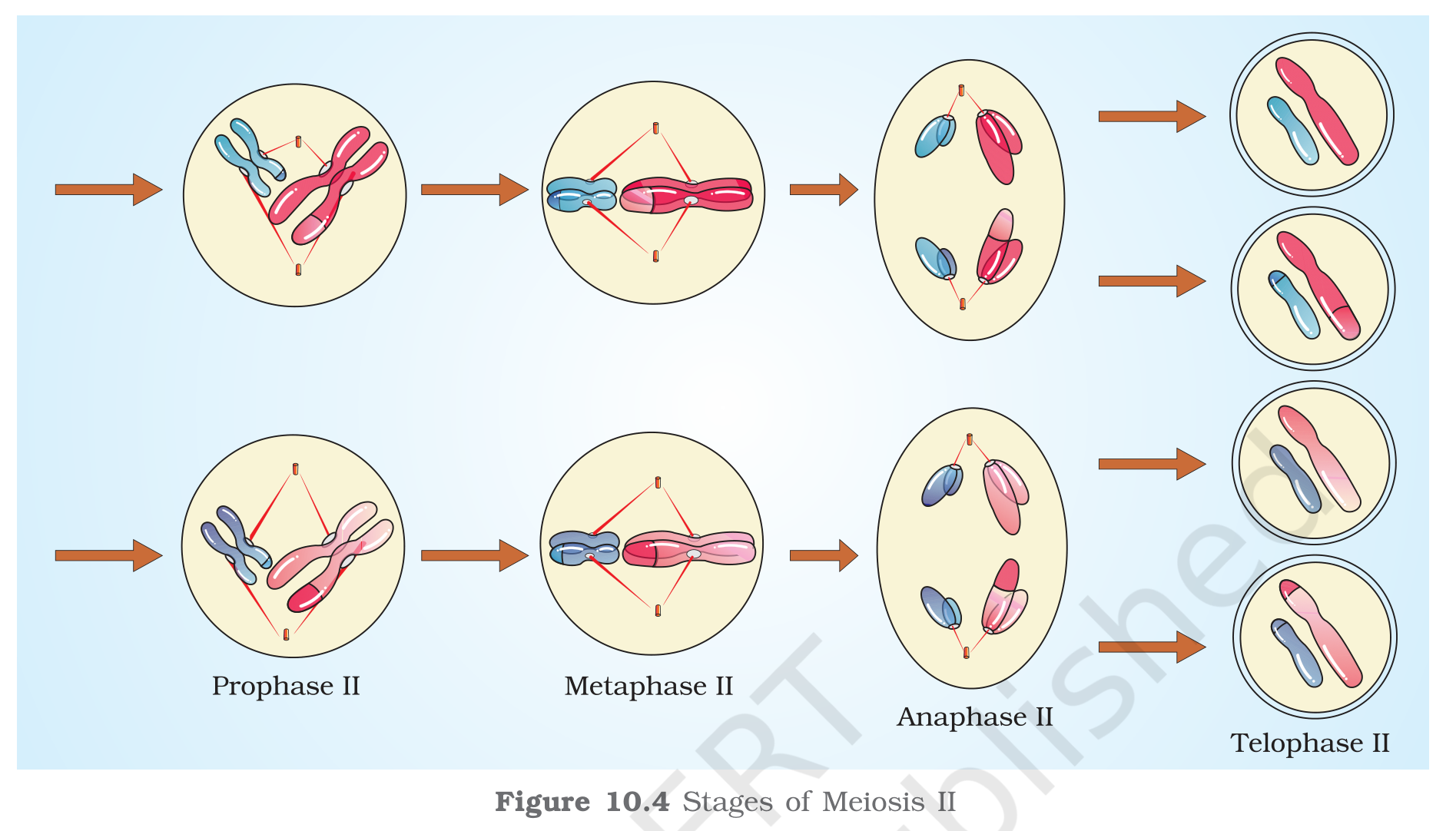
Meiosis II resembles a normal mitosis, except that it starts with haploid cells. Prophase II is brief and the nuclear membrane disappears. In metaphase II the chromosomes align at the equator and spindle fibres attach to the kinetochores of sister chromatids. In anaphase II the centromeres split and the sister chromatids move to opposite poles. In telophase II nuclear envelopes form around both groups and cytokinesis produces four haploid daughter cells, called a tetrad of cells.
3.1.4 Why meiosis matters
Meiosis keeps the chromosome number of a species constant across generations. Gametes carry half the set, and fertilisation restores the full set. The second function is variation. Crossing over and the random separation of homologues in anaphase I shuffle alleles into new combinations, and that variation is the raw material on which evolution works.
| Feature | Mitosis | Meiosis |
|---|---|---|
| Divisions | One | Two |
| Daughter cells | Two diploid | Four haploid |
| Chromosome number | Same as parent | Half of parent |
| Pairing and crossing over | Absent | Present in prophase I |
| DNA replication | Once before division | Once before meiosis I, none before meiosis II |
| Function | Growth and repair | Gamete formation, variation |
3.1.5 Practice from the NCERT exercises, questions 9, 12, 13 and 14
Exercise 9. The four products are equal in size in the formation of pollen grains from a pollen mother cell and in the formation of microspores in a plant. They are unequal in the formation of an egg from a megaspore mother cell and in animal oogenesis, where one large ovum and three small polar bodies are produced.
Exercise 12. The significance of meiosis is that it keeps the chromosome number constant across generations and creates genetic variation that supports evolution.
Exercise 13. Haploid cells divide by mitosis in the gametophyte generation of plants and in male bees, and those cells support the production of gametes in the haploid phase. In many higher plants some haploid cells, such as the synergids and antipodal cells of the embryo sac, do not divide further.
Exercise 14. Mitosis without S phase DNA replication does not give viable daughter cells because each daughter would receive only half the DNA. DNA replication without cell division does happen, for example in cells that become polyploid or multinucleate, and it leaves one cell with more DNA rather than two normal cells.
Exam
For a long answer on prophase I, write the five sub-stages in order and attach one event to each: visibility of chromosomes, synapsis with bivalent formation, crossing over at recombination nodules, chiasmata after the synaptonemal complex dissolves, and terminalisation with spindle assembly. For the comparison answer, put two divisions and four haploid cells against one division and two diploid cells, then add crossing over as the feature mitosis never shows.
Common mistake
Do not say that DNA replicates before meiosis II. Interkinesis is short and has no S phase, and this single round of replication for the whole process is a favourite one-mark point. Do not write that homologous chromosomes separate in anaphase II; that happens in anaphase I, while anaphase II separates sister chromatids. Do not confuse a bivalent with a chromatid pair either, because a bivalent has four chromatids and two centromeres.