

Concepts: Mitosis, cytokinesis and its significance
Cell Cycle and Cell Division24 min readLesson 2 of 5
2.1 The most visible phase of the cycle
Mitosis is the division that keeps the chromosome number the same in the parent cell and in each daughter cell, which is why it is called equational division. By the end of mitosis, one nucleus has become two nuclei with the same diploid set of chromosomes. The nucleus divides through four overlapping stages: prophase, metaphase, anaphase and telophase. The stages are a convenience for study, because the actual process is continuous.
2.1.1 Prophase
Prophase follows S and G2. The duplicated DNA, which lay tangled as chromatin, begins to condense into compact mitotic chromosomes. Each chromosome is now visibly a pair of sister chromatids joined at a centromere. The centrosome, duplicated during S phase, moves to opposite poles and radiates microtubules called asters. The two asters with the spindle fibres that form between them make up the mitotic apparatus. By the end of prophase the nucleolus, the nuclear envelope, the golgi complex and the endoplasmic reticulum can no longer be seen under the microscope.
2.1.2 Metaphase
Metaphase starts when the nuclear envelope breaks down completely, so the condensed chromosomes lie free in the cytoplasm. This is the stage when chromosome morphology is easiest to study. Each chromosome carries two chromatids held at the centromere, and small disc-shaped kinetochores appear on the centromere surface. Spindle fibres attach to the kinetochores and move the chromosomes until all of them lie in one plane at the centre of the cell. That plane of alignment is the metaphase plate. The two kinetochores of one chromosome face opposite poles, so one chromatid is pulled towards one pole and its sister towards the other.
2.1.3 Anaphase
At the start of anaphase the centromere of every chromosome at the metaphase plate splits at the same time. The two chromatids, now called daughter chromosomes, begin moving to opposite poles. The centromere leads the movement and the arms trail behind, which gives the characteristic V, J or L shapes under the microscope. Anaphase is therefore remembered by two events: centromeres split and chromatids move to opposite poles.
2.1.4 Telophase
Telophase is the final stage of karyokinesis. The chromosomes that have reached the poles decondense and lose their separate identity. The nuclear envelope reforms around each set of chromatin, the nucleolus reappears, and the golgi complex and endoplasmic reticulum are rebuilt. The cell now has two daughter nuclei, and cytokinesis usually follows.
2.1.5 Cytokinesis differs in animals and plants
In an animal cell the plasma membrane is flexible, so cytokinesis begins with a furrow in the membrane. The furrow deepens and finally joins at the centre, separating the cytoplasm into two. In a plant cell the rigid cell wall does not allow a furrow. Wall material is laid down from the centre of the cell outwards. The first precursor is the cell plate, which becomes the middle lamella between the walls of the two new cells. Mitochondria and plastids are distributed between the daughters during this division. When karyokinesis is not followed by cytokinesis, the result is a multinucleate syncytium, as in the liquid endosperm of coconut.
2.1.6 Why mitosis matters
Mitosis produces diploid daughter cells with an identical genetic complement. Growth of every multicellular organism is mitosis at work. As a cell grows, the ratio of nucleus to cytoplasm becomes too small, and division restores a workable ratio. Mitosis also replaces worn out cells. The outer skin layer, the gut lining and the blood cells are renewed by frequent mitotic divisions, so the body keeps repairing itself. In plants, mitosis in the apical and lateral meristems keeps growth going throughout life. Haploid cells can also divide by mitosis in some lower plants and in male honey bees, but the standard case is diploid somatic tissue.
2.1.7 Practice from the NCERT exercises, questions 5 to 8, 10, 11 and 15
Exercise 5. Mitosis is called equational division because the chromosome number of the parent cell is conserved in each daughter cell.
Exercise 6. Chromosomes move to the spindle equator in metaphase. The centromere splits and chromatids separate in anaphase. Homologous chromosomes pair in zygotene of prophase I. Crossing over happens in pachytene of prophase I.
Exercise 7. Synapsis is the pairing of homologous chromosomes during zygotene. The paired complex of two homologous chromosomes is a bivalent, also called a tetrad because it has four chromatids. Chiasmata are the X-shaped points where the recombined homologues stay joined after the synaptonemal complex dissolves in diplotene.
Exercise 8. Plant cytokinesis builds a cell plate from the centre outwards because the rigid wall will not furrow. Animal cytokinesis pinches the membrane inward as a furrow from the surface.
Exercise 10. In mitotic anaphase the centromeres split and sister chromatids separate. In anaphase I of meiosis the homologues separate while the sister chromatids stay joined at their centromeres.
Exercise 11. Mitosis is one division, produces two diploid cells, keeps the chromosome number the same and shows no pairing or crossing over. Meiosis has two divisions, produces four haploid cells, halves the chromosome number and includes synapsis and crossing over.
Exercise 15. DNA can be replicated without division, as in polytene chromosomes and in cells that become multinucleate, but the DNA then sits in a cell that has not divided. Division without prior replication would leave a daughter short of DNA and is not the normal route of cell division.
Slideshow, slide 1 of 3. Use the left and right arrow keys to change slides and the space bar to play or pause.
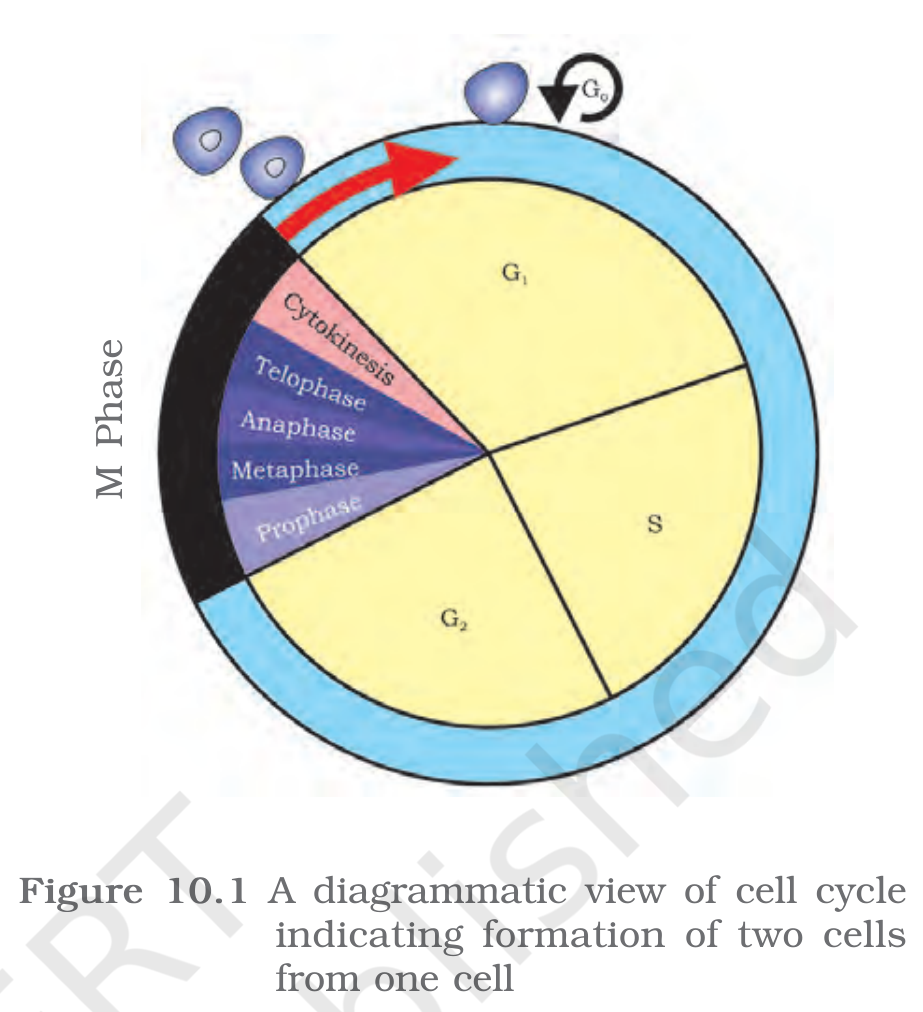
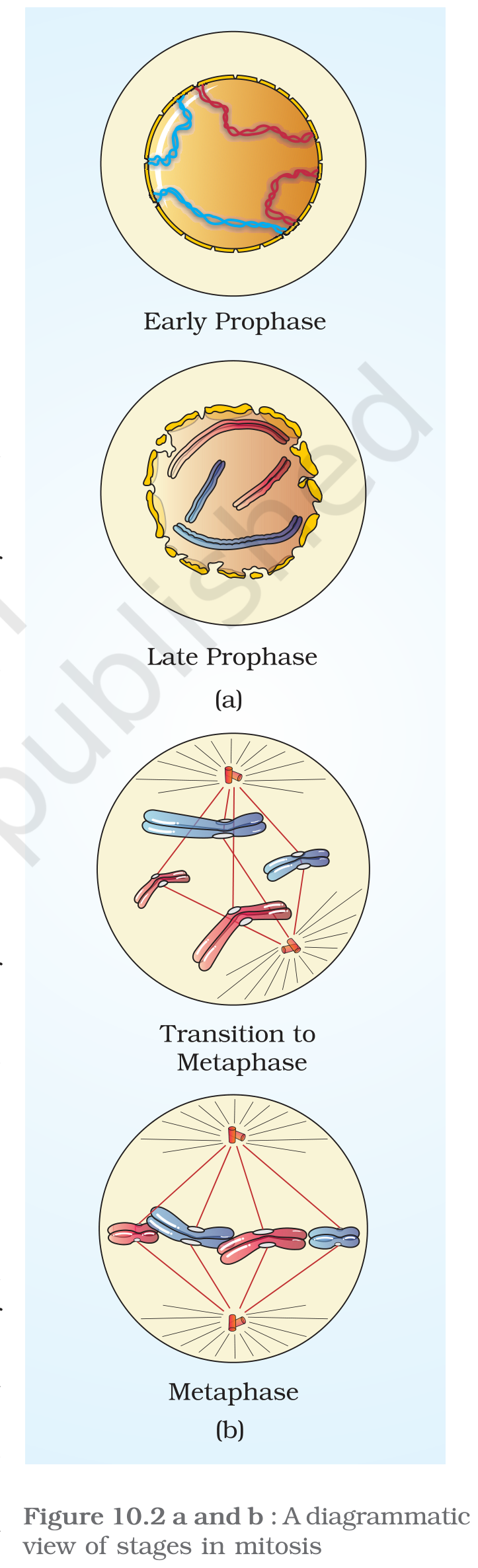
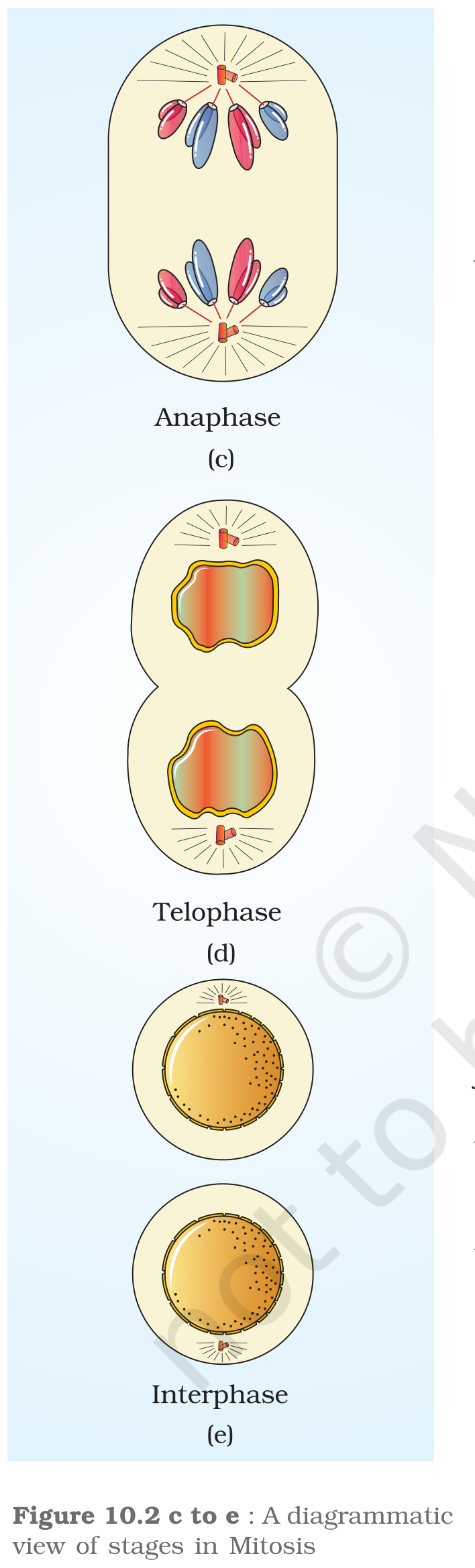
Figure 10.1: diagrammatic view of the cell cycle showing interphase phases G1, S and G2 and the M phase
Exam
Questions that ask for the sequence expect the stages in order with one key event each: prophase for condensation and spindle formation, metaphase for alignment at the plate, anaphase for centromere splitting, telophase for nuclear envelope and nucleolus re-forming. Cytokinesis is a separate event after karyokinesis, and the animal furrow against the plant cell plate is a standard two-mark comparison.
Common mistake
Do not write that the nuclear envelope disappears in prophase and then claim the chromosomes are still inside the nucleus in metaphase. Do not say that the chromosome number doubles during anaphase: the chromatids separate and the number of chromosomes per cell becomes 4n temporarily, but the whole cell then divides. Do not confuse the cell plate with the plasma membrane; the cell plate becomes the middle lamella, and the new wall material is added on both sides of it.