

Concepts: Nomenclature and identification
The Living World16 min readLesson 2 of 5
2.1 Why a scientific name is needed
A plant that one village calls by one name may carry a different name two districts away, and the same name may refer to a different plant in another state. A scientist who reads an old record cannot tell which plant the writer meant. The answer is a naming system that is the same in every country. Naming is possible only after the organism has been described properly and identified, which is why taxonomy treats identification and nomenclature as two separate steps.
2.1.1 Binomial nomenclature
Carolus Linnaeus gave the system that biologists still use. Every scientific name has two parts. The first is the generic name, which is the genus. The second is the specific epithet, which marks the species inside that genus. The two words together are the binomial, and the system is called binomial nomenclature.
The mango is the standard example. Its scientific name is Mangifera indica. Mangifera is the genus and indica is the specific epithet. The name is written with the genus first, then the species word, and the two are treated as one unit. Because a genus can hold several species, the first word alone does not fix the organism; the pair does.
2.1.2 The written rules
Biological names are in Latin, or are Latinised from other languages, whatever the origin of the word. They are printed in italics, and when written by hand the two parts are underlined separately so that the Latin origin is clear. The genus word opens with an upper-case letter while the species word opens in lower case. A name that respects the four points looks like this: Mangifera indica. A version such as Mangifera Indica breaks the third point.
The name of the author who first described the species is placed at the end of the scientific name in an abbreviated form. Mangifera indica Linn. carries Linn. after the species word, which shows that Linnaeus described it. The author name is not part of the binomial itself; it is a citation that tells the reader whose description the name rests on.
2.1.3 The two codes
Plants and animals are named under different rule books. Botanical names follow the International Code for Botanical Nomenclature, ICBN. Zoological names follow the International Code of Zoological Nomenclature, ICZN. Both codes exist to keep one thing true: a scientific name must be unique, so that no two different organisms carry the same name and no organism carries two accepted names.
2.1.4 Identification
Identification is the process of finding out to which known taxon a specimen belongs. It rests on a careful description of the specimen, then a comparison with named specimens, published descriptions and keys. The step matters because a name can be attached only after the identity is settled. A wrong identification gives a correct name to the wrong plant, which is worse than no name at all.
2.2 Taxonomy and systematics
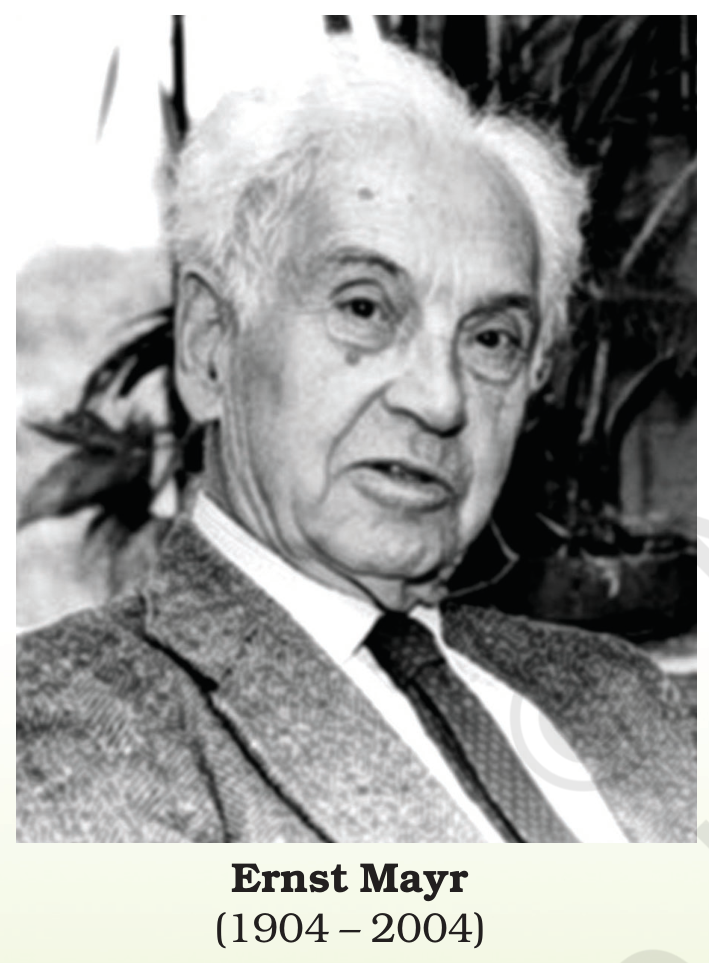
Taxonomy is the branch of knowledge that deals with identification, nomenclature and classification. Systematics is the branch that does the same work and also traces evolutionary relationships. Ernst Mayr, whose portrait appears in the unit opener, spent his career on exactly that second part. His work on species diversity and on the biological species concept pushed taxonomy from a filing system towards a study of descent.
2.2.1 The word taxon
A taxon is a group of organisms that a taxonomist treats as a unit at some level of the hierarchy. The word is used at every level. The group called animals is a taxon, the group called mammals is a taxon, and the group called dogs is a taxon as well. They are not the same kind of unit, because dogs sit inside mammals and mammals sit inside animals. Each of them is a taxon at a different rank.
That is why the same organism appears in more than one taxon. A mango is a taxon at the species level as Mangifera indica, a taxon at the genus level as Mangifera, and a taxon at the family level as Anacardiaceae. The taxon is the group; the rank is the step in the hierarchy where the group sits.
2.2.2 Practice from the NCERT exercises, questions 5 and 8
Exercise 5. The correctly written name of mango is Mangifera indica. The first letter of the genus is capital, the specific epithet begins with a small letter, and the two words are printed in italics. Mangifera Indica is wrong because the specific epithet has been capitalised.
Exercise 8. The word species carries more than one accepted meaning. For a higher plant or animal, a species is a group of individuals that share fundamental features and can be told apart from close relatives by clear morphological differences. For bacteria, where morphology offers very little, the practical meaning rests on genetic and biochemical identity, and the boundaries are harder to draw. That is why the same word needs a different operational test in different groups.
Exam
Questions on binomial nomenclature usually want four points: Latin, two parts, genus capital and species small, italics or separate underlining. Add the author citation only when the question carries an example with a name at the end, as in Brassica campestris Linn. If the marks are for the difference between taxonomy and systematics, put characterisation, identification, classification and nomenclature on the taxonomy side and add evolutionary relationships on the systematics side.
Common mistake
Do not invent an author name for a binomial you were not given. The author citation would be a factual claim about who described the species. Do not write the specific epithet with a capital letter, and do not say that the two words can be separated and used apart as a full name. The binomial works as a pair.