

Concepts: Taxonomic categories and the hierarchy
The Living World20 min readLesson 3 of 5
3.1 From one rank to the next
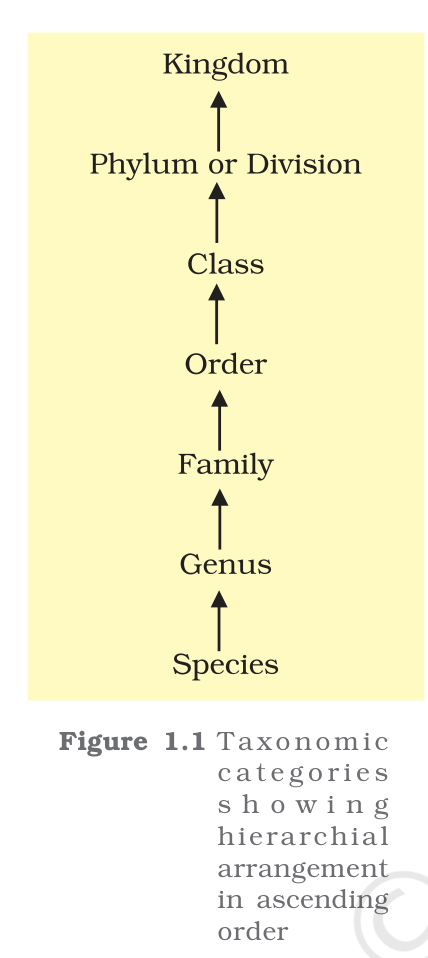
Classification is not one decision but a series of steps. Each step is a rank, and the rank is called a taxonomic category. All the categories together make up the taxonomic hierarchy. An organism that has been identified is placed at the species level first, then carried upward through genus, family, order, class, phylum or division, and finally kingdom.
3.1.1 Species
A species is a group of individual organisms that share fundamental features and can be separated from closely related species by distinct morphological differences. Mango, potato and lion are three examples, and their scientific names show how the rank is written: Mangifera indica, Solanum tuberosum and Panthera leo. The words indica, tuberosum and leo are specific epithets, and each one fixes the species inside its genus.
A genus can hold several species. Panthera also holds tigris, the tiger. Solanum holds species such as nigrum and melongena, apart from tuberosum. For human beings the species word is sapiens and the genus is Homo, which gives the full name Homo sapiens.
3.1.2 Genus
A genus is a collection of closely related species. All the species in one genus share more characters with one another than with the species of another genus. Potato and brinjal are two different species, and both sit in Solanum. Lion, leopard and tiger are three species of Panthera, and they share a set of common features. Panthera differs from Felis, the genus that holds the small cats.
3.1.3 Family
The next rank, the family, holds related genera. The species inside a family share fewer features than the species inside a genus do. Plant families are recognised from vegetative and reproductive characters together. Solanum, Petunia and Datura are three genera inside Solanaceae. Among animals, Panthera sits with Felis inside Felidae, while the dog group is placed in a separate family, Canidae. A cat and a dog share some features, but the differences put them in different families.
3.1.4 Order
An order is an assemblage of families that share a few characters. The plant families Convolvulaceae and Solanaceae are grouped in the order Polymoniales, mainly on floral characters. Among animals, the order Carnivora includes Felidae and Canidae.
3.1.5 Class
A class holds related orders. The order Primata, which contains monkeys, gorillas and gibbons, is placed in the class Mammalia along with Carnivora, which contains tigers, cats and dogs. Mammalia holds other orders as well.
3.1.6 Phylum and division
A phylum is the rank above class in the animal system. Fishes, amphibians, reptiles, birds and mammals are all classes inside the phylum Chordata, and they share a notochord and a dorsal hollow nerve cord. In the plant system the same rank is called a division.
3.1.7 Kingdom
The kingdom is the highest category of the hierarchy. All animals from every phylum are placed in Kingdom Animalia, and all plants from every division are placed in Kingdom Plantae. The two kingdoms are kept distinct, and the chapter calls them the animal kingdom and the plant kingdom.
3.1.8 How the hierarchy behaves
Figure 1.1 arranges the categories from species at the bottom to kingdom at the top. As you climb, the number of shared characters falls. Members of one species share a great deal, members of one family share less, and members of one kingdom share only the broadest features. The other side of the same rule is that relationships become harder to settle at higher ranks, because the shared features are fewer and the group is larger. Taxonomists also use sub-categories such as subspecies and subfamily where a broad category needs finer division.
Table 1.1 in the printed chapter places four common organisms into the hierarchy. The table is shown here with the categories as rows so that the four examples sit side by side.
| Category | Man | Housefly | Mango | Wheat |
|---|---|---|---|---|
| Species | Homo sapiens | Musca domestica | Mangifera indica | Triticum aestivum |
| Genus | Homo | Musca | Mangifera | Triticum |
| Family | Hominidae | Muscidae | Anacardiaceae | Poaceae |
| Order | Primata | Diptera | Sapindales | Poales |
| Class | Mammalia | Insecta | Dicotyledonae | Monocotyledonae |
| Phylum or division | Chordata | Arthropoda | Angiospermae | Angiospermae |
The table shows the same rule from another side. Man and housefly share a kingdom but almost nothing else, while mango and wheat share a division yet sit in different classes. The more steps two organisms share, the closer their relationship.
3.1.9 Practice from the NCERT exercises, questions 6 to 10
Exercise 6. A taxon is any group of organisms treated as a unit at a rank. At the species rank a taxon is Mangifera indica; at the genus rank it is Mangifera; at the family rank it is Anacardiaceae; at the order rank it is Sapindales.
Exercise 7. The correctly ordered option is (c), which lists species, genus, order and phylum. Kingdom, the rank above phylum, is not part of that printed option.
Exercise 8. Already worked with nomenclature. For higher plants and animals morphology gives the working test, while for bacteria the boundary is drawn from genetic and biochemical evidence.
Exercise 9. Phylum is the rank above class. Class is above order. Family is above genus. Order is above family. Genus is above species. Each rank is defined by how many shared characters its members carry.
Exercise 10. For a plant, take mango: species Mangifera indica, genus Mangifera, family Anacardiaceae, order Sapindales, class Dicotyledonae, division Angiospermae. For an animal, take man: species Homo sapiens, genus Homo, family Hominidae, order Primata, class Mammalia, phylum Chordata.
Exam
For a hierarchy question, write the ranks in a single line: species, genus, family, order, class, phylum or division, kingdom. Then give one organism as an example. If the question asks what happens as you go up the hierarchy, give the two answers together: shared characters decrease and the difficulty of deciding relationships increases.
Common mistake
Do not mix the plant and animal names for the phylum rank. Plants are placed in divisions, so a plant has no phylum. Do not write species as the highest category or kingdom as the lowest. And do not assume that two organisms in the same class are closer than two organisms in the same family: the shared rank must be the same depth for the comparison to mean anything.