

Concepts: chemical combination, atomic mass and the mole
Some Basic Concepts of Chemistry22 min readLesson 3 of 6
3.1 Laws of chemical combination
Chemical reactions obey a small set of mass and volume laws that were established by experiment long before atoms were accepted. These laws are the evidence behind the mole concept, and most exam questions in this chapter are built on them.
The law of conservation of mass fixes the total mass in a chemical change. Atoms are rearranged, not formed or removed, so the mass before the change and after it must be the same as long as no product escapes. A sealed tube in which a gas is produced shows this directly; an open beaker loses a gas and appears to lose mass.
The law of definite proportions concerns composition. Every sample of a compound, whatever its source, carries its elements in one fixed mass ratio. Pure water always has hydrogen and oxygen in the mass ratio 1 to 8. A compound prepared in a laboratory and the same compound taken from a mineral both obey the ratio.
The law of multiple proportions appears when two elements can form more than one compound. Choose a fixed mass of the first element; the masses of the second element that pair with it then stand in a ratio of simple integers. Carbon shows this with carbon monoxide and carbon dioxide. In carbon monoxide, 12 g of carbon combines with 16 g of oxygen; in carbon dioxide, the same 12 g of carbon combines with 32 g of oxygen. The two oxygen masses are in the ratio 1 to 2.
Gay-Lussac's law of gaseous volumes applies when gases react. The volumes that combine, and the volumes of any gaseous products, are in a simple whole number ratio provided the temperature and pressure stay fixed. One volume of hydrogen reacts with one volume of chlorine to give two volumes of hydrogen chloride, and one volume of nitrogen with three volumes of hydrogen gives two volumes of ammonia.
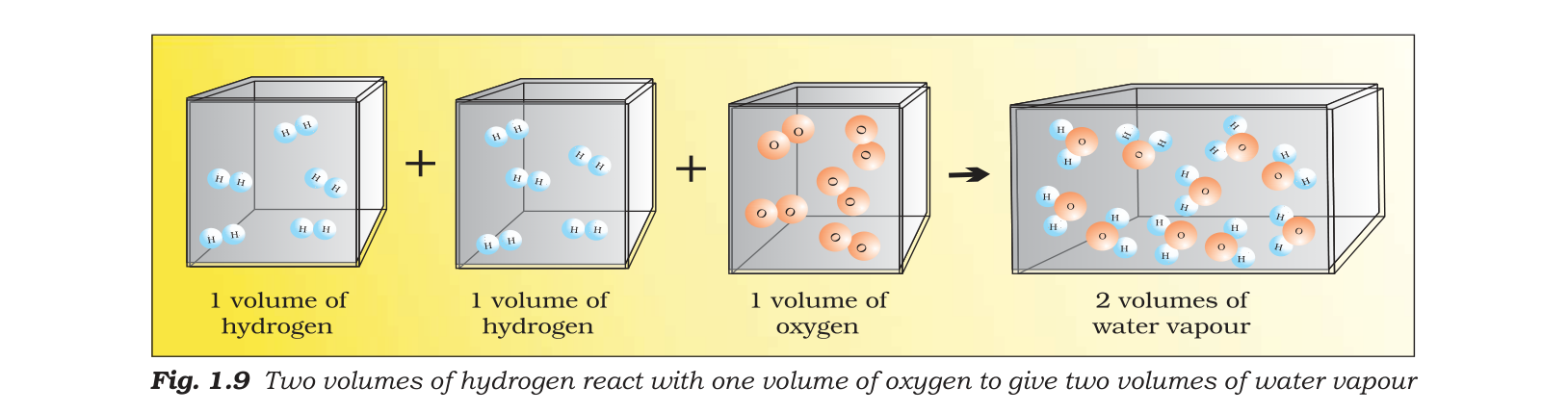
Avogadro's law explains those volume ratios. At a fixed temperature and pressure, a given volume of any gas holds the same count of molecules as the same volume of any other gas. Since one molecule of chlorine reacts with one molecule of hydrogen, one volume of each must react. A gas volume can therefore stand in for a count of molecules.
3.2 Dalton's atomic theory
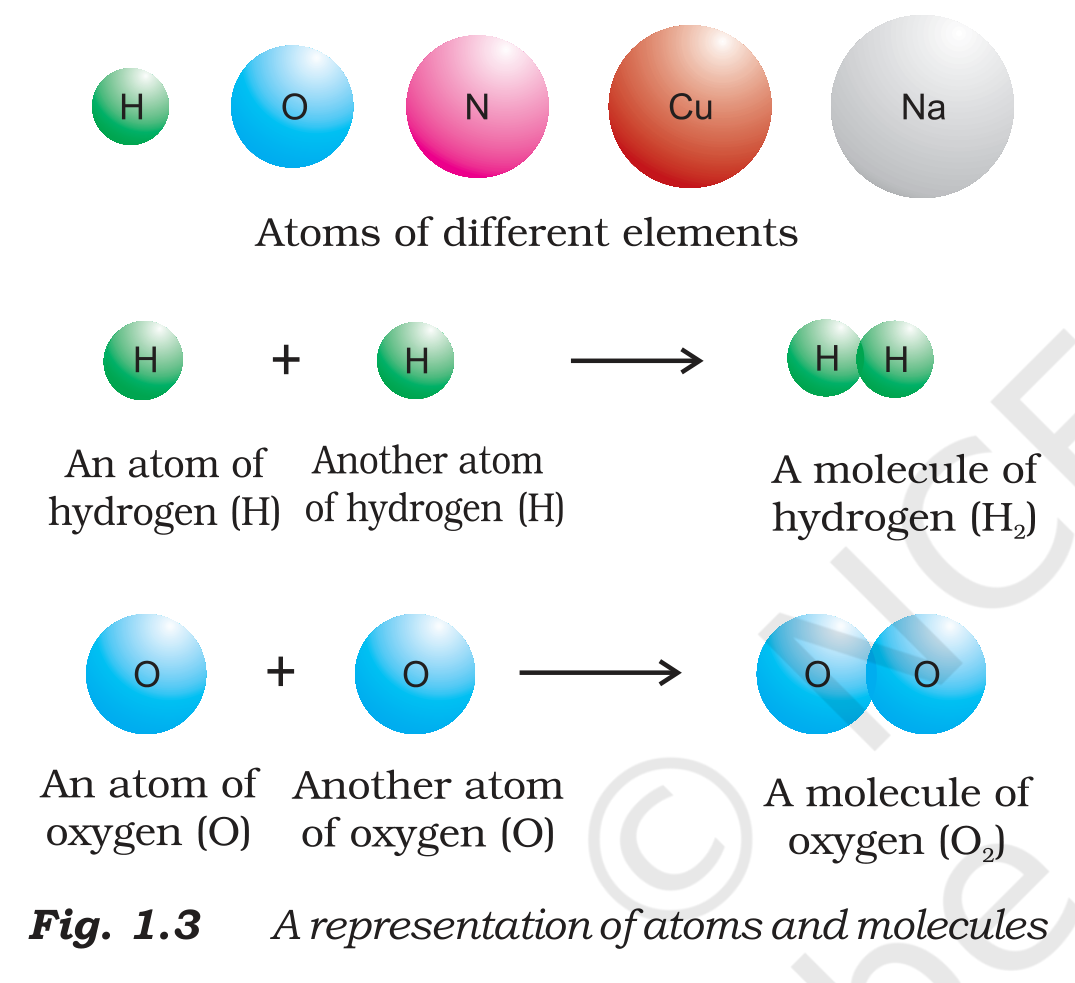
Dalton proposed that every element is made of tiny indivisible particles called atoms, that all atoms of an element are identical in mass, that compounds form when atoms combine in fixed whole number ratios, and that a chemical reaction only rearranges atoms. The theory explains conservation of mass, definite proportions and multiple proportions in one stroke.
The theory has clear limits. It assumes atoms of an element all have the same mass, which is false because isotopes exist. It treats the atom as indivisible, while electrons, protons and neutrons are its parts. It does not explain the volume ratios of gases, which need Avogadro's idea that molecules can contain more than one atom.
3.3 Atomic and molecular masses
Atomic masses are relative masses. The standard is the carbon-12 atom, whose mass is fixed at exactly 12 unified mass units, written u. One unified mass unit equals 1.66056 x 10^-24 g, so the atomic mass in u multiplied by this factor gives the mass of a single atom in grams. The older unit amu has been replaced by u.
Most elements exist as a mixture of isotopes, so the atomic mass printed in the periodic table is an average weighted by natural abundance. For chlorine, the two isotopes are chlorine-35 with abundance 75.77 percent and molar mass 34.9689 g mol^-1, and chlorine-37 with abundance 24.23 percent and molar mass 36.9659 g mol^-1.
The molecular mass of a substance is the sum of the atomic masses of the atoms in one molecule. For water, two hydrogen atoms and one oxygen atom give 2(1.008) + 16.00 = 18.02 u. For methane, one carbon and four hydrogen atoms give 12.011 + 4(1.008) = 16.043 u.
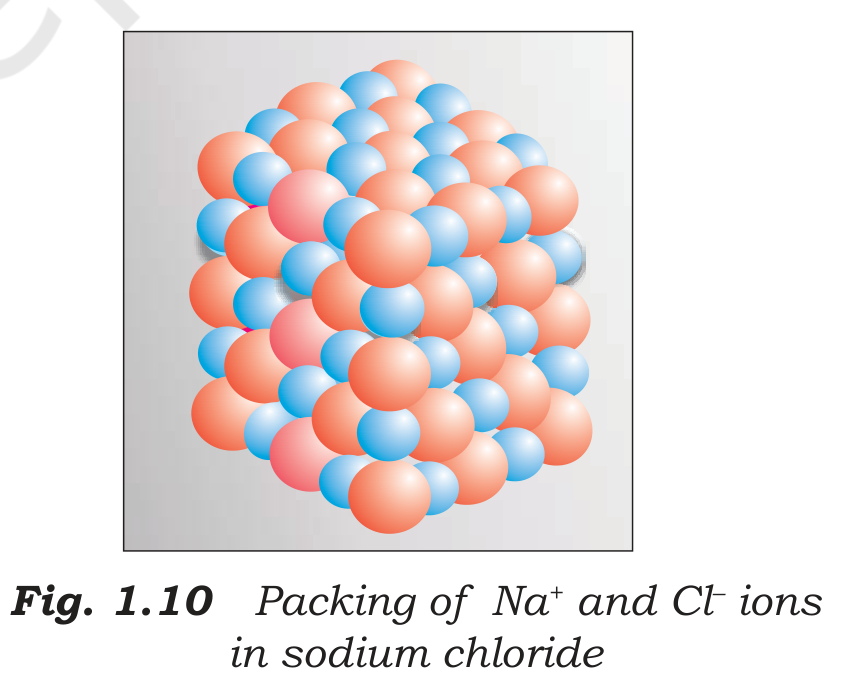
Some solids do not contain separate molecules. Sodium chloride is built from a three-dimensional array of sodium and chloride ions, so the unit that repeats is the formula unit, and the mass calculated from the formula is called the formula mass. Sodium chloride has a formula mass of 23.0 + 35.5 = 58.5 u.
3.4 The mole and molar mass
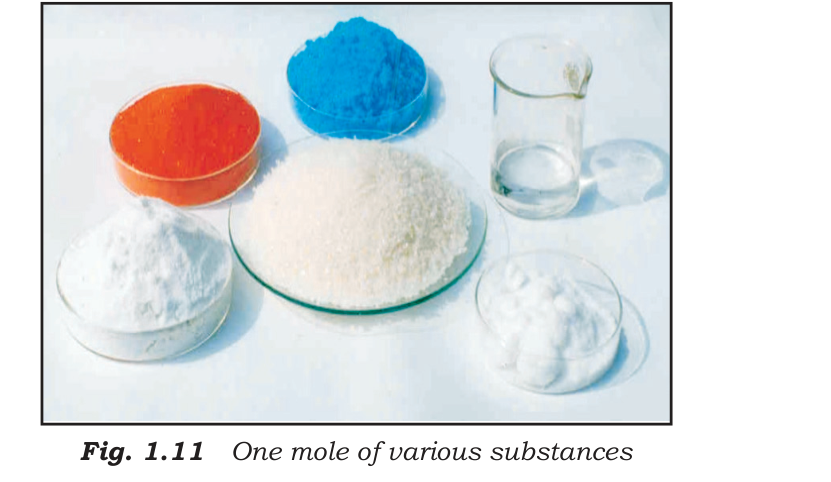
A mole is the amount of a substance that contains as many elementary entities as there are atoms in exactly 12 g of carbon-12. That number is the Avogadro constant, 6.02214076 x 10^23 mol^-1. The definition is worth reading twice: the mole counts entities, and the entities may be atoms, molecules, ions, electrons or formula units, so the question must always say which entity is being counted.
The gram mass of one mole is called the molar mass, and its value matches the atomic, molecular or formula mass expressed in u. One mole of water is 18.02 g, one mole of sodium is 23.0 g, and one mole of sodium chloride is 58.5 g. This equality is what lets a balance, which measures mass, stand in for a count of particles.
A worked example makes the bridge concrete. Calculate the mass of one water molecule. The molar mass is 18.02 g mol^-1, so the mass of one molecule is 18.02 divided by 6.022 x 10^23, which is 2.99 x 10^-23 g. Going the other way, 9.0 g of water contains 9.0 divided by 18.02, which is 0.50 mol, and that is 0.50 x 6.022 x 10^23 = 3.01 x 10^23 molecules.
Exam
When a question asks for the number of atoms in a given mass, go through moles twice: mass to moles of the compound, then moles of compound to moles of atoms using the formula, and only then multiply by the Avogadro constant. Skipping the middle step is the most common way to lose marks here.