

Concepts: nature of matter and measurement
Some Basic Concepts of Chemistry20 min readLesson 2 of 6
2.1 What chemistry counts
Chemistry deals with the composition, structure and changes of matter, and almost every calculation in this book starts by counting particles that are far too small to see. Before counting them, the chapter fixes what matter is and how it is measured. Two ideas carry the rest of the chapter: matter has a particulate nature, and any measurement worth reporting carries a unit and an honest statement of how precise it is.
2.2 States and classification of matter
Matter exists in three familiar states. In a solid the particles sit close together in an ordered arrangement and vibrate about fixed positions, so the shape and the volume are both definite. In a liquid the particles are still close together but can slide past one another, so the volume is fixed while the shape follows the container. In a gas the particles are far apart and fill whatever space is available, so neither shape nor volume is fixed.
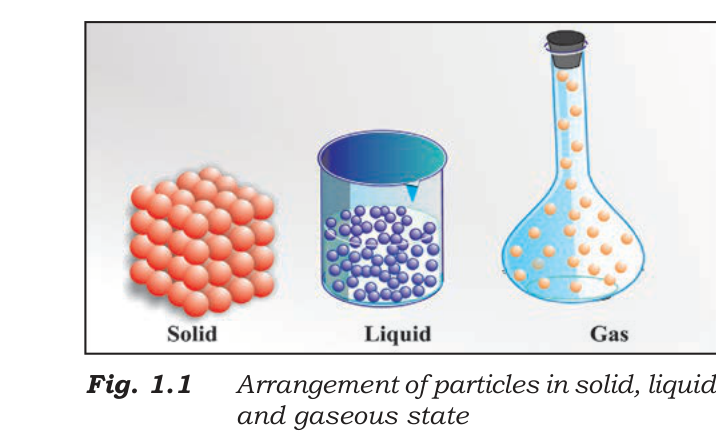
Heating a solid loosens the packing until it melts, and further heating turns the liquid into a gas. Cooling reverses the sequence. The same substance can appear in all three states, so the state is a condition of the sample, not a different kind of matter.
Matter divides into mixtures and pure substances. A mixture holds two or more components in any proportion, and its components keep their own identities and can usually be separated by physical means. Air is a mixture of gases, and sugar dissolved in water is a mixture of a solid in a liquid. A mixture whose composition is the same throughout is homogeneous, while one with visible separate parts is heterogeneous.
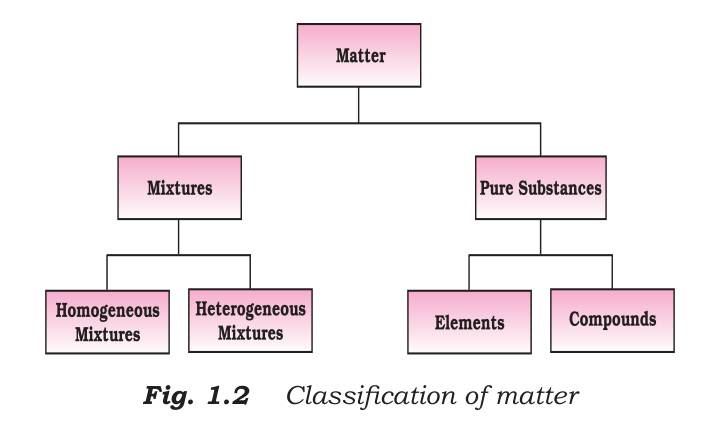
A pure substance has a fixed composition and a fixed set of properties. Elements are pure substances made of one kind of atom, such as copper or oxygen. Compounds are pure substances made of two or more elements combined in a fixed ratio by mass, and their properties differ from those of the elements that formed them. Water is a liquid at room temperature even though hydrogen and oxygen are gases, which shows that a compound is a new substance and not a physical blend.
2.3 Properties: physical and chemical
A physical property can be observed or measured without changing the identity of the substance, for example colour, melting point, density or electrical conductivity. A chemical property describes a change in which the substance becomes something else, for example its reaction with an acid or its combustion in oxygen. Physical properties are enough to identify a sample and to separate a mixture; chemical properties decide what products a reaction will give.
2.4 Measuring mass, volume and temperature
The SI system builds every quantity from seven base units: metre, kilogram, second, ampere, kelvin, mole and candela. Larger and smaller amounts are written with prefixes, and the prefixes most used in chemistry run from pico (10^-12) through nano (10^-9), micro (10^-6), milli (10^-3) and centi (10^-2) up to kilo (10^3), mega (10^6) and giga (10^9).
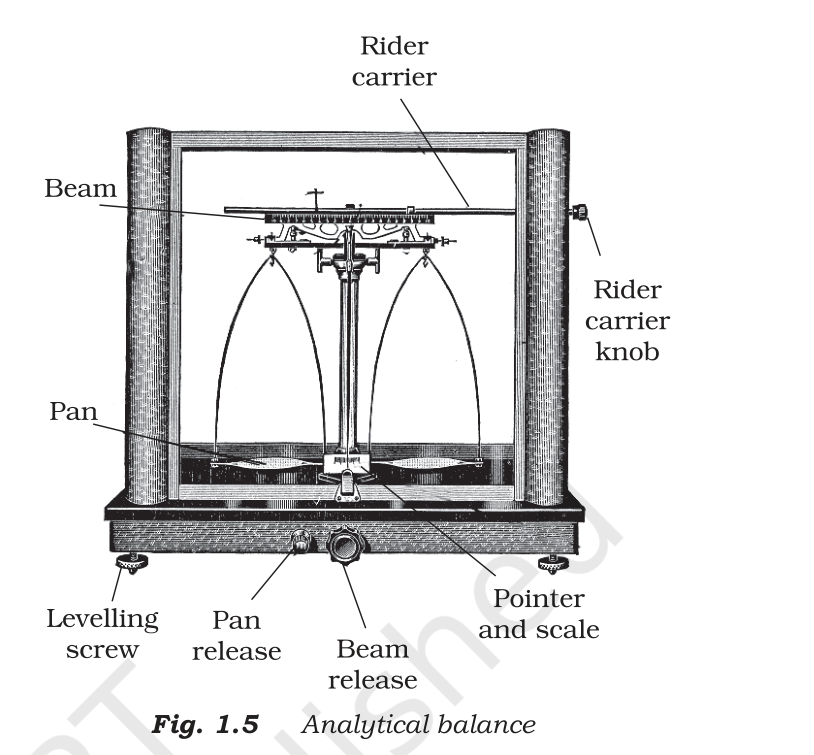
Mass is the amount of matter in a sample, while weight is the force that gravity exerts on it. The mass of a body stays the same on the moon; its weight changes because gravity changes. A laboratory balance measures mass by comparing it with standard masses, and an analytical balance can reach fractions of a milligram.
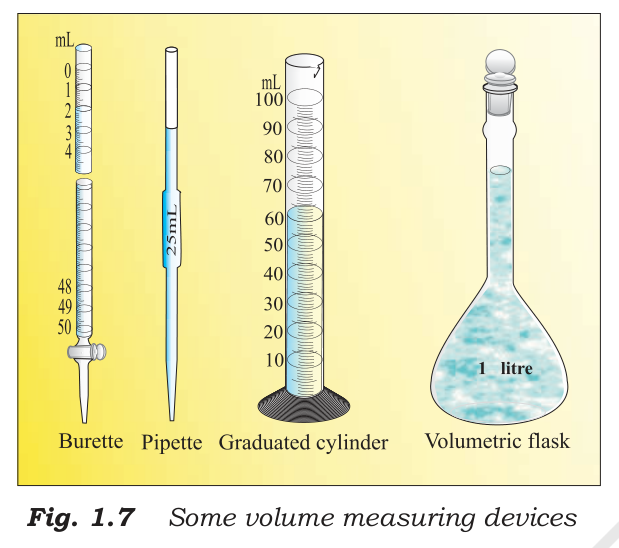
Volume is the space occupied by a sample and has the units of length cubed. The SI unit is the cubic metre, which is far too large for routine work, so chemists use litres and millilitres. One litre is one cubic decimetre, one millilitre is one cubic centimetre, and a thousand millilitres make a litre. Density ties mass and volume together: mass divided by volume, commonly in g cm^-3 for solids and liquids.
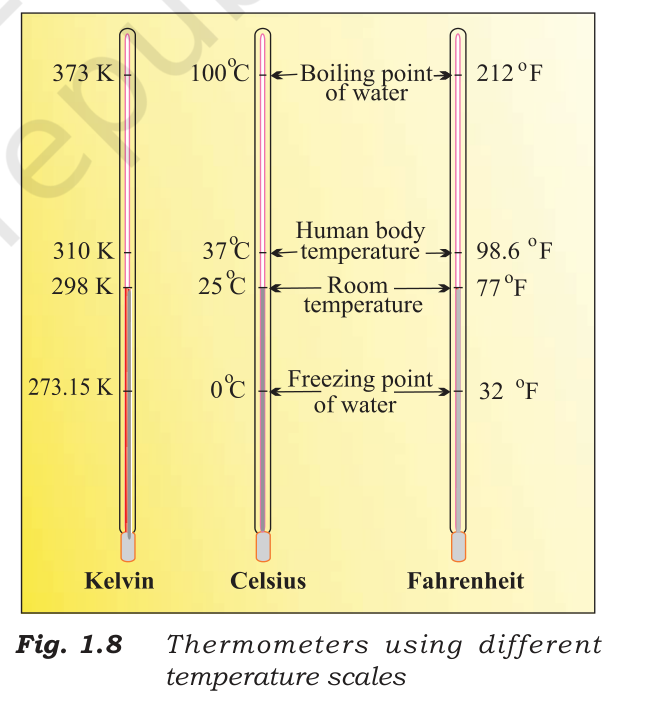
Temperature decides the direction of heat flow. The Celsius scale is fixed with 0 at the freezing point of water and 100 at its boiling point, the kelvin scale starts at absolute zero, and a temperature difference of one degree is the same on both scales. The Fahrenheit scale is still common on laboratory instruments in some countries and is related to Celsius by a linear conversion.
Slideshow, slide 1 of 3. Use the left and right arrow keys to change slides and the space bar to play or pause.
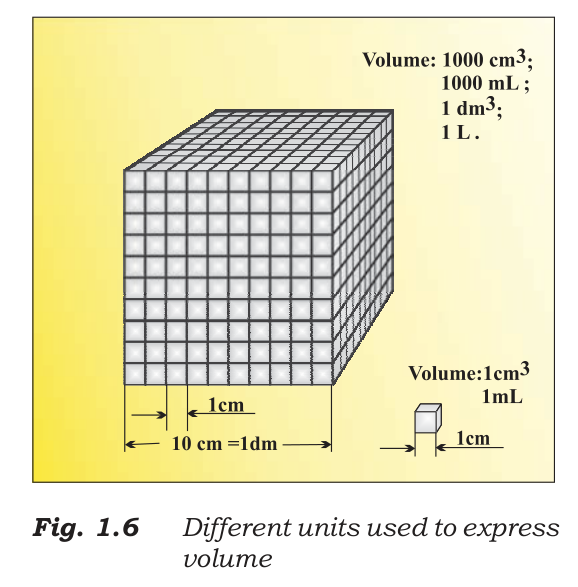
A cube of side one decimetre holding one litre, one thousand millilitres and one thousand cubic centimetres, next to a smaller cube of volume one cubic centimetre.
2.5 Uncertainty, scientific notation and significant figures
Every measurement carries uncertainty. The digits that are actually measured and the first uncertain digit together form the significant figures of a result. A burette reading of 22.45 mL has four significant figures: the last digit is estimated but still reported. Writing a number in scientific notation keeps that information visible, because the coefficient carries the significant digits and the power of ten only fixes the magnitude. Thus 0.0048 becomes 4.8 x 10^-3, while 8008 becomes 8.008 x 10^3.
The rules are short. Non-zero digits are always significant; zeros between them count; leading zeros never count; trailing zeros count only when there is a decimal point or a marked decimal. In multiplication and division the answer keeps as many significant figures as the measurement with the fewest; in addition and subtraction the answer keeps as many decimal places as the measurement with the fewest decimal places. Exact numbers, such as the coefficient in a balanced equation, are not limited by these rules.
2.6 Dimensional analysis
Dimensional analysis converts units by multiplying with ratios that equal one. To convert 28.7 pm into metres, use the fact that 1 pm equals 10^-12 m, so the factor is 10^-12 m divided by 1 pm. The unit being cancelled must appear opposite to itself, and the unit left over is the answer's unit. The method also catches mistakes: if the final unit is not the one asked for, the ratio was written upside down.
Common mistake
Do not mix mass and weight, and do not write a number without its unit. A density in g mL^-1 is numerically equal to the density in g cm^-3, but a density in kg m^-3 is a thousand times smaller, which is why unit conversion comes before substitution.