

Concepts: Le Chatelier's principle and equilibrium shifts
Equilibrium22 min readLesson 3 of 8
3.1 Le Chatelier's principle
Le Chatelier's principle says that when a system at equilibrium is disturbed, the system shifts in the direction that reduces the disturbance. The principle is a guide rather than a calculation: it tells the direction of the shift, and the new position can be found by working out the reaction quotient after the change.
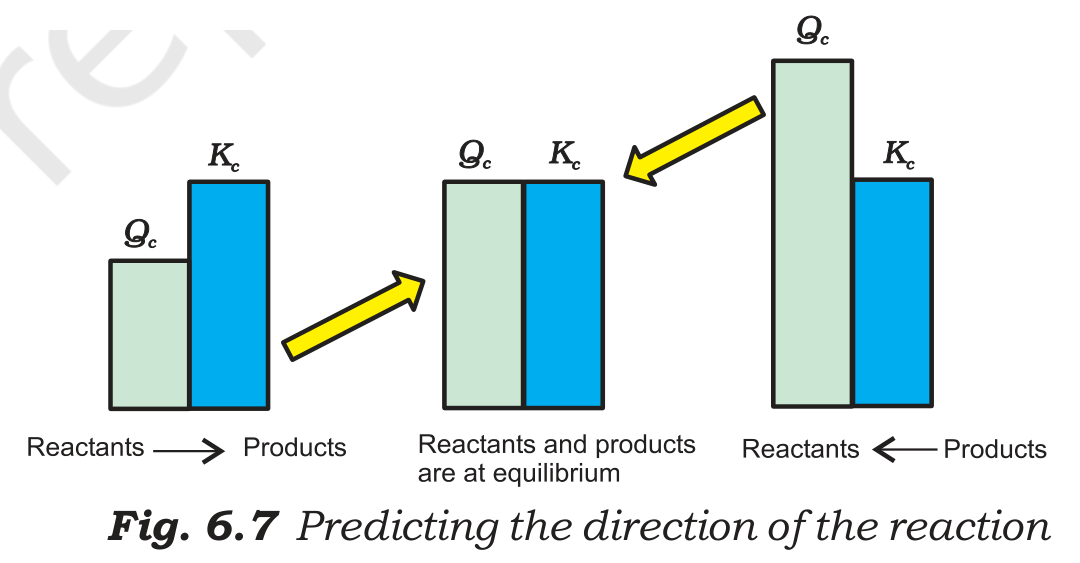
The reaction quotient is the link between the principle and the calculation. After a disturbance, the concentrations or pressures change and Q no longer equals K. If Q is smaller than K, the reaction must move towards the products; if Q is larger, it must move towards the reactants. Once the system settles, Q equals K again, but the composition has changed.
3.2 Effect of concentration
Adding a reactant increases its concentration, which makes Q smaller than K, so the reaction shifts forward to use up some of the added substance. Removing a product has the same effect: the denominator of Q falls, so the reaction moves forward. Adding a product or removing a reactant shifts the equilibrium backward. In every case the equilibrium constant itself does not change, because it depends only on temperature.
The industrial synthesis of ammonia uses this idea. Removing ammonia as it forms drives the reaction towards more ammonia, and adding fresh nitrogen and hydrogen keeps the forward reaction supplied.
3.3 Effect of pressure and volume
Pressure changes matter only when gases are present and the number of gas molecules differs on the two sides. Increasing the pressure by reducing the volume shifts the equilibrium towards the side with fewer moles of gas, because that direction reduces the total number of molecules and the pressure. Decreasing the pressure shifts it towards the side with more gas molecules.
The hydrogen-iodine equilibrium is unaffected by pressure changes because the number of gas molecules is the same on both sides; H2 + I2 giving 2HI has delta n_g equal to zero. At constant volume, an inert gas raises the total pressure but leaves each reacting gas partial pressure unchanged, so the equilibrium does not move. Adding it at constant pressure lowers the partial pressures of the reactants, which shifts the equilibrium towards the side with more gas molecules.
3.4 Effect of temperature
Temperature changes the equilibrium constant itself. The direction of the shift depends on whether the forward reaction is exothermic or endothermic. Heating an equilibrium shifts it in the endothermic direction, and cooling shifts it in the exothermic direction.
For an exothermic synthesis such as ammonia formation, the equilibrium constant falls as the temperature rises, so the yield falls at high temperature. The industrial compromise is a moderate temperature chosen so that the rate is high enough while the yield stays acceptable.
3.5 Effect of a catalyst
A catalyst speeds up both the forward and the reverse reactions by the same factor, so it does not change the equilibrium constant or the position of equilibrium. It only helps the system reach equilibrium faster. This distinction is a frequent exam point: a catalyst changes the rate, not the position.
3.6 Law of mass action in practical form
The direction predictions can be collected into a compact set of rules. Adding a reactant or removing a product shifts the equilibrium forward. Adding a product or removing a reactant shifts it backward. Increasing pressure shifts the equilibrium towards fewer gas moles. Raising the temperature shifts it in the endothermic direction. A catalyst changes neither K nor the position.
3.7 The industrial picture
The Haber process combines these effects. Nitrogen and hydrogen react exothermically to give ammonia, with a decrease in the number of gas moles. High pressure favours the products because the product side has fewer gas moles. A moderate temperature keeps the rate reasonable without making the yield too small. Removing the ammonia continuously pushes the reaction forward, and an iron catalyst brings the mixture to equilibrium quickly. Every one of these choices follows from a principle in this page.
A useful habit is to write the reaction quotient after every disturbance before reasoning verbally. For the ammonia equilibrium, if the volume is halved the concentrations of all species double, so Q changes by a factor that depends on the change in gas moles. Working that factor out gives the direction without any ambiguity, and Le Chatelier then serves as a check on the answer rather than as the only method.
The temperature dependence can also be handled with the van't Hoff relation, which predicts how K changes between two temperatures from the standard enthalpy of reaction. A reaction with a negative standard enthalpy has a smaller K at the higher temperature, and an endothermic reaction has a larger one. This is the quantitative version of the qualitative temperature rule.
Exam
When a question says pressure is increased, check whether it means decreasing the volume at constant temperature or adding an inert gas at constant pressure. The first shifts the equilibrium if delta n_g is not zero; the second behaves differently because it dilutes the reacting gases.