

Concepts: physical and chemical equilibrium, Kc and Kp
Equilibrium22 min readLesson 2 of 8
2.1 Reversible reactions and dynamic equilibrium
Many reactions do not go to completion. As products build up they begin to react in the reverse direction, and eventually the forward and reverse rates become equal. At that point the concentrations of all species stay constant with time, although both reactions continue at the molecular level. This is dynamic equilibrium, and it can be reached from either side.
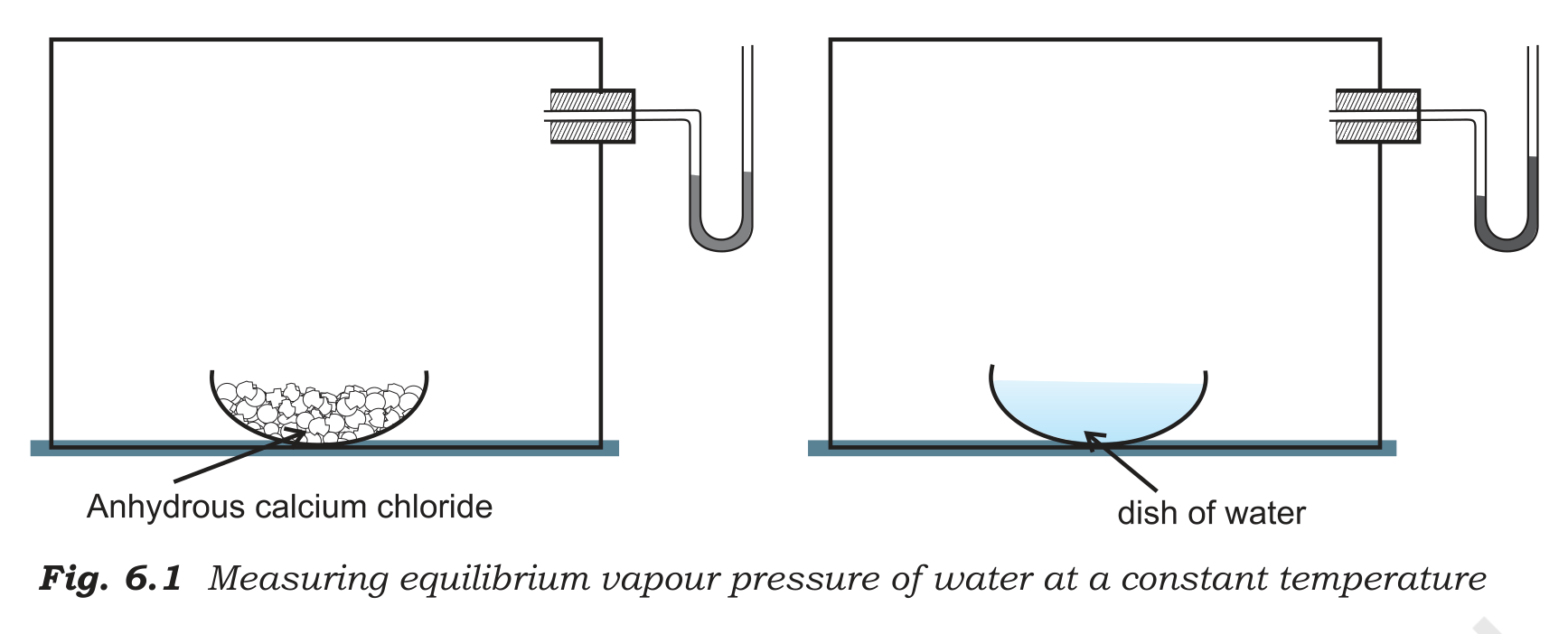
The same is true of physical changes. In a closed vessel, liquid water evaporates and water vapour condenses. When the two rates match, the vapour pressure stops changing and the liquid level stays constant. The measurement of this equilibrium vapour pressure is shown in the figure below: a dish of water in a closed space gives a constant pressure once equilibrium is established.
A chemical reaction once started can approach equilibrium from the reactant side or from the product side, and the final composition is the same either way as long as the temperature is the same. The graph below shows the approach to equilibrium: the product concentrations rise and the reactant concentrations fall until both level off. The curves bend and flatten, and the flat region is the equilibrium state, which looks static on the graph but is not static at the molecular level.
Slideshow, slide 1 of 3. Use the left and right arrow keys to change slides and the space bar to play or pause.
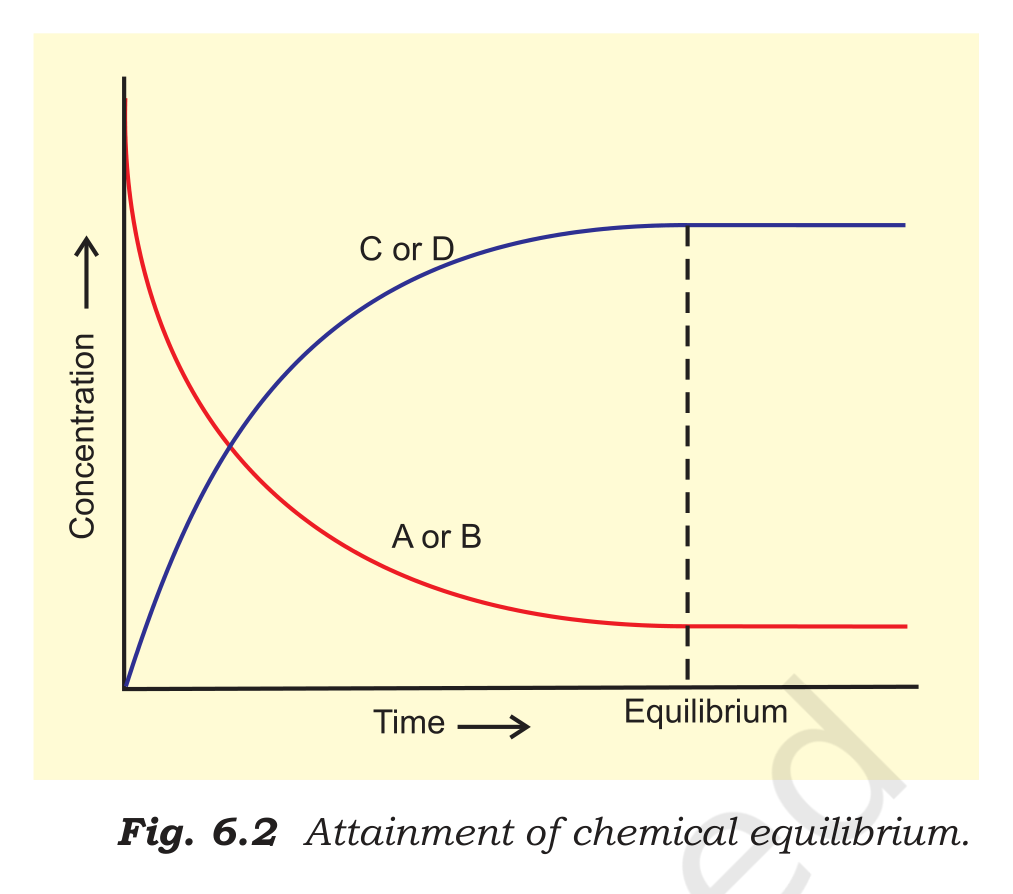
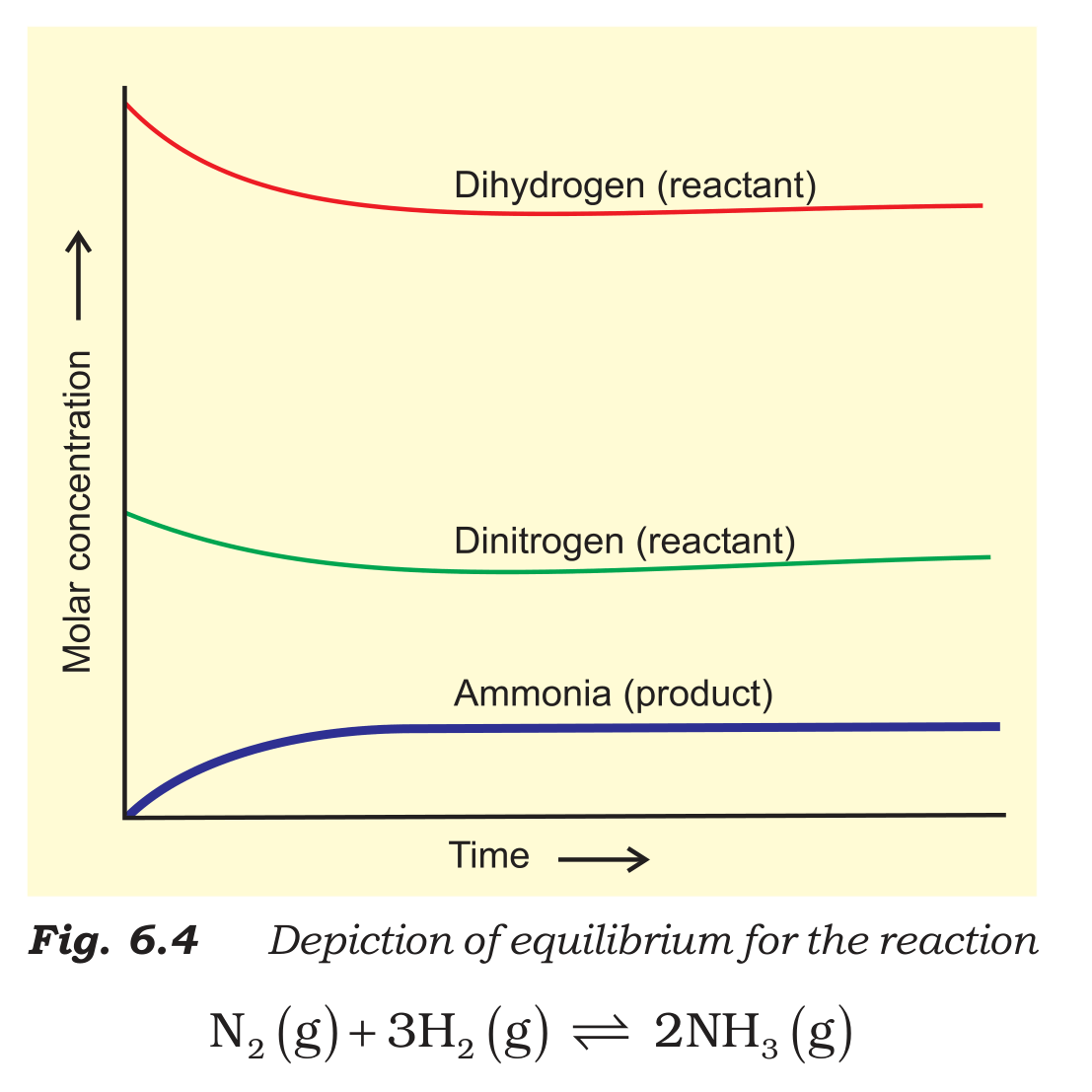
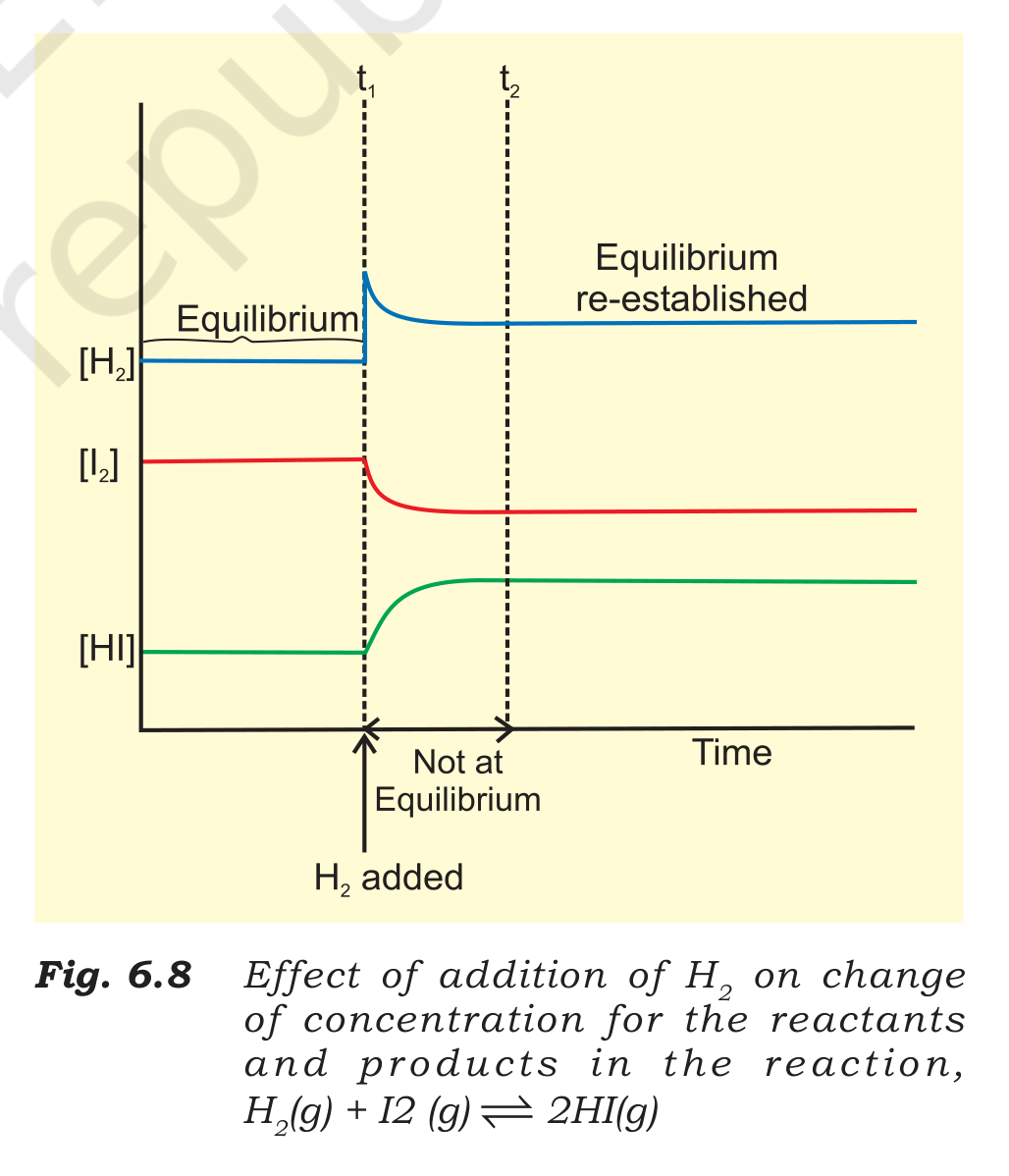
Graph of concentration against time showing the reactants decreasing and the products increasing until both become constant at equilibrium.
2.2 The law of mass action
For a reversible reaction written with small whole number coefficients, the equilibrium constant is the product of the product concentrations, each raised to its coefficient, divided by the same product for the reactants. The concentrations are measured at equilibrium and are usually in mol L^-1.
Pure solids and pure liquids are left out of the expression because their concentration is fixed and their activity is taken as one. A gas is included through its partial pressure when the constant is written in pressure form. Water as a solvent is also left out of dilute aqueous equilibria, which is why it does not appear in the expression for the autoionisation of water or for the hydrolysis of an ester.
The magnitude of the equilibrium constant tells how far the reaction has gone. A value much larger than one means the products dominate at equilibrium, a value much smaller than one means the reactants dominate, and a value near one means both are present in comparable amounts.
2.3 Kp and its relation to Kc
For reactions involving gases it is convenient to use partial pressures instead of concentrations. The pressure constant is defined in the same way with partial pressures. Because pressure and concentration are related through the ideal gas equation, the two constants are related by a factor that depends on the change in the number of moles of gas.
The exponent delta n_g is products minus reactants, counting only gaseous species. For the synthesis of ammonia the reaction N2 + 3H2 giving 2NH3 has delta n_g equal to -2, so Kp equals Kc divided by RT squared.
2.4 The reaction quotient and the direction of reaction
At any moment, not necessarily at equilibrium, the same ratio can be calculated from the current concentrations. This ratio is the reaction quotient Q. Comparing Q with K tells which way the reaction must move to reach equilibrium.
The quotient rule is worth remembering in words: if there are too few products, the reaction moves forward to make more; if there are too many, it moves backward. The same comparison decides whether a solution is supersaturated, exactly saturated or unsaturated with respect to a sparingly soluble salt.
2.5 Gibbs energy and the equilibrium constant
Thermodynamics ties the constant to energy. The standard free energy change maps onto K through a logarithm, while the actual free energy change at any composition also involves the reaction quotient.
At equilibrium delta G is zero and Q equals K, so the second relation reduces to the first. A large negative standard Gibbs energy change makes K large, so the products dominate; a positive value makes K small. The relation also shows that equilibrium does not require delta G standard to be zero, only the actual delta G.
A worked miniature shows how the pieces fit together. For the reaction H2 + I2 giving 2HI at a temperature where Kc is 50, suppose the equilibrium concentrations are 0.11 M hydrogen, 0.11 M iodine and 0.78 M hydrogen iodide. Substituting into the expression gives 0.78 squared divided by 0.11 times 0.11, which is 50, so the numbers are consistent. If the measured concentrations were instead 0.20, 0.20 and 0.78, the quotient would be 15.2, which is smaller than K, and the system would have to produce more hydrogen iodide to reach equilibrium. This single calculation combines the law of mass action, the constant, and the direction test.
Common mistake
The equilibrium constant changes only with temperature. Adding more of a reactant, changing the pressure, or adding a catalyst shifts the position of equilibrium but leaves K unchanged. A temperature change alters K itself because it changes the standard Gibbs energy change.