

Concepts: alkenes and their addition and oxidation reactions
Hydrocarbons30 min readLesson 3 of 7
3.1 Structure of the double bond
An alkene has a carbon-carbon double bond made of one sigma bond and one pi bond. Both carbon atoms are sp2 hybridised, so the molecule is planar around the double bond and the bond angles are close to 120 degrees. The pi bond is formed by the side-by-side overlap of the unhybridised p orbitals, and its electron cloud lies above and below the plane of the molecule. The pi electrons are less tightly held than the sigma electrons, which is why alkenes are electron rich and are attacked by electrophiles.
Rotation about the double bond is not possible without breaking the pi bond, and this restriction is the reason alkenes show geometrical isomerism. When each carbon of the double bond carries two different groups, two arrangements exist: the cis form has the similar groups on the same side, and the trans form has them on opposite sides. Alkenes also show structural isomerism, because the position of the double bond or the branching of the chain can change. C4H8, for example, has but-1-ene, but-2-ene and 2-methylprop-1-ene as structural isomers, and but-2-ene adds the cis and trans geometrical forms.
A test follows from the pi bond: cold dilute potassium permanganate solution is decolourised and gives a vicinal glycol, and bromine water is also decolourised. Both reactions are used to distinguish an alkene from an alkane, because the alkane has no pi bond to attack.
3.2 Addition reactions
Hydrogen adds across the double bond in the presence of nickel, palladium or platinum, and the product is the corresponding alkane. The reaction is the basis of the hardening of vegetable oils, in which unsaturated chains are converted into saturated ones. When the hydrogenation is stopped part way with a partially deactivated catalyst such as Lindlar catalyst, the product is a cis alkene.
Halogens add to give vicinal dihalides, and the reaction with bromine is the familiar decolourisation test. Hydrogen halides add to give haloalkanes. For an unsymmetrical alkene such as propene the addition could place the halide on either carbon, and the Markovnikov rule states that the hydrogen goes to the carbon that already has more hydrogen atoms, while the halogen goes to the carbon with fewer hydrogen atoms. The reason is the stability of the intermediate carbocation: the more substituted carbocation, which is a secondary or tertiary one, is more stable than a primary carbocation, so the route through it is faster.
The peroxide effect, also called the anti-Markovnikov addition or Kharasch effect, is seen when HBr is added to an unsymmetrical alkene in the presence of a peroxide. The product has the bromine on the carbon with more hydrogen atoms, the opposite of the Markovnikov product. The effect is observed only with HBr and not with HCl or HI, because the free radical chain that produces it requires the H-Br bond to break in the right way.
Water adds in the presence of an acid catalyst to give an alcohol following the Markovnikov orientation, so propene gives propan-2-ol. Dilute sulphuric acid can be used to convert an alkene into an alcohol on an industrial scale.
3.3 Oxidation and ozonolysis
With cold dilute alkaline potassium permanganate the alkene gives a vicinal glycol, and the purple colour of the reagent disappears. With acidic permanganate or acidic dichromate the carbon skeleton is broken at the double bond, and the products are ketones and carboxylic acids depending on the substituents present. The reaction is vigorous and can be used to find the position of the double bond from the fragments.
Ozonolysis is a milder and more useful cleavage. Ozone adds to the double bond to form an ozonide, and the ozonide is then decomposed with zinc and water; the double bond is completely broken and each carbon of the double bond becomes a carbonyl carbon. A carbon with two alkyl groups gives a ketone, a carbon with one alkyl group and one hydrogen gives an aldehyde, and a terminal carbon gives formaldehyde. Working backwards from the carbonyl products is the standard method for locating the double bond in an unknown alkene, and the exercise questions on ozonolysis are all of this type.
3.3.1 Physical behaviour and stability
Alkenes are slightly polarisable and are insoluble in water but soluble in organic solvents, and their boiling points rise with the size of the molecule like those of alkanes. The cis and trans isomers of the same alkene differ in their physical constants because the cis form is less symmetrical and has a small dipole moment, while the trans form is more symmetrical and packs better. The stability of an alkene increases as the number of alkyl groups attached to the double bond increases, because the alkyl groups release electron density towards the double bond by hyperconjugation and the inductive effect, and the more substituted alkene is therefore the more stable one. This rule is used to predict the major product when an unsymmetrical alkene reacts with an acid or when an alkene can be formed in more than one way by elimination.
Slideshow, slide 1 of 3. Use the left and right arrow keys to change slides and the space bar to play or pause.
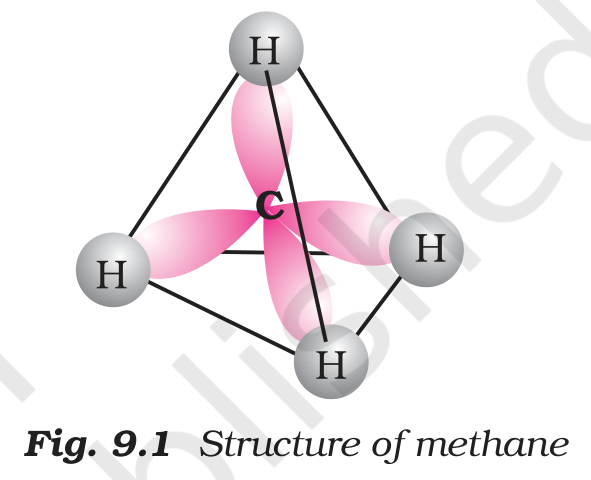
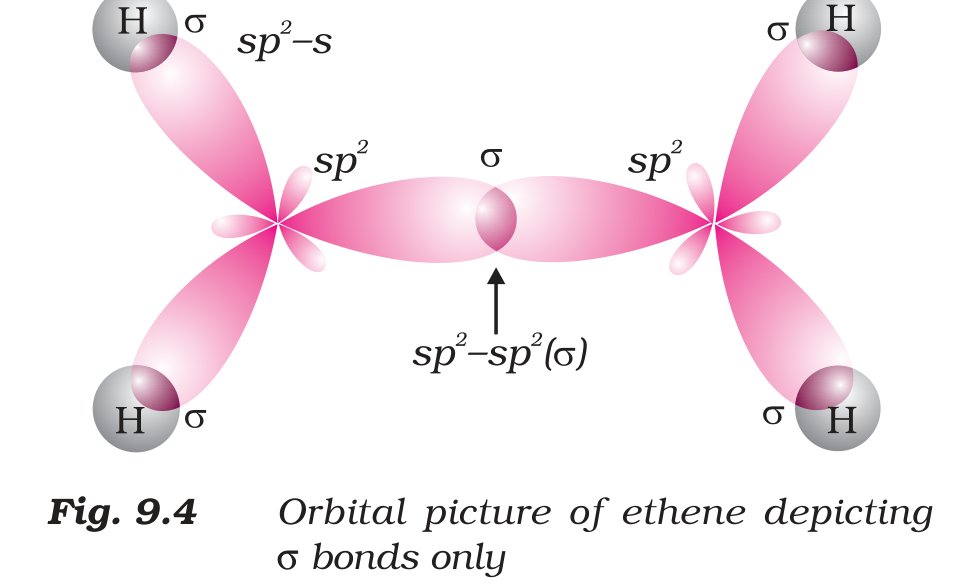
Fig. 9.1 Structure of methane showing the tetrahedral arrangement of the four hydrogen atoms around the central carbon
Exam
For a Markovnikov question, draw the two possible products, identify the more stable carbocation, and then state the major product; do not just quote the rule. For the peroxide effect, always mention that it works for HBr only. For ozonolysis, write the structures of the carbonyl products and then join the two fragments by a double bond to recover the alkene. For the unsaturation test, give the observation as well as the reagent: potassium permanganate loses its purple colour, and bromine water loses its orange colour.
Common mistake
Do not say that the double bond permits free rotation; the restriction is the whole reason for geometrical isomerism. Do not apply the peroxide effect to HCl or HI, because it is observed only with HBr. Do not write that ozonolysis gives carbon dioxide for every terminal carbon, because a terminal carbon of the double bond gives formaldehyde, and only a carbon with three alkyl groups would give a ketone with no hydrogen. Also do not forget the zinc and water step, since the ozonide must be decomposed before the carbonyl products are obtained.