

Concepts: alkynes and aromatic hydrocarbons
Hydrocarbons30 min readLesson 4 of 7
4.1 Structure and reactions of alkynes
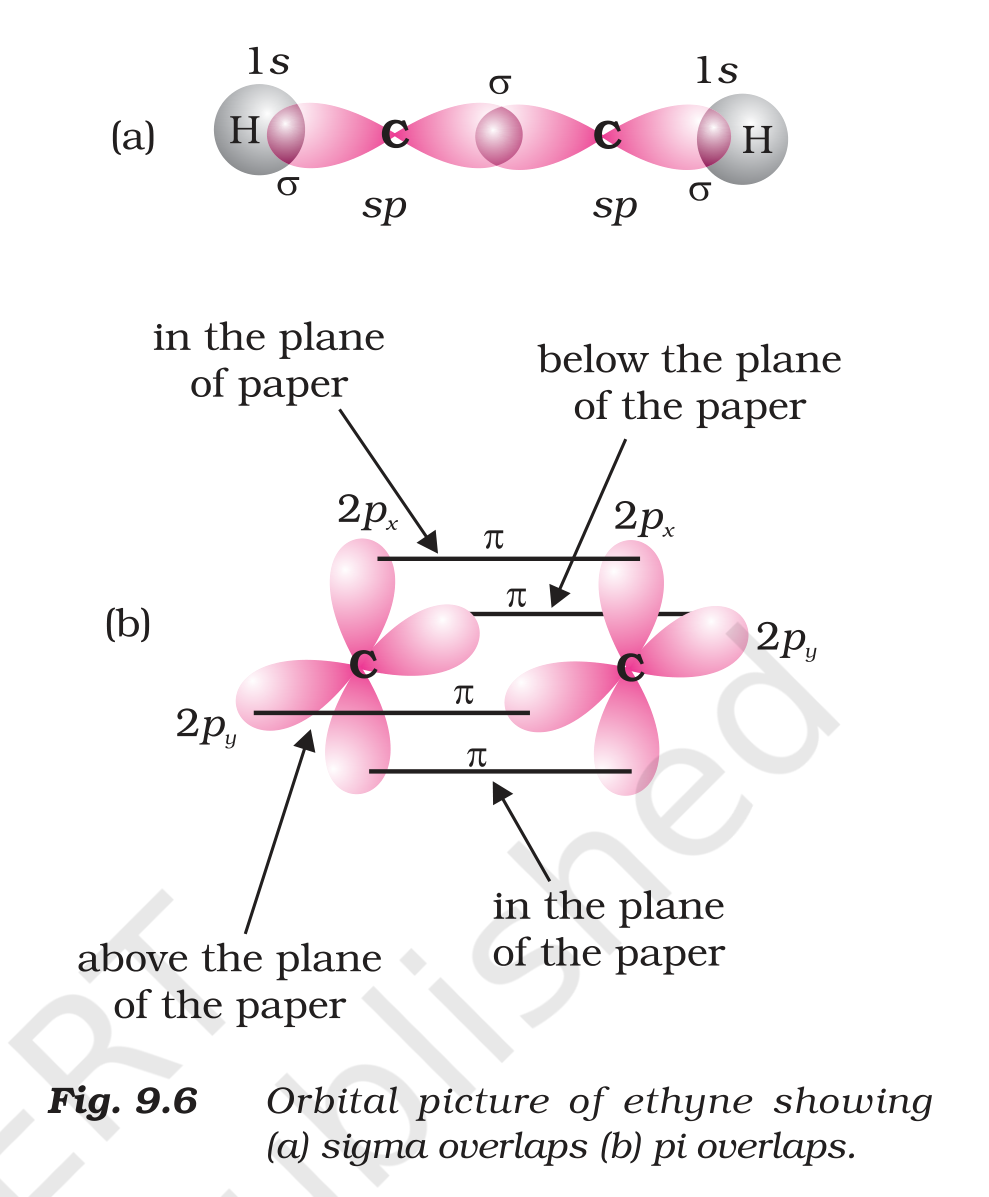
An alkyne contains a carbon-carbon triple bond made of one sigma bond and two pi bonds. Both carbon atoms are sp hybridised, so the molecule is linear around the triple bond and the bond angle is 180 degrees. Ethyne is the simplest alkyne, and the two pi bonds are perpendicular to each other and surround the sigma bond like a cylinder of electron density.
The most characteristic property of a terminal alkyne is the acidity of the hydrogen on the triple bonded carbon. Because an sp hybridised carbon is more electronegative than an sp3 carbon, the C-H bond in a terminal alkyne is polarised, and the hydrogen can be removed by a strong base or by sodium metal. The resulting acetylide ion is stable enough to be formed, and the reaction with sodium gives sodium acetylide and hydrogen gas. Terminal alkynes also react with ammoniacal silver nitrate or ammoniacal cuprous chloride to give a precipitate of the metal acetylide, which is a test for a terminal triple bond; an internal alkyne has no such hydrogen and gives no precipitate.
Alkynes show addition reactions like alkenes, but each triple bond can add two molecules of the reagent. Hydrogenation with nickel, palladium or platinum gives the alkane, while controlled hydrogenation over Lindlar catalyst gives a cis alkene and reduction with sodium in liquid ammonia gives a trans alkene. Hydrogen halides add following the Markovnikov rule, and two molecules can add to give a geminal dihalide. Water adds in the presence of mercuric sulphate and dilute sulphuric acid, and the enol that first forms rearranges to a carbonyl compound; ethyne gives acetaldehyde and other alkynes give ketones. Oxidation with acidic permanganate cleaves the triple bond and gives carboxylic acids or carbon dioxide at the ends, and ozonolysis also cleaves it.
4.2 Benzene and aromaticity
Benzene has the formula C6H6 and a ring of six carbon atoms. Each carbon is sp2 hybridised, so the ring is planar and the bond angles are 120 degrees. Every carbon has one unhybridised p orbital, and the six p orbitals overlap side by side above and below the ring plane to give a delocalised cloud of six pi electrons. The actual molecule is a resonance hybrid of the two Kekule structures, and all six carbon-carbon bonds are equal in length, between the length of a single and a double bond. This delocalisation makes benzene unusually stable, and the extra stability is called resonance energy.
The Huckel rule states the conditions for aromaticity: the ring must be planar, there must be complete conjugation around the ring, and the ring must contain 4n plus 2 pi electrons, where n is a whole number. Benzene has six pi electrons, so n equals one and the ring is aromatic. Cyclooctatetraene has eight pi electrons, which does not fit 4n plus 2, and it is also not planar, so it is not aromatic.
4.3 Electrophilic substitution
Because benzene is electron rich, it is attacked by electrophiles. Substitution rather than addition is favoured, because substitution restores the aromatic ring, while addition would destroy the delocalisation and lose the resonance energy. The common reactions are nitration, sulphonation, halogenation, Friedel-Crafts alkylation and Friedel-Crafts acylation. For nitration the two concentrated acids are mixed and the active electrophile that results is the nitronium ion. Sulphonation uses concentrated sulphuric acid or fuming sulphuric acid and gives benzene sulphonic acid. Halogenation needs a Lewis acid such as ferric bromide or aluminium chloride, and gives chlorobenzene or bromobenzene. Friedel-Crafts alkylation uses an alkyl halide with anhydrous aluminium chloride and gives an alkyl benzene, while acylation uses an acyl chloride with aluminium chloride and gives an aromatic ketone.
A substituent already present on the ring controls where the next group goes. Activating groups such as the hydroxyl, amino and alkyl groups increase the electron density and direct the incoming electrophile to the ortho and para positions. Halogens are deactivating because of their inductive withdrawal, but they still direct to ortho and para because of resonance donation. Deactivating groups such as the nitro, carboxyl, cyano and sulphonic acid groups withdraw electron density and direct the electrophile to the meta position.
4.4 Carcinogenicity and toxicity
Benzene and the polynuclear hydrocarbons that contain more than two fused benzene rings are toxic and are cancer producing, or carcinogenic. These polynuclear hydrocarbons are formed during the incomplete combustion of organic materials such as tobacco, coal and petroleum. They enter the body, undergo biochemical reactions and damage DNA, which can lead to cancer. This is one reason smoking and exposure to soot and coal tar are health hazards, and it is the practical reason the aromatic part of the chapter ends with a warning about toxicity.
Exam
For the alkyne acidity question, link the sp hybridisation of the carbon to the electronegativity and then to the loss of the hydrogen. For the aromaticity question, check three things in order: planarity, complete conjugation and 4n plus 2 pi electrons. For a substitution question, give the electrophile and the catalyst with the product: nitronium ion with sulphuric acid for nitration, and aluminium chloride with the halogen for halogenation. For directive effects, state whether the group is activating or deactivating and whether it directs ortho and para or meta.
Common mistake
Do not say that every alkyne has an acidic hydrogen, because the hydrogen is acidic only when it is attached to a terminal triple bonded carbon. Do not call benzene a simple cycloalkene; its six pi electrons are delocalised, so it does not give the addition reactions of an alkene. Do not write that benzene decolourises bromine water readily by addition, because the substitution needs a Lewis acid and the ring stays intact. Do not say that halogens are activating groups simply because they direct ortho and para; their inductive effect makes them deactivating overall.