

Concepts: electronic effects and ion stability
Organic Chemistry – Some Basic Principles and Techniques22 min readLesson 4 of 7
4.1 The inductive effect
The inductive effect is the permanent displacement of the electrons of a sigma bond toward the more electronegative atom. A group that pulls electrons toward itself is said to have a minus I effect, and a group that pushes electrons away has a plus I effect. The effect is transmitted through the sigma framework and weakens quickly with distance, so it matters most for atoms close to the group.
Halogens show a strong minus I effect, and the nitro group and the carboxyl group also withdraw electrons. Alkyl groups show a weak plus I effect because of their slight electron releasing character compared with hydrogen, and this is why alkyl-substituted carbocations are more stable than the parent carbocation. The inductive effect is a static effect in the ground state, not a temporary polarisation during a reaction.
For carbanions the situation is reversed. Alkyl groups destabilise the negatively charged carbon because they push electron density toward a site that is already electron rich. The stability of alkyl carbanions therefore follows the order methyl, then ethyl, then isopropyl, then tert butyl, and this is often tested directly as a statement question.
4.2 Resonance and the electromeric effect
The resonance effect is the delocalisation of pi electrons through a conjugated system. When a group donates pi electrons into the conjugated chain it has a plus R effect, and when it withdraws pi electrons it has a minus R effect. The actual molecule is a hybrid of the contributing structures, and the hybrid is more stable than any single structure. Resonance stabilises both carbocations and carbanions, provided the charge can be delocalised onto more atoms.
The electromeric effect is a temporary effect that operates only when a reagent approaches, in which the pi electrons shift completely to one atom of a multiple bond to form a carbocation or carbanion. It explains the first step of addition to alkenes, in which the approaching electrophile causes the pi electrons to be displaced and creates a carbocation intermediate.
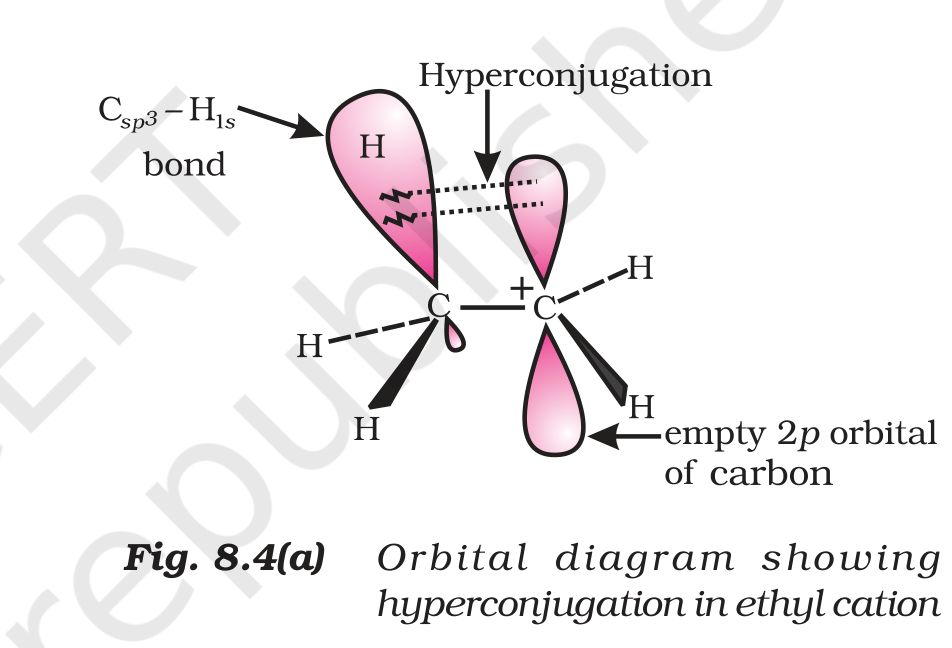
The figure shows the orbital picture of hyperconjugation in the ethyl cation. The sigma electrons of an adjacent carbon-hydrogen bond overlap with the empty p orbital of the positively charged carbon, which spreads the charge and lowers the energy. This interaction is called hyperconjugation and it explains why the ethyl cation is more stable than the methyl cation.
4.3 Stability of intermediates
Carbocations are electron deficient and are stabilised by electron releasing groups, by resonance and by hyperconjugation. The order of stability is tertiary, then secondary, then primary, then methyl, and a benzyl or allyl carbocation is stabilised by resonance beyond what the carbon skeleton alone would give. The more stable the carbocation, the faster the reaction that forms it, which is why tertiary halides react fastest in substitution reactions that go through a carbocation.
Carbanions are electron rich and are stabilised by electron withdrawing groups and by resonance. Their stability order is the reverse of that for carbocations, so methyl is the most stable simple alkyl carbanion and tert butyl the least. Free radicals fall between the two extremes and are stabilised by both electron releasing groups and resonance.
These trends decide regiochemistry. In the addition of a hydrogen halide to an alkene, the proton adds to the carbon that leaves the more stable carbocation, which is the Markovnikov rule. In the addition of water to an alkene, the same logic puts the hydroxyl on the more substituted carbon. The rule is therefore a consequence of the stability order that the electronic effects predict.
Warning
Do not confuse the inductive effect with the resonance effect. Inductive effects act through the sigma framework and fall off with distance; resonance acts through the pi system and can reach far along a conjugated chain. A group can have both effects, and the two may point in opposite directions.
4.4 Worked examples
Compare the stability of the carbocations CH3 plus, CH3CH2 plus and (CH3)3C plus. The methyl cation has no alkyl group to release electrons, the ethyl cation has one and the tert butyl cation has three, so the order of stability is tert butyl, then ethyl, then methyl. The same order appears when counting the number of hyperconjugative hydrogen atoms: the tert butyl cation has more of them than the ethyl cation.
Compare the acidity of acetic acid and its substituted derivatives. A group with a minus I effect withdraws electrons, which stabilises the negative charge of the carboxylate anion and increases the acidity. A group with a plus I effect destabilises the anion and decreases the acidity. This is why trichloroacetic acid is much stronger than acetic acid.
Compare the stability of allyl and benzyl carbanions with the simple alkyl carbanions. The allyl and benzyl ions have resonance structures in which the negative charge is delocalised onto other carbons, so they are much more stable than the monoatomic carbanion, even though an alkyl group might release electrons inductively. The resonance effect usually dominates over the inductive effect in conjugated systems. A second worked comparison is the acidity order of the halogen substituted acetic acids: fluorine withdraws electrons most strongly by the inductive effect, so fluoroacetic acid is the strongest of the three haloacetic acids, and iodine gives the weakest. The order follows the electronegativity of the halogen, and it is a good test of whether the inductive effect has been understood as a distance dependent sigma effect.