

Concepts: purification and quantitative analysis
Organic Chemistry – Some Basic Principles and Techniques24 min readLesson 5 of 7
5.1 Purification techniques
The first step with an organic product is purification. Filtration, crystallisation and sublimation are used for solids, while distillation and extraction are used for liquids. Crystallisation works when the compound is much less soluble in a cold solvent than in a hot one, and it separates the compound from small amounts of impurities. Sublimation works for compounds that vaporise without melting, such as camphor and naphthalene.
Distillation is used for liquids. Simple distillation separates a volatile liquid from a non-volatile impurity or from a liquid with a large difference in boiling point. Fractional distillation uses a fractionating column and separates liquids with close boiling points, and it is the method used in petroleum refining. Distillation under reduced pressure is used for liquids that decompose at their normal boiling point, because lowering the pressure lowers the boiling temperature.
Steam distillation is used for compounds that are volatile in steam and immiscible with water, such as essential oils. The compound and water are heated together, and the mixture boils at a temperature below the boiling point of water because the total vapour pressure is the sum of the two. The distillate is a mixture of water and the volatile compound, and the two are separated by a separating funnel.
5.2 Extraction and chromatography
Solvent extraction separates a compound from a mixture by using two immiscible solvents and the difference in solubility. The compound distributes itself between the two layers, and the layer containing more of it is separated. Repeated extraction with small portions of solvent is more efficient than a single extraction with the same total volume, which is the principle behind differential extraction.
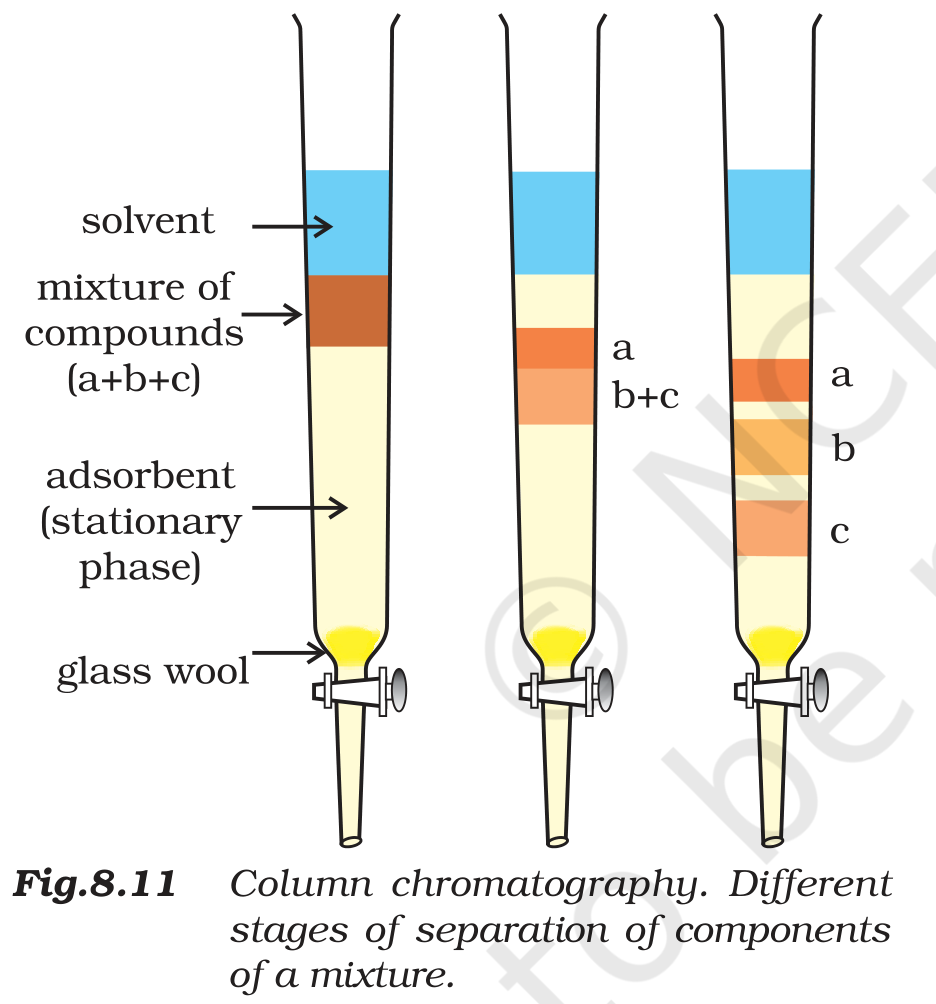
Chromatography separates components of a mixture by passing them through a stationary phase and a mobile phase. In column chromatography the stationary phase is a solid adsorbent such as alumina or silica and the mobile phase is a solvent. In thin layer chromatography the stationary phase is a thin film on a plate, and in paper chromatography it is water held in the paper, with partition between the water and the mobile solvent as the principle.
The figures gallery below shows the purification set-ups from the chapter: simple distillation, differential extraction, column chromatography and the Dumas method for nitrogen estimation. Read each diagram together with its printed caption.
Slideshow, slide 1 of 4. Use the left and right arrow keys to change slides and the space bar to play or pause.
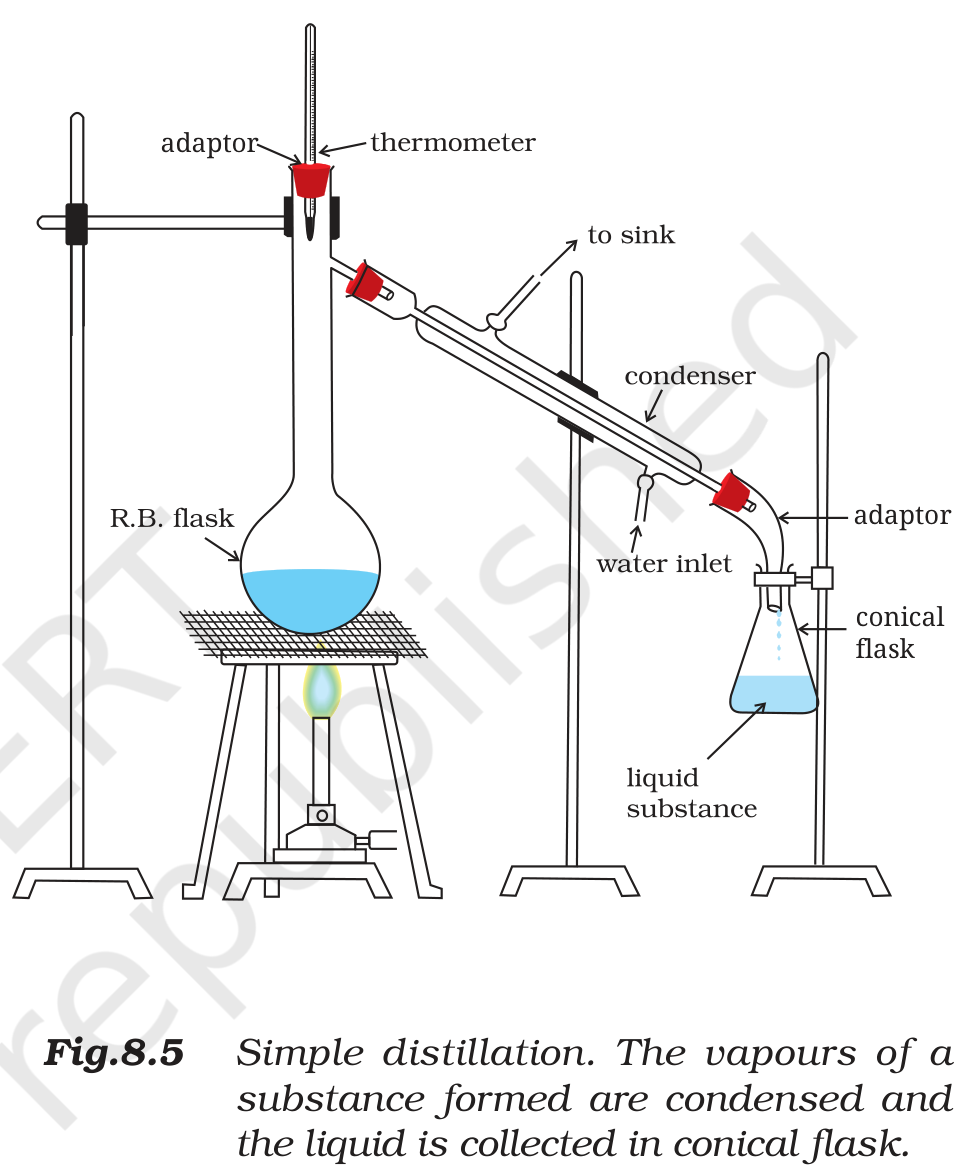
NCERT Figure 8.5: simple distillation set-up with a round bottom flask, condenser and conical flask.
5.3 Quantitative analysis
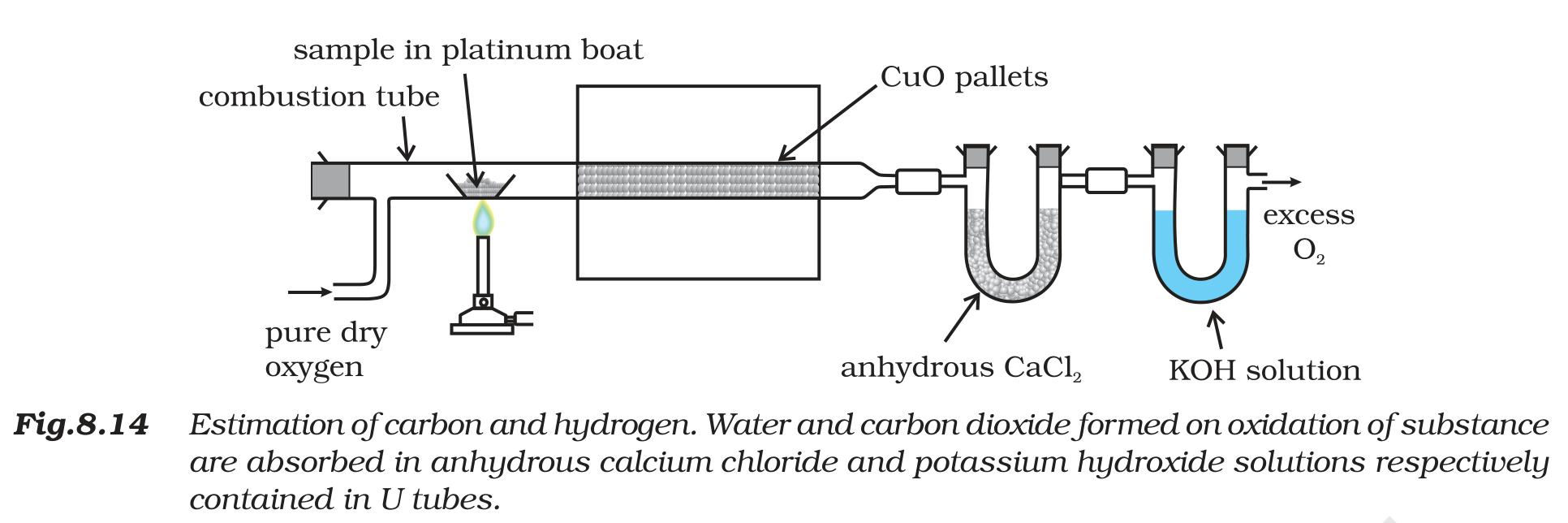
The percentage of carbon and hydrogen is found by burning a known mass of the compound in a stream of oxygen. The carbon dioxide produced is absorbed in potassium hydroxide and the water in calcium chloride, and the increases in mass of the absorbers give the masses of carbon dioxide and water. The mass of carbon is twelve forty-fourths of the carbon dioxide mass, and the mass of hydrogen is two eighteenths of the water mass.
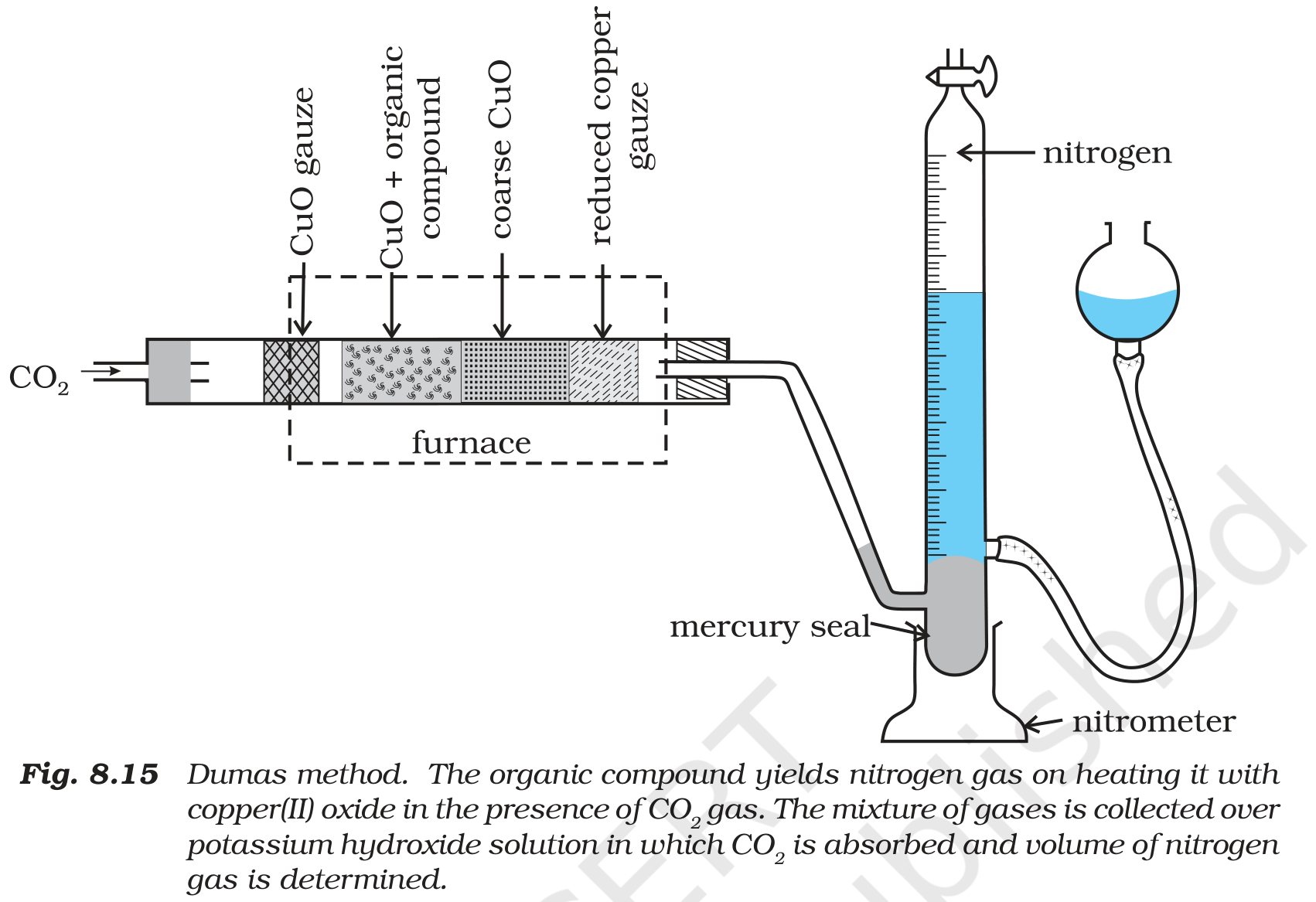
Nitrogen is estimated by the Dumas method or the Kjeldahl method. In the Dumas method the compound is heated with copper oxide in an atmosphere of carbon dioxide, and the nitrogen released is collected over potassium hydroxide solution, which absorbs the carbon dioxide. The volume of nitrogen measured and corrected to standard conditions gives its mass. In the Kjeldahl method the compound is digested with concentrated sulphuric acid to convert nitrogen to ammonium sulphate, and the ammonia liberated by alkali is distilled into a known amount of acid and then back titrated.
Oxygen is usually found by difference, and the percentages of all the elements should add up to one hundred. The empirical formula comes from the mole ratio of the percentages, and the molecular formula comes from the empirical formula and the molar mass. There are also methods for halogens and sulphur, but the carbon, hydrogen and nitrogen methods are the ones most often asked in this chapter. A worked numerical makes the arithmetic clear. Suppose 0.2 g of an organic compound gives 0.44 g of carbon dioxide and 0.18 g of water. The mass of carbon is twelve forty-fourths of 0.44, which is 0.12 g, and the percentage of carbon is 0.12 over 0.2 times 100, which is 60 percent. The mass of hydrogen is two eighteenths of 0.18, which is 0.02 g, and the percentage is 10 percent. If the compound contains only carbon, hydrogen and oxygen, oxygen is the remainder, 30 percent, and the empirical formula is obtained by dividing each percentage by the atomic mass. This is the standard sequence for combustion data.
Chromatography needs a little more care about the principle. In adsorption chromatography the components are held on the surface of the stationary phase with different strengths, while in partition chromatography they distribute themselves between two liquid phases. Paper chromatography is a partition method because the water held in the paper acts as the stationary phase. The ratio of the distance travelled by a component to the distance travelled by the solvent front is called the retention factor, and comparing retention factors of known and unknown samples identifies the components of a mixture.
Exam
In a percentage composition problem, convert the masses of carbon dioxide and water to masses of carbon and hydrogen first, then add the masses and subtract from the sample mass to find oxygen. Doing the subtraction earlier is the usual source of error.