

Concepts: addition rules and applications
Probability24 min readLesson 4 of 6
4.1 The event A or B
The event A or B is the union of the two sets. Counting its outcomes by adding the size of A to the size of B double counts the outcomes common to both, so the probability of the union is the sum of the two probabilities minus the probability of the intersection. This is the general addition rule. When the events are mutually exclusive the intersection is empty, the last term vanishes, and the probabilities simply add. The rule extends to three events with three pairwise intersections subtracted and the triple intersection added back.
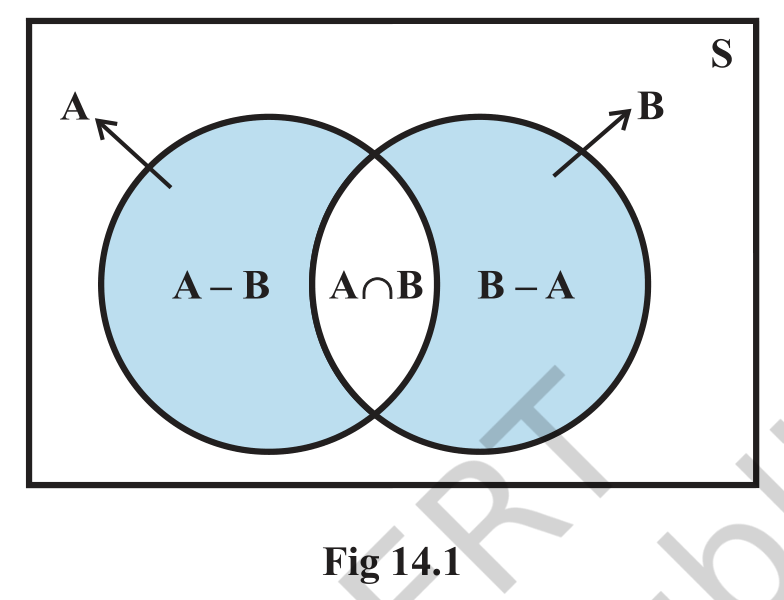
4.2 Reading the rule from the diagram
The Venn diagram shows the sample space cut into three disjoint parts: the part of A outside B, the overlap, and the part of B outside A. Adding the probabilities of A and B counts the overlap twice, so subtracting the probability of the overlap once leaves each region counted exactly once. This picture is the reason the general rule works and it also suggests the practical method: split the union into disjoint pieces before adding. The region outside both circles is the complement of the union, whose probability is 1 minus the probability of the union.
4.3 Worked example: faulty brakes and worn tyres
At a road check, 23 percent of trucks have faulty brakes, 24 percent have badly worn tyres, and 38 percent have at least one of the two problems. Let B be faulty brakes and T be worn tyres. The general rule gives P(B union T) = P(B) + P(T) - P(B intersection T), so 0.38 = 0.23 + 0.24 - x and x = 0.09. Nine percent of the trucks have both problems. The fraction with neither problem is 1 - 0.38 = 0.62. This example shows how the union and the intersection determine each other once two of the three numbers are known.
4.4 Worked example: two events from one pack
A single card is taken from a well shuffled pack of 52. Let A be the event that the card is a king and let B be the event that it is a heart. Four kings and thirteen hearts are present, and the king of hearts is in both groups, so P(A union B) = 4/52 + 13/52 - 1/52 = 16/52 = 4/13. The probability that the card is neither a king nor a heart is 1 - 4/13 = 9/13. If the second event is changed to a red card instead, the overlap is the two red kings and the union probability becomes 4/52 + 26/52 - 2/52 = 28/52 = 7/13. The method is the same each time: add the two counts, then remove the outcomes counted twice.
4.5 Worked example: numbers from 1 to 20
A number is chosen at random from 1 to 20. Let A be the event the number is a multiple of 3 and B the event the number is a multiple of 5. Then A = {3, 6, 9, 12, 15, 18} with six outcomes and B = {5, 10, 15, 20} with four outcomes, while the intersection is {15} with one outcome. The probability of A union B is 6/20 + 4/20 - 1/20 = 9/20. The probability of the complement, that the number is a multiple of neither 3 nor 5, is 1 - 9/20 = 11/20. Listing the sets is safer than trying to count in the head, especially when the intersection is easy to miss.
4.6 Two more union problems
A card is drawn from a pack of 52. Let A be the event the card is black and B the event the card is a face card. There are 26 black cards and 12 face cards, and 6 black face cards, so P(A union B) = 26/52 + 12/52 - 6/52 = 32/52 = 8/13. In a class of 40 students, 22 play cricket, 18 play football and 10 play both. The probability that a randomly chosen student plays at least one game is 22/40 + 18/40 - 10/40 = 30/40 = 3/4, and the probability of playing neither is 1 - 3/4 = 1/4. Both problems use the same two-step method: add the two counts, then subtract the overlap.
4.7 Exercise practice: NCERT questions worked in short
14.1 Question 1 For a die, the event E = {4} and the event F = {2, 4, 6} share the outcome 4, so they are not mutually exclusive. 14.1 Question 2 For a die the events described in the exercise give A = {1, 2, 3, 4, 5, 6} = S for numbers less than 7, and the corresponding unions and intersections follow from the sets. 14.2 Question 1 An assignment of probabilities is valid only when every value lies between 0 and 1 and the values add to 1; any assignment with a negative value or a total different from 1 is rejected. The remaining exercises in 14.1 and 14.2 apply the addition rule and the complement rule to dice, cards, coins and number-selection problems.
Exam
If the question says at least one, use the union and the addition rule. If it says neither or none, take the complement at the end. Reading the wording correctly is half the problem.