

Concepts: sample spaces, events and their types
Probability24 min readLesson 2 of 6
2.1 Random experiments and sample spaces
An experiment is called random when its result cannot be predicted with certainty before it is performed and when the set of possible results is known. Tossing a coin, rolling a die and drawing a card are standard examples. The collection of all possible outcomes is the sample space S. For one toss of a fair coin S is {H, T}; for one throw of a die S is {1, 2, 3, 4, 5, 6}; for two tosses of a coin S has four outcomes, HH, HT, TH and TT, because the order in which the results appear is recorded. Listing the sample space correctly is the first step of every probability problem, and the size of S decides the denominator of the probability.
2.2 Events as subsets
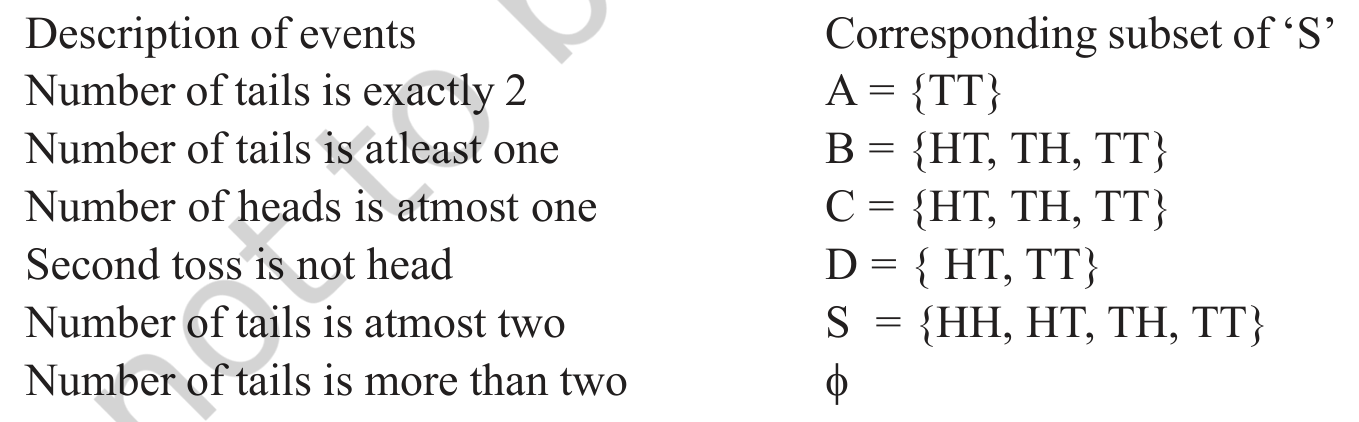
An event is any subset of the sample space. In the two-coin experiment, the event exactly one head is {HT, TH}, the event at least one tail is {HT, TH, TT}, and the event no head is {TT}. The event occurs when the actual outcome belongs to the subset. Because events are sets, the language of sets carries over directly: the complement of A is the set of outcomes not in A, the union of A and B collects the outcomes in either, and the intersection collects the outcomes in both. The difference A minus B is the event that A happens but B does not, which is the same as A intersection with the complement of B.
2.3 Algebra of events
Since events are subsets, the operations on them follow the rules of sets. The event not A is the complement of A and contains every outcome of S that is not in A. The event A or B is the union and the event A and B is the intersection. The event A but not B is the difference and consists of the outcomes that lie in A and not in B. Two identities are worth remembering: the complement of a union is the intersection of the complements, and the complement of an intersection is the union of the complements. These are the statements that a combined requirement fails only when at least one part fails. Writing a verbal condition as a set is the skill that the exercise set trains.
2.4 Types of events
The empty set is the impossible event and the whole sample space is the sure event. A simple or elementary event has exactly one outcome; a compound event has more than one. Two events are mutually exclusive when they have no common outcome, so they cannot happen in the same trial. For a single die, the event an even number and the event an odd number are mutually exclusive. A group of events is exhaustive when their union is the whole sample space, so at least one of them must happen in every trial. When the events of a group are both mutually exclusive and exhaustive, exactly one of them occurs, and their probabilities add to 1.
2.5 Worked example: set operations on a die
For one throw of a die, let A be the event the number is even, B the event the number is a multiple of 3, and C the event the number is less than 3. Then A = {2, 4, 6}, B = {3, 6} and C = {1, 2}. The complement of A is {1, 3, 5}, the union of A and B is {2, 3, 4, 6} and the intersection of A and C is {2}. The event A union C has five outcomes, while A and C each have three, which already shows why the addition rule must subtract the overlap: adding 3 and 3 counts the outcome 2 twice. These small checks build the habit of writing sets before computing probabilities.
2.6 Sure, impossible and complementary events
For a single throw of a die, the event that the number is less than 7 is the sure event, because every outcome satisfies it. The event that the number is greater than 6 is the impossible event, because no outcome satisfies it. The event that the number is even and the event that the number is odd are complements of each other: they are mutually exclusive, and together they fill the sample space. Pairs like these are useful in calculations because the probability of one member is one minus the probability of the other, so only one of the two needs to be counted.
2.7 Worked example: classifying events
A die is rolled once. Let A be the event the number is even, B the event the number is a multiple of 3, and C the event the number is greater than 4. Then A = {2, 4, 6}, B = {3, 6} and C = {5, 6}. The events A and B are not mutually exclusive because 6 belongs to both. The events A and C are also not mutually exclusive, again because of 6. However, A and the event the number is odd are mutually exclusive and exhaustive, so their probabilities add to 1. The event A union B is {2, 3, 4, 6}, and the event A intersection C is {6}. These set translations are used directly in the addition rule.
Common mistake
Two events with probabilities adding to less than 1 are not automatically mutually exclusive. Check the sets for a common outcome before setting the intersection probability to zero.