

Concepts: coordinate axes, planes and octants
Introduction to Three Dimensional Geometry22 min readLesson 2 of 5
2.1 From the plane to space
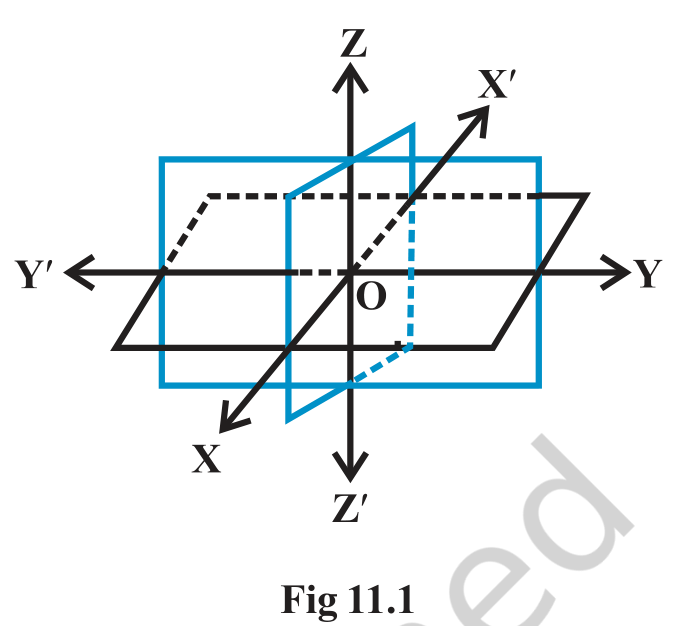
In two dimensions a point is located by two numbers, one along each axis. In space a third axis is needed, perpendicular to both of the others. The positive directions are fixed by convention, and once the axes and origin are chosen, every point of space corresponds to exactly one ordered triple of numbers. This one-to-one correspondence is the foundation of three-dimensional coordinate geometry: geometric conditions become equations in x, y and z, and equations describe sets of points.
The three coordinate planes are important because they are the reference surfaces. A point on the xy-plane has z equal to zero, a point on the yz-plane has x equal to zero and a point on the zx-plane has y equal to zero. On an axis two coordinates vanish: the x-axis has y and z equal to zero, the y-axis has x and z equal to zero and the z-axis has x and y equal to zero. The origin is the only point where all three coordinates vanish.
The octant names are also used in inequality questions. A condition like x greater than zero, y greater than zero and z greater than zero describes exactly the points of the first octant, and each change of an inequality sign moves the region to another octant. When a set of points is described by three inequalities, sketching the octants in order makes the answer immediate. This is the same idea as sketching regions in the plane, extended by one more sign.
Working with coordinates also fixes the meaning of distance in space. A point on the x-axis has the form (x, 0, 0), so its distance from the origin is the absolute value of x; a point on the xy-plane has z equal to zero and its distance from the origin is the plane formula. These observations often shorten an exercise question because one term under the root disappears before any substitution, and they make the signs in the distance formula easier to trust.
Octant questions also appear in reverse. When a description says that x is negative and z is positive while y is free, the set is the union of two octants, and a sketch of the signs shows which two. Reading a point from a description is exactly the same skill as naming the octant from the coordinates, and the exercise set uses both directions to make sure the sign table is understood rather than memorised. A good exercise is to write down the eight sign triples in order and then place a few random points; this fixes the table for good. The sign table is short enough to reconstruct in an exam from the first octant plus the rule that crossing a plane flips one sign.
2.2 The eight octants
The three coordinate planes cut space into eight octants. The signs of the coordinates decide which octant contains the point: all three positive is the first octant, two positive and one negative gives one of the next three, one positive and two negative gives another three, and all three negative gives the eighth octant. When a question gives a point and asks for its octant, write the signs first and then look them up; the magnitudes do not matter.
The division is not equally named in every textbook, so the reliable method is the sign pattern rather than memory of a diagram. NCERT numbers the octants I to VIII in a fixed order, and the table in the formula sheet follows that order. A quick sketch with the x-axis coming out of the page, the y-axis to the right and the z-axis upward makes the signs easy to visualise.
2.3 Exercise 11.1 practice
Question 1 asks for the coordinates of a point on the x-axis, which must have y and z equal to zero. Question 2 asks what can be said about the y-coordinate of a point on the zx-plane, and the answer is that it is zero because the zx-plane contains all points with y equal to zero.
Question 3 names the octants of eight given points. The method is to list the signs of the three coordinates and match them with the sign table. For example, (1, 2, 3) is in octant I, (4, minus 2, 3) is in octant IV and (minus 3, 1, 2) is in octant II. A point with two negative coordinates is in one of the octants III, VII or VIII depending on which coordinate is positive.
Question 4 asks for the plane determined by two axes and for the general form of a point in the xy-plane. The x-axis and y-axis together determine the xy-plane, and points there have the form (x, y, 0). The last part asks how many parts the coordinate planes divide space into, which is the eight octants.
Tip
To identify an octant, write the three signs in order before looking at any table. The magnitudes never matter, only the signs.