

Concepts: distance between two points and exercise practice
Introduction to Three Dimensional Geometry24 min readLesson 3 of 5
3.1 Distance in space
The distance between two points in space is computed with the same idea as in the plane, but with three squared differences under the root. The formula comes from applying the Pythagoras theorem twice: first in the base plane to get the horizontal distance, then in the vertical plane using that distance and the height difference. Every exercise question about the length of a segment, the radius of a sphere or the side of a cube uses this formula.
When one point is the origin, the formula simplifies to the square root of the sum of squares of the coordinates of the other point. When two points differ in only one coordinate, the distance is the absolute difference of that coordinate; this covers points on an axis or on a line parallel to an axis. Checking these special cases is a quick way to catch a formula copied wrongly.
A typical exercise question gives a cube by its vertices and asks for a diagonal or an angle. Since every edge of a cube has the same length, placing one vertex at the origin with edges along the axes turns the geometry into coordinates, and then the distance formula does the rest. The same strategy works for a cuboid with three different edge lengths, and for a parallelepiped when the edges are not perpendicular, where the squared length of the body diagonal is the sum of the squared edge lengths plus twice the products of the edges times the cosines of the angles between them.
A second pattern is the sphere question. The set of points at a fixed distance r from a centre (h, k, l) satisfies (x minus h) squared plus (y minus k) squared plus (z minus l) squared equal to r squared, which is the space version of the circle equation. Determining whether a given point lies inside, on or outside the sphere is then a comparison of the left side with r squared, and this appears in the miscellaneous exercise as a check on coordinates.
Another common question places a point on a coordinate plane and asks for distances to two fixed points. Because one coordinate is zero, the resulting equation is simpler, and the answer is often a point with a simple fraction. Writing the general point of the plane first, and only then imposing the distance condition, keeps the algebra short and avoids solving three equations at once. The same idea covers questions about a point on an axis, where now two coordinates are zero and the equation collapses to a single variable.
Slideshow, slide 1 of 3. Use the left and right arrow keys to change slides and the space bar to play or pause.
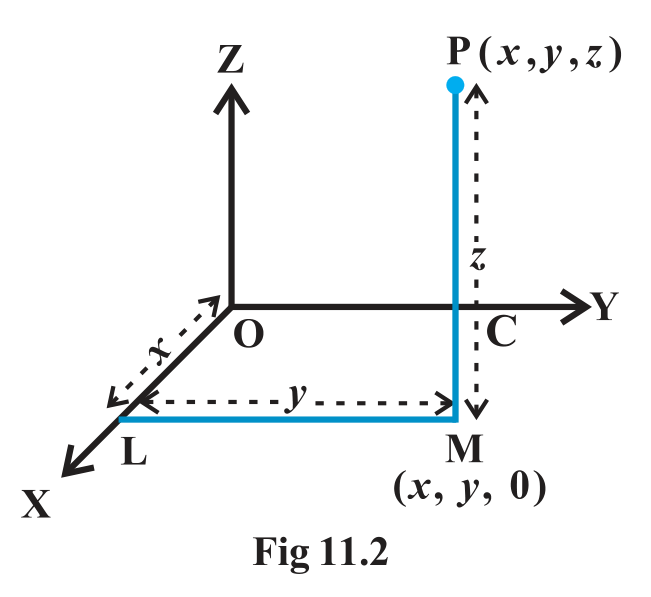
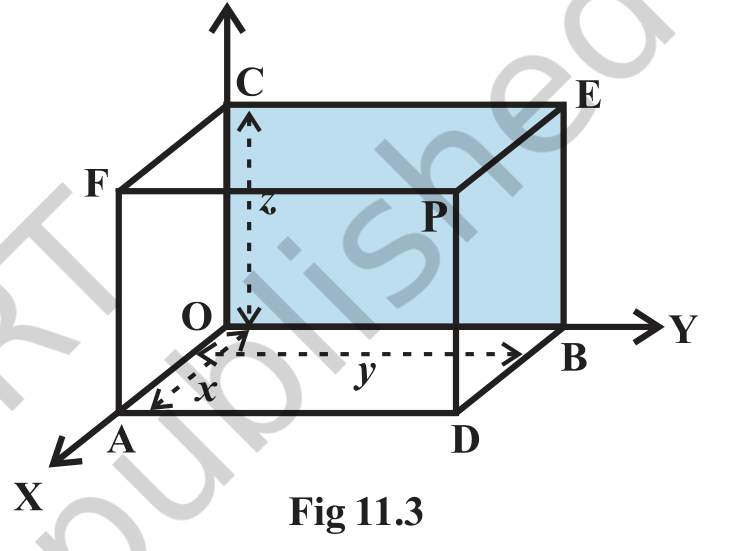
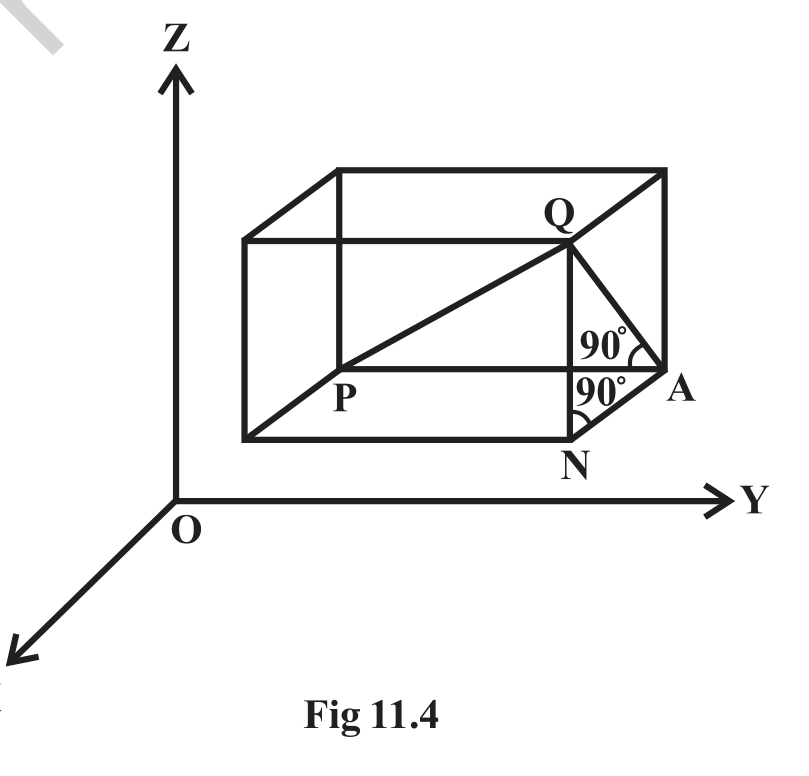
Point P in space with its coordinates x, y and z marked by perpendiculars to the axes and planes
3.2 Midpoint, centroid and collinearity
The mid-point formula in space averages the coordinates of the two endpoints. The centroid of a triangle averages the coordinates of its three vertices. A parallelogram question usually reduces to the statement that the diagonals bisect each other, so the mid-point of one diagonal equals the mid-point of the other. This gives three linear equations for the unknown vertex.
Collinearity can be tested in two ways. The distance test checks whether the largest pairwise distance equals the sum of the other two. The ratio test checks whether one point divides the segment between the other two in a fixed ratio, which also gives the ratio in which it divides the join. Both are acceptable in an exam; the distance test is usually faster when all coordinates are numbers, and the ratio test is required when the question asks for the ratio itself.
A right-angled triangle test in space uses the converse of the Pythagoras theorem: compute the three squared side lengths and check whether the largest equals the sum of the other two. This avoids computing dot products, which belong to the vectors chapter, and it is the method the exemplar expects.
3.3 Exercise 11.2 and miscellaneous practice
Question 1 asks for the distance between two points with the same y and z coordinates, which reduces to the difference of the x-coordinates. Question 2 asks for the distance from the origin to (6, 6, 7), which is the square root of 36 plus 36 plus 49, that is 11.
Question 3 asks whether three given points form an isosceles or right-angled triangle, and computing the three squared distances settles it. Question 5 asks for the points that trisect a segment, which uses the section idea twice: the point one-third of the way and the point two-thirds of the way.
The miscellaneous exercise adds cube and parallelepiped questions. For a cube of known edge placed with one vertex at the origin and edges along the axes, the other vertices are obtained by adding the edge length to one, two or three coordinates. The body diagonal then follows from the distance formula, and the angle questions reduce to comparing squared lengths. A parallelepiped is handled the same way, with three edge vectors instead of one.
Common mistake
Forgetting the z-difference is the standard error in a distance question. Write all three squared differences before adding anything, so a missing coordinate is visible.