

Concepts: distance of a point from a line
Straight Lines22 min readLesson 4 of 6
4.1 Distance from a point to a line
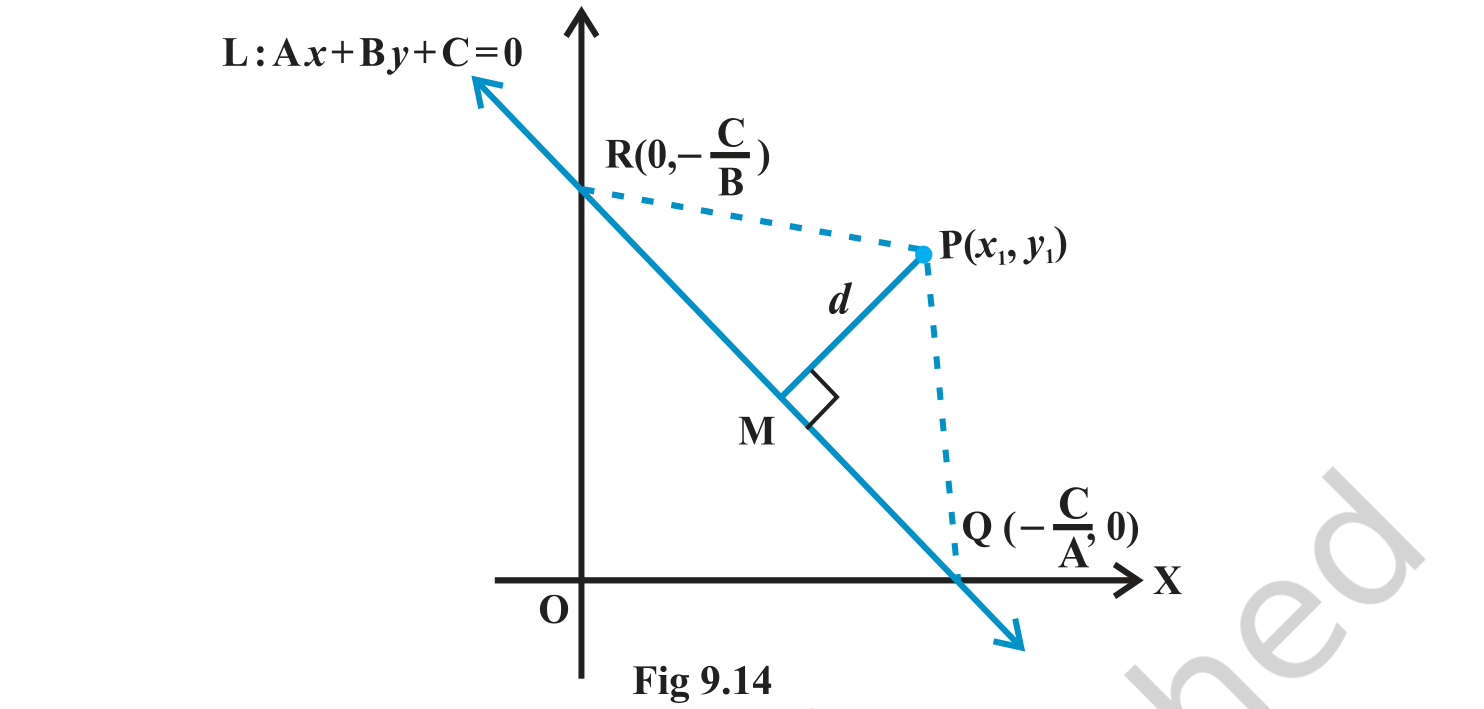
The shortest route from a point to a line runs along the perpendicular, and that length is what the chapter calls the distance. In symbols it is the absolute value of Ax1 plus By1 plus C divided by the square root of A squared plus B squared, once the line is written in general form. The denominator is the length of the normal vector, and the numerator is the value of the line expression at the point.
The signed value of the expression without the absolute value tells which side of the line the point lies on. Points on the same side give the same sign, which is the basis of questions about whether two points are on the same side of a line. The absolute value is for distance only; keep the sign when the question asks about position.
A line in slope-intercept form can be converted to general form before applying the formula, or the formula can be used with the denominator as the square root of 1 plus m squared. Both give the same answer; write the line in general form to avoid mixing the two.
4.2 Distance between parallel lines
Parallel lines have the same coefficients of x and y but different constants. Write both as Ax plus By plus C1 equal to 0 and Ax plus By plus C2 equal to 0, then the distance is the absolute value of C1 minus C2 divided by the square root of A squared plus B squared. If the two equations have different coefficients for the same line family, scale one of them so the coefficients match before subtracting.
A special case is the distance from the origin to a line. Putting the point as the origin in the point-distance formula leaves just the constant over the root, which matches the parallel-line formula with one line through the origin. This is a useful check on the algebra.
The distance between parallel lines is constant, so it can be measured at any point of either line. Choosing the point where a line meets an axis often keeps the arithmetic simple, because one coordinate is zero.
4.3 Foot of the perpendicular and distance along a line
To find the foot of the perpendicular from a point to a line, write the perpendicular line through the point using the negative reciprocal slope, then intersect it with the original line. The distance from the point to that foot is the distance from the point to the line. This construction is the proof behind the distance formula, and it is also the method for problems that ask for the image of a point in a line.
The image of a point in a line is found by taking the foot of the perpendicular and reflecting the point across it. If the foot is M and the point is P, the image P prime satisfies M as the midpoint of P and P prime. Questions about symmetry and about shortest paths with a reflection use exactly this step.
Exercise 9.3 combines the distance formula with area questions. The area of a triangle with a known base on a line and a vertex off the line is half the base times the distance of the vertex from the line, so the distance formula replaces the altitude. This is often quicker than computing all three side lengths.
4.4 Exercise 9.3 practice
The first exercise item pairs the point (2, 3) with the line 3x plus 4y plus 9 equal to 0. Substituting gives the absolute value of 6 plus 12 plus 9, that is 27, over the square root of 25, that is 5, so the distance is 27 by 5. The sign inside the numerator is positive, so the point lies on the side where the expression is positive.
Another item gives the parallel pair 3x minus 4y plus 9 equal to 0 and 6x minus 8y minus 15 equal to 0. Halving the second equation gives 3x minus 4y minus 15 by 2 equal to 0, so the constants are 9 and minus 15 by 2. The difference is 33 by 2 and the denominator is 5, giving the distance 33 by 10.
A third item measures the distance from (1, 1) to the line 12 times (x minus 1) equal to 5 times (y plus 2). Rewriting gives 12x minus 5y minus 22 equal to 0, so the distance is the absolute value of 12 minus 5 minus 22 over 13, which is 15 by 13. Writing the line in standard form first is what keeps the constant correct.
Warning
The denominator uses the square root of A squared plus B squared, not A plus B. Check the denominator before dividing, because it is where most answer choices differ.