

Concepts: slope of a line and angle between lines
Straight Lines24 min readLesson 2 of 6
2.1 Inclination and slope
The inclination of a line is the angle between the positive x-axis and the line, measured anticlockwise. It is always taken between 0 and 180 degrees. A line rising to the right has an acute inclination, a line falling to the right has an obtuse inclination, a horizontal line has inclination 0 and a vertical line has inclination 90 degrees.
The slope is the tangent of this angle. For an acute inclination the slope is positive, for an obtuse inclination it is negative, and for a right angle it does not exist. This is why the slope tells us the direction of the line: equal slopes mean the same direction, and a larger magnitude means a steeper line.
Slideshow, slide 1 of 3. Use the left and right arrow keys to change slides and the space bar to play or pause.
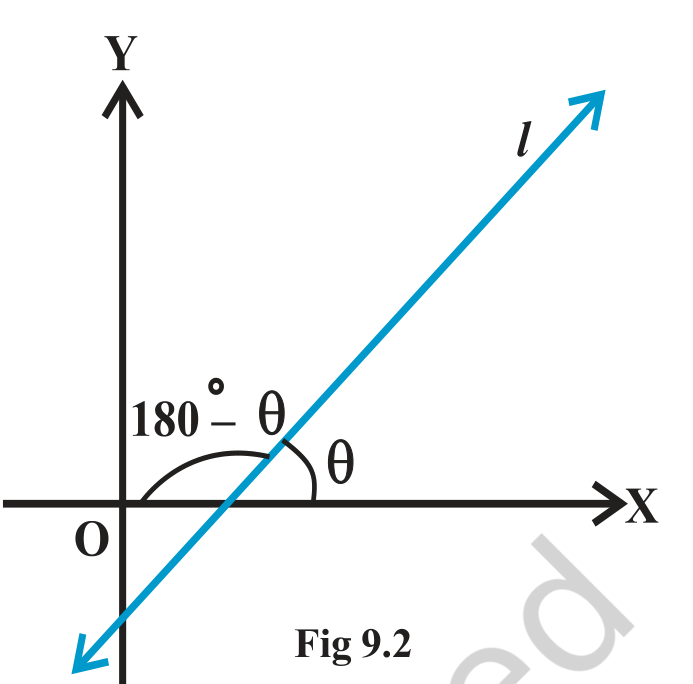
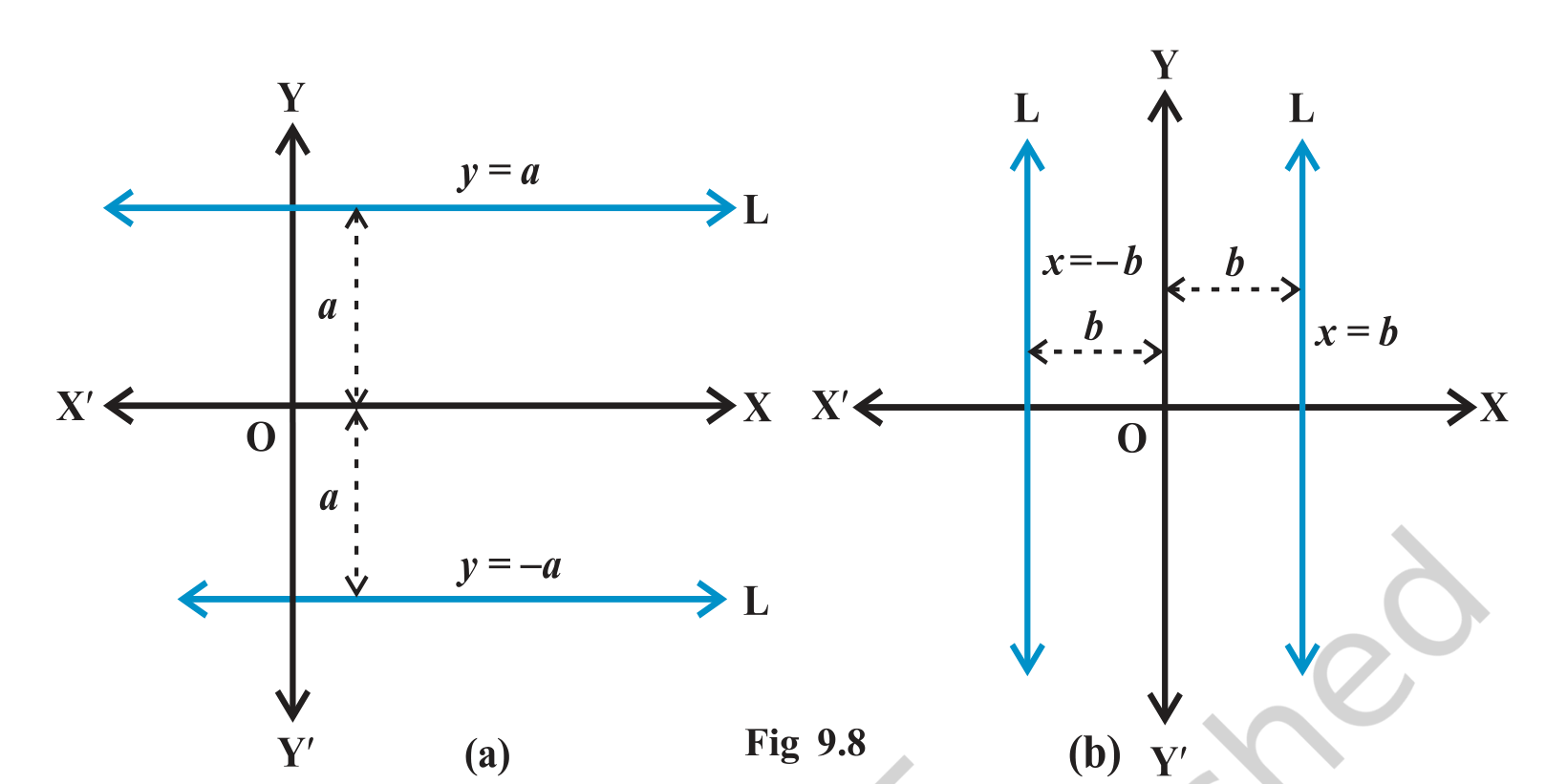
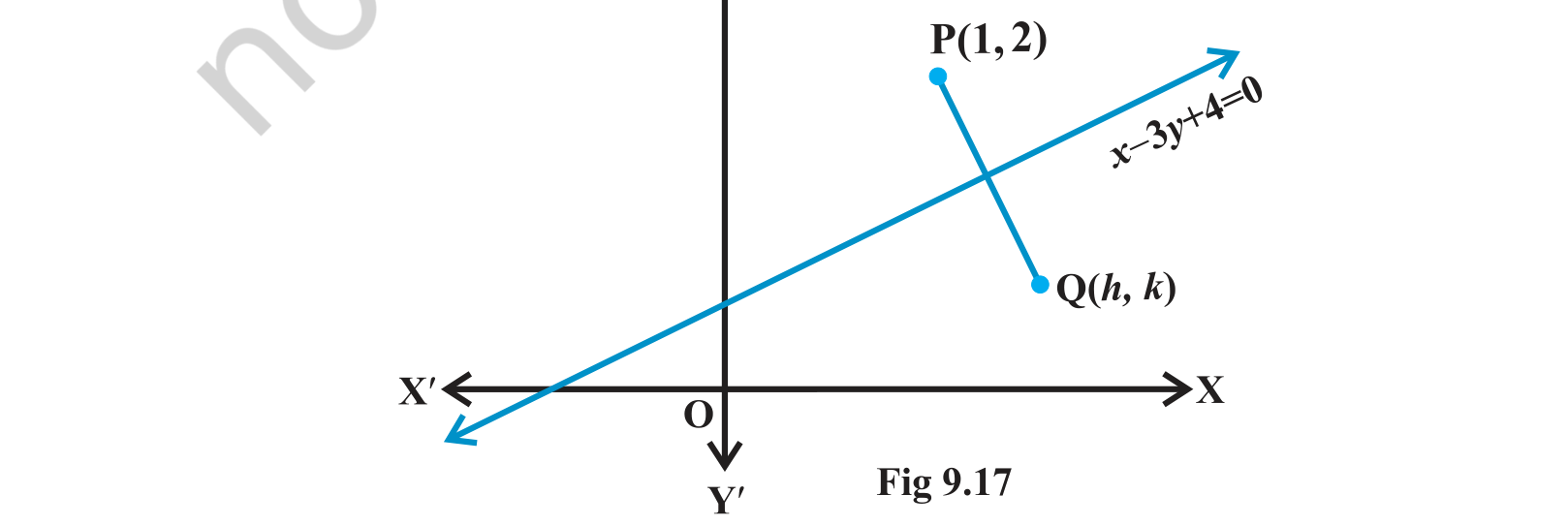
Line l with inclination theta to the positive x-axis and the supplementary angle 180 degrees minus theta marked
2.2 Slope from two points
When two points on a line are known, the slope is the vertical change divided by the horizontal change. This formula also shows why a vertical line has no slope: the horizontal change is zero, so the division is not defined. A horizontal line has zero slope because the vertical change is zero, and the division gives 0.
The order of the points does not matter as long as the subtraction is consistent. Using (x1, y1) and (x2, y2) in one order gives the same value as using them in the reverse order, because both numerator and denominator change sign. A frequent error is reversing only one of them, which gives minus the correct slope.
Three points are collinear exactly when the slope between the first pair equals the slope between the second pair. This is the standard test in Exercise 9.1, where several questions give three points and ask for the value of a parameter that makes them lie on one line.
The same slope test works for a line and a point: a point lies on a line of known slope through a known point exactly when the slope between the two points equals the given slope. In an exercise question that asks for a missing coordinate, this condition gives a linear equation, so the answer is unique unless the line is vertical. For a vertical line the condition is simply that both x-coordinates agree, because the slope formula cannot be used.
2.3 Parallel and perpendicular lines
Lines with equal slopes are parallel, and a pair of horizontal lines or a pair of vertical lines is parallel automatically. Perpendicular lines have slopes whose product is minus 1: if one slope is m, the other is minus 1 by m. A horizontal line is perpendicular to every vertical line, a case the product rule does not catch, so it is checked separately.
The perpendicular slope is what makes the normal to a line easy to write. If a line has slope m, the line perpendicular to it through a given point has slope minus 1 by m; this is the first step in finding the foot of the perpendicular and in reflection problems. Exercise 9.1 tests the condition directly by giving two lines with a parameter and asking for the value that makes them parallel or perpendicular.
2.4 Angle between two lines
The acute angle between two non-vertical lines comes from the tangent formula with the absolute value. The formula is derived by writing the angle as the difference of the two inclinations and expanding the tangent of a difference, so the denominator 1 plus m1m2 is exact, not an approximation. When the denominator is zero, the tangent is infinite, which matches perpendicular lines.
In a question that asks for the angle between lines that are already given in general form, first convert each to slope or use the coefficient form directly: the tangent of the angle is the absolute value of (A1B2 minus A2B1) divided by (A1A2 plus B1B2). Either route gives the same angle, so pick the one with less algebra.
A common exercise is to find the angle between a line and a given axis, or between a line and a line with a known inclination. Draw a rough sketch first: it tells you whether the answer should be acute or obtuse and catches sign errors.
When a question gives the equations in general form, the coefficient route avoids two slope computations: for A1x plus B1y plus C1 equal to 0 and A2x plus B2y plus C2 equal to 0, the tangent of the angle is the absolute value of (A1B2 minus A2B1) divided by (A1A2 plus B1B2). This is the same formula as the slope version after substituting minus A by B, and it saves algebra in a timed paper.
Common mistake
A single point does not fix a line. A line needs a point and a direction, or two points. When a question gives only a point, look for a second condition such as parallelism, perpendicularity or a distance.