

Concepts: sections of a cone and the circle
Conic Sections22 min readLesson 2 of 7
2.1 Cutting the cone
Imagine an infinite double cone with a vertical axis and a plane slicing it. The curve of intersection is the conic. The five possibilities come from the angle of the cut relative to the cone: a cut perpendicular to the axis gives a circle, a cut exactly parallel to one generator gives a parabola, a steeper cut that passes through both nappes gives a hyperbola, and the intermediate slanted cut gives an ellipse. The Greek geometers named these curves from the way they were obtained, and the algebra later gave each one its standard equation.
When the plane passes through the vertex, the intersection collapses. The possible degenerate results are a single point, one line (the plane touching along a generator) and two intersecting lines (the plane passing through the axis). These cases are worth remembering because the general second degree equation can represent them, and a question that asks for the type of a conic needs them in the list.
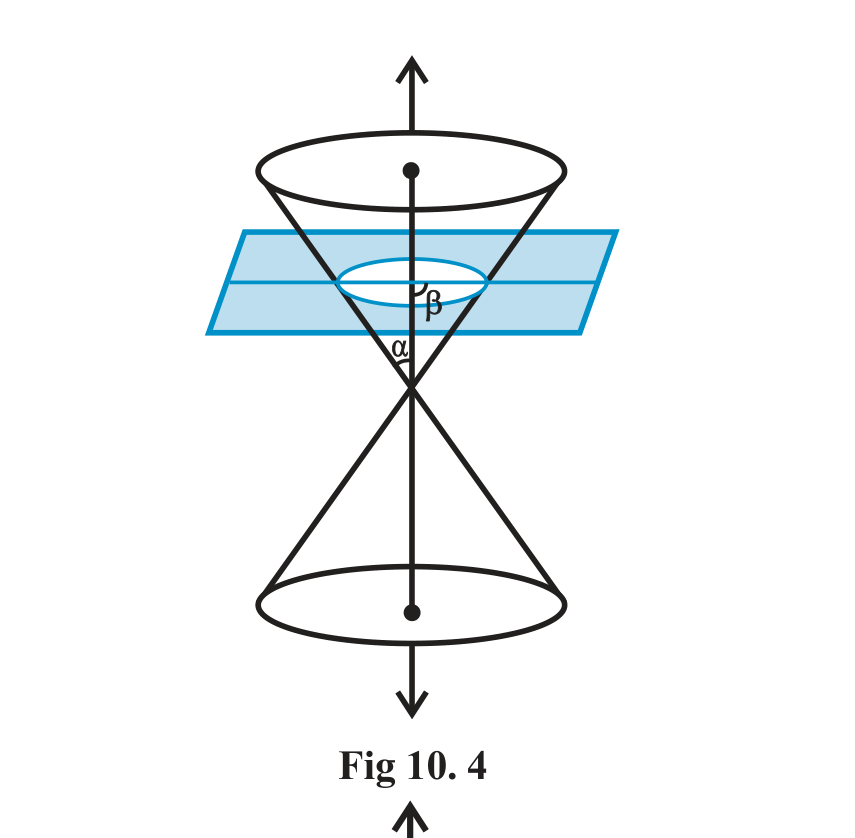
2.2 The circle
A circle is the locus of points at a fixed distance from a fixed point. If the centre is (h, k) and the radius is r, the distance formula gives (x minus h) squared plus (y minus k) squared equal to r squared, which is the standard form. Expanding it gives a general form in which the coefficients of x squared and y squared are equal and the term in xy is absent.
When a circle equation is given in expanded form, complete the squares to recover the centre and radius. For example, x squared plus y squared minus 4x minus 6y plus 9 equal to 0 becomes (x minus 2) squared plus (y minus 3) squared equal to 4, so the centre is (2, 3) and the radius is 2. This single skill covers most of Exercise 10.1.
To find the equation from conditions, substitute the given points and the given centre or radius into the standard form. Three points determine a circle; two points and a centre, or a point and a radius, determine it as well. Keep the unknown radius or centre as a variable until the conditions are all used.
A circle question can also be attacked from three general points: write the equation with unknown centre and radius, substitute all three points, subtract pairs of equations to eliminate the radius squared, and solve the resulting linear system. The centre-on-a-line condition replaces one of those equations with a substitution. Both routes end at the same circle, so choose the one with fewer unknown squares, and check the final equation by substituting the original points. In the exam the substitution route is usually quicker because the squared terms cancel in one step.
2.3 Exercise 10.1 practice
Question 1 asks for the centre and radius of the circle x squared plus y squared minus 4x plus 8y minus 45 equal to 0. Completing the squares gives (x minus 2) squared plus (y plus 4) squared equal to 65, so the centre is (2, minus 4) and the radius is the square root of 65.
Question 2 asks for the equation of the circle with centre (minus 2, 3) and radius 4. Substituting in the standard form gives (x plus 2) squared plus (y minus 3) squared equal to 16. Question 4 asks for the equation of the circle through the points (4, 1), (6, 5) and having its centre on the line 4x plus y equal to 16. Writing the centre as (h, 16 minus 4h) and equating distances from the two points gives a linear equation for h, and the radius follows.
Circle questions also include the diameter form: if the endpoints of a diameter are given, the centre is their midpoint and the radius is half the distance between them. This is the quickest route whenever the word diameter appears.
A circle question can also be attacked from three general points: write the equation with unknown centre and radius, substitute all three points, subtract pairs of equations to eliminate the radius squared, and solve the resulting linear system. The centre-on-a-line condition replaces one of those equations with a substitution. Both routes end at the same circle, so choose the one with fewer unknown squares, and check the final equation by substituting the original points.
When a circle question supplies two points and a radius, the unknown centre lies on the perpendicular bisector of the chord joining the points, so the distance condition becomes a single equation in one variable. This is a common examination pattern and it avoids the full three-equation system entirely.
Tip
In an expanded circle equation, always complete the square for both x and y. The centre comes out with signs opposite to those in the brackets, which is the usual trap.