

Concepts: the hyperbola and exercise practice
Conic Sections24 min readLesson 5 of 7
5.1 Definition and standard equation
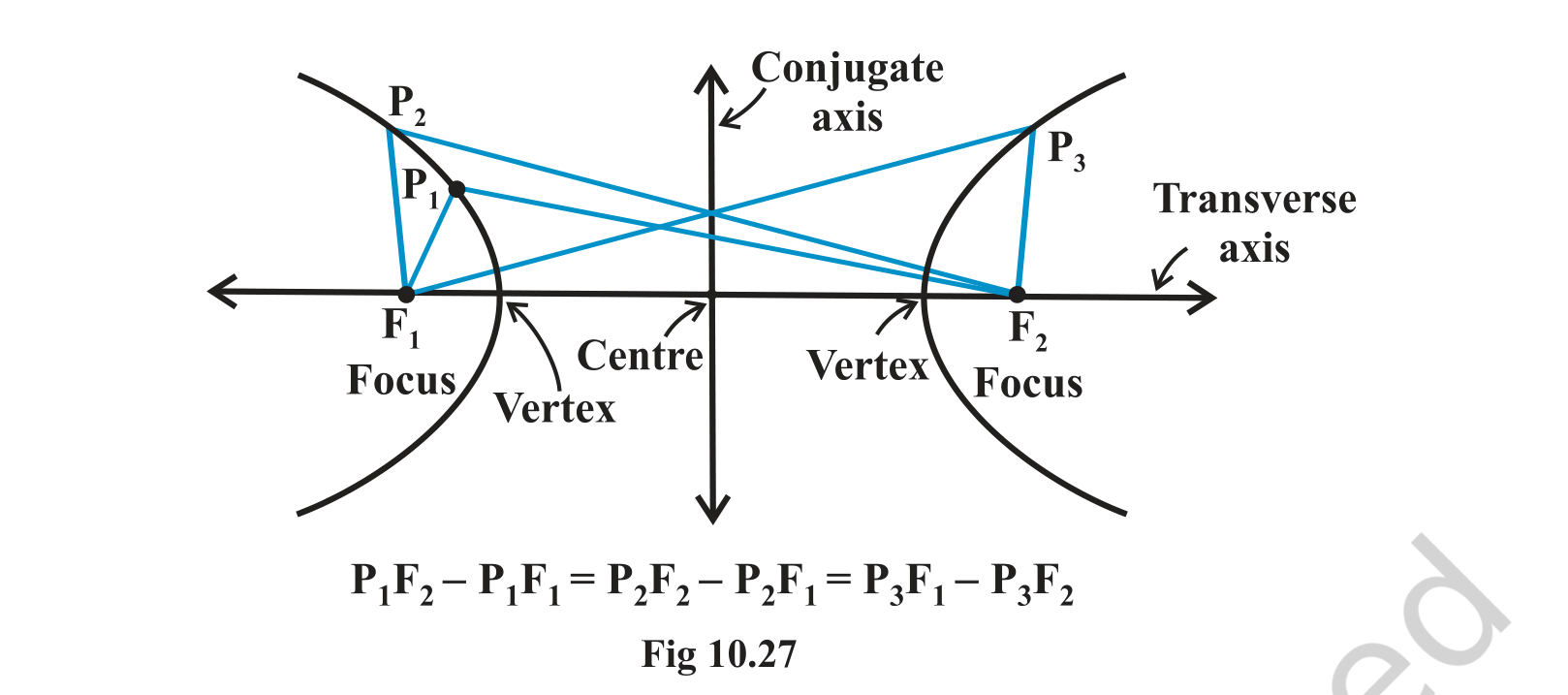
A hyperbola is the set of points whose distances from two fixed foci differ by a constant 2a. The standard equation x squared by a squared minus y squared by b squared equal to 1 has two branches opening left and right, centre at the origin, foci at (plus or minus c, 0) where c squared equals a squared plus b squared, and eccentricity c by a greater than 1.
The distance from the centre to a vertex is a, and the transverse axis has length 2a. The conjugate axis has length 2b and lies across the other direction. The rectangle with sides 2a and 2b determines the asymptotes, whose equations are y equal to plus or minus b by a times x. The asymptotes are the straight lines the branches approach far from the centre.
The hyperbola with equation y squared by a squared minus x squared by b squared equal to 1 opens up and down instead. Its foci are (0, plus or minus c), its eccentricity is still c by a and its asymptotes are y equal to plus or minus a by b times x. Read which variable has the positive term to decide the opening direction.
A useful check on a hyperbola answer is the asymptote direction. The branches must open towards the side where the positive term appears, and they must approach lines of slope plus or minus b by a. A quick sketch of the asymptotes, the vertices and the rectangle between them shows immediately whether the computed a and b have been swapped, which is the most common error in this section and the quickest one to catch.
5.2 Eccentricity, latus rectum and directrices
The eccentricity of a hyperbola is greater than 1 and equals c by a, with c squared equal to a squared plus b squared. A small eccentricity means the branches are close to the axes, a large one means they open widely. The directrices are x equal to plus or minus a by e, and the latus rectum is 2b squared by a, the same expression as for an ellipse but with the hyperbola relation between a, b and c.
A tangency condition is useful: the line y equal to mx plus c touches x squared by a squared minus y squared by b squared equal to 1 exactly when c squared equals a squared m squared minus b squared. This comes from the discriminant of the substituted quadratic and is a good check on long algebra.
A single hyperbola question often mixes three facts: the standard equation, the eccentricity and the asymptotes. Write all three before starting, then substitute whatever the question gives.
When the asymptotes are given and the curve passes through a point, write the equation as x squared by a squared minus y squared by b squared equal to 1 with the ratio b by a fixed by the asymptotes. Substituting the point then fixes a, and b follows from the ratio.
5.3 Exercise 10.4 and mixed practice
Question 1 asks for the coordinates of the foci and vertices, the eccentricity and the latus rectum of x squared by 16 minus y squared by 9 equal to 1. Here a is 4 and b is 3, c squared is 25 and c is 5, so the foci are (plus or minus 5, 0), the vertices are (plus or minus 4, 0), the eccentricity is 5 by 4 and the latus rectum is 2 times 9 by 4, that is 9 by 2.
Question 3 asks for the hyperbola with vertices at (0, plus or minus 3) and foci at (0, plus or minus 5). The positive term is in y, so the equation has the form y squared by a squared minus x squared by b squared equal to 1 with a equal to 3 and c equal to 5, giving b squared equal to 16 and the equation y squared by 9 minus x squared by 16 equal to 1.
Mixed questions combine the conics. A parabola and an ellipse may share a focus, or a hyperbola may share asymptotes with a given pair of lines. In each case write the standard form of each curve, translate the shared condition into an equation in a and b, and solve. The latus rectum formulas are often the fastest bridge between different curves because they involve a and b directly.
A useful check on a hyperbola answer is the asymptote direction. The branches must open towards the side where the positive term appears, and they must approach lines of slope plus or minus b by a. A quick sketch of the asymptotes, the vertices and the rectangle between them shows immediately whether the computed a and b have been swapped, which is the most common error in this section.
Slideshow, slide 1 of 3. Use the left and right arrow keys to change slides and the space bar to play or pause.
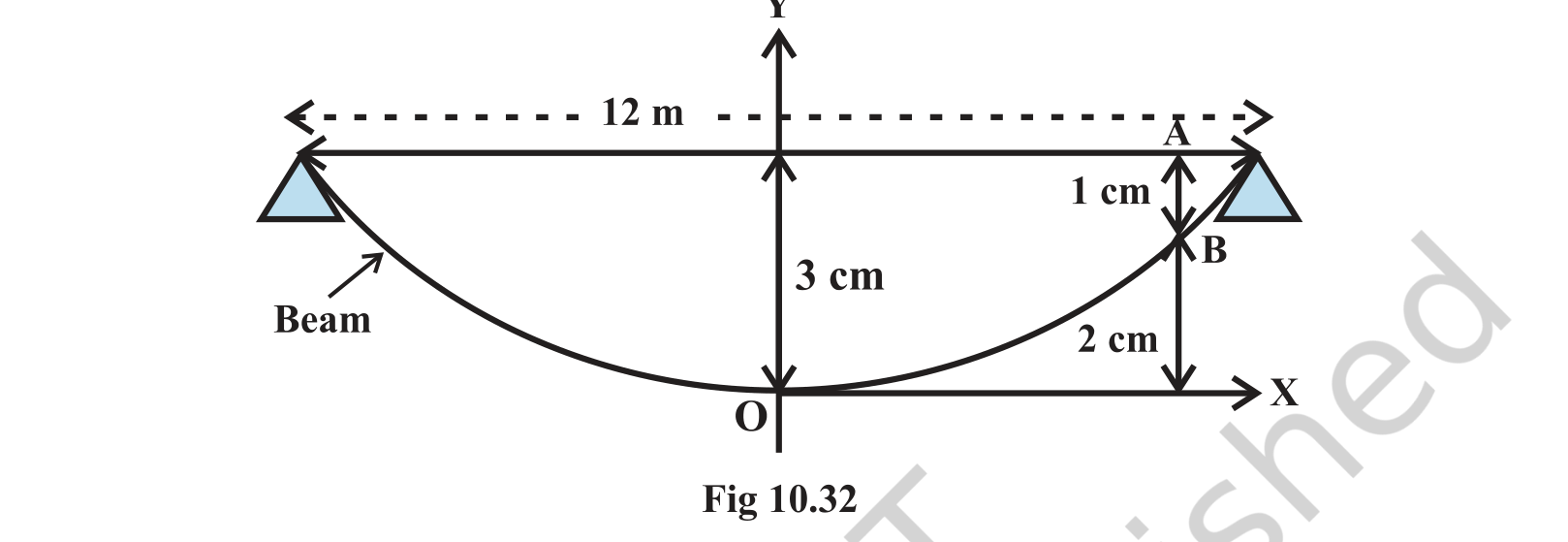
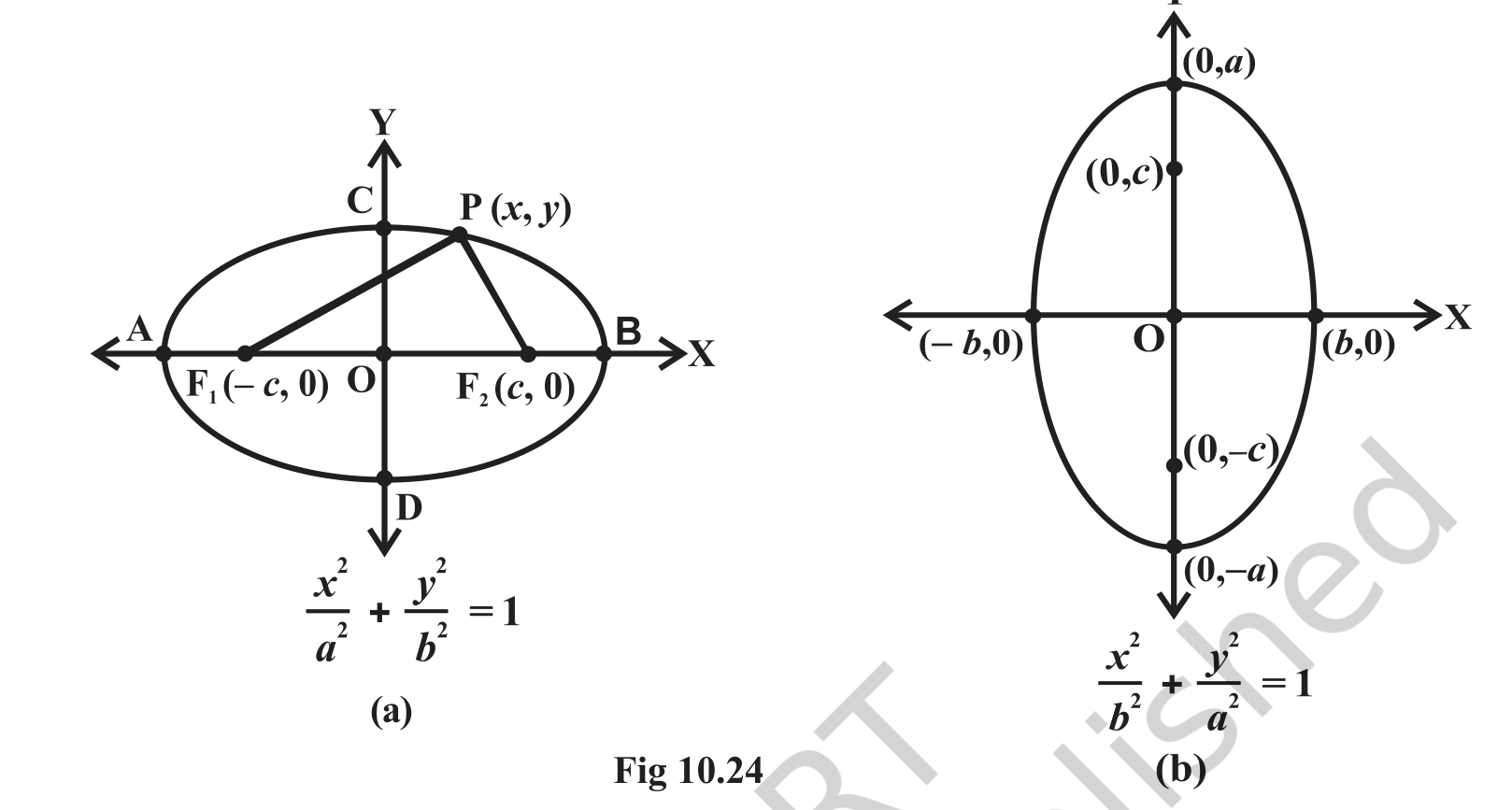
Parabolic arch of a bridge with a horizontal beam across it and the span and deflection marked
Warning
For a hyperbola the relation is c squared equal to a squared plus b squared, not minus. Mixing it with the ellipse relation changes the eccentricity and every later answer.