

Concepts: circular motion dynamics and exercise practice
Laws of Motion24 min readLesson 5 of 7
5.1 The centripetal force
A body moving in a circle at constant speed still has an acceleration, directed toward the centre, with magnitude speed squared over radius. By the second law there must be a net force of mass times that acceleration toward the centre. This required force is called the centripetal force, and it is not a new kind of force: friction, tension, gravity or the normal reaction supplies it in different situations.
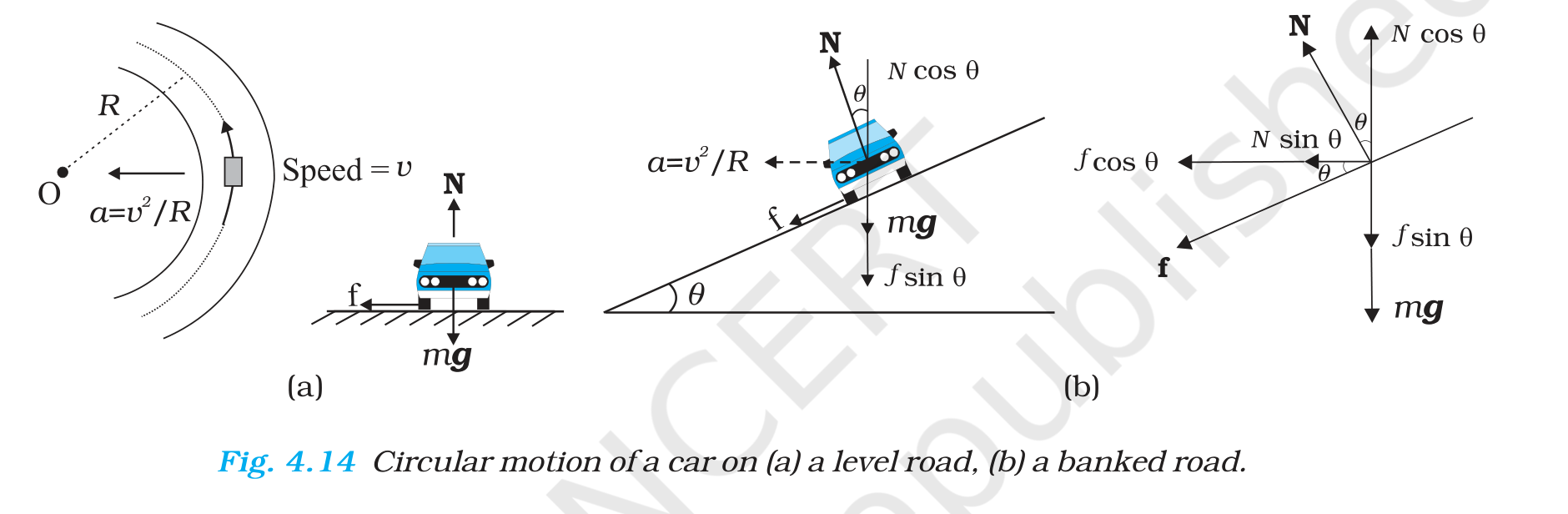
When a car turns on a level road, the inward force comes from static friction at the tyres. Because that friction has a ceiling, the speed has one too, namely the square root of the coefficient times the radius times g. Above that speed the tyres start to slip and the car skids outward, since there is no longer enough friction to keep it on the curve.
On a banked road the surface is tilted so that the normal reaction itself has a horizontal component toward the centre. At the design speed the horizontal component of the normal supplies the centripetal force and friction is not needed, so the road stays safe even when it is wet. The banking angle satisfies tangent equal to speed squared over the product of radius and g.
Slideshow, slide 1 of 3. Use the left and right arrow keys to change slides and the space bar to play or pause.
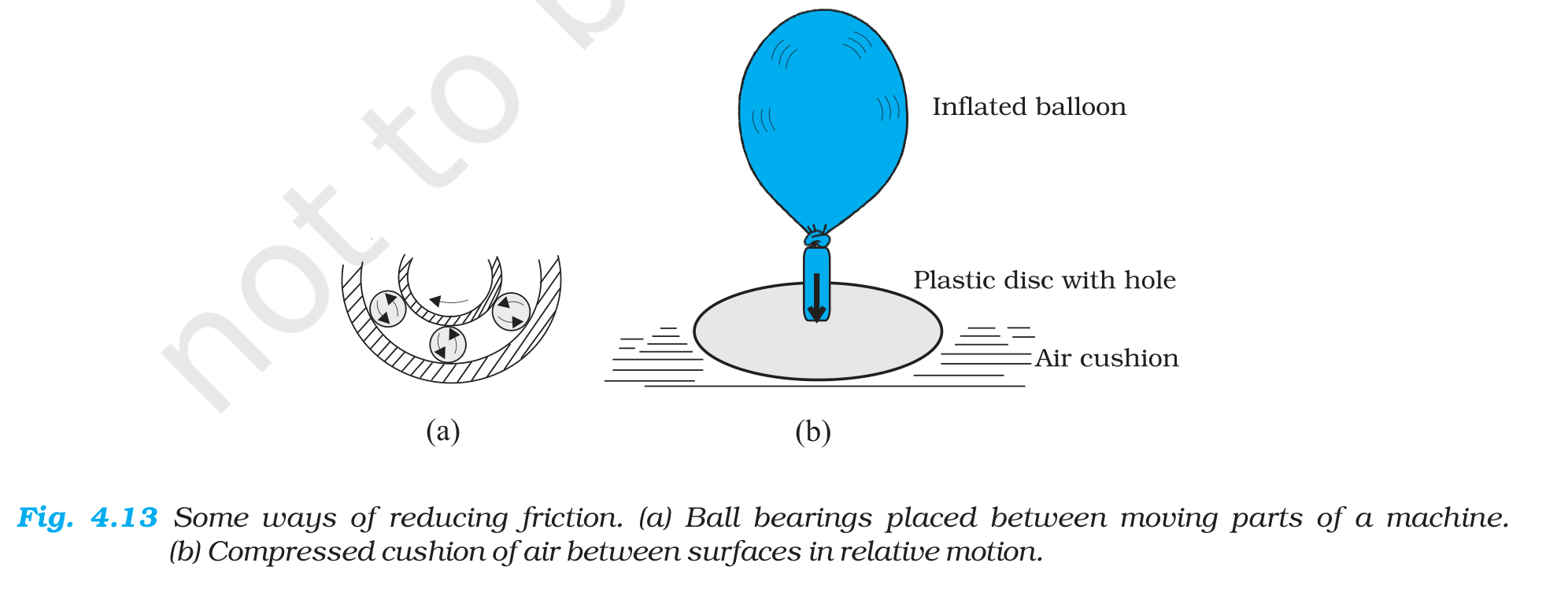
NCERT Figure 4.13: reducing friction with ball bearings and with a compressed air cushion between surfaces in relative motion.
5.2 A conical pendulum and a vertical circle
A conical pendulum is a bob on a string moving in a horizontal circle. The string sweeps a cone and makes an angle theta with the vertical. The vertical component of the tension balances the weight and the horizontal component supplies the centripetal force, which gives tan theta equal to v squared over r g. The same relation governs a car on a banked road, which is why the two problems look alike.
In a vertical circle the speed changes and the tension varies. At the top of the circle both the weight and the tension point downward, so the minimum speed for the string to stay taut follows from setting the tension to zero: v squared equals g times the radius. At the bottom the tension is larger than the weight and the speed is greatest. These two results cover most vertical circle questions.
5.3 Exercise practice: the three laws and momentum
Exercise 4.1 gives a position function x = t squared and asks for the force from the second derivative, which is a constant 2a times the mass. Exercise 4.2 gives x = 2t cubed and asks for the force at a stated time, so the position is differentiated twice and multiplied by the mass. Exercise 4.3 uses a velocity-time graph to find the force in two intervals, and exercise 4.4 asks for the impulse obtained from the area under a force-time graph.
Exercises 4.5 and 4.6 give the momentum change of a ball and ask for the force or impulse with a stated contact time. Exercises 4.7 to 4.9 use the conservation of momentum: two masses joined by a spring, a shell fired from a gun and a rocket at two instants. Exercise 4.10 tracks a body whose velocity changes direction under a constant force, and exercises 4.11 and 4.12 use the second law for a truck and for a bob hanging from the ceiling of a moving car.
Exercises 4.13 and 4.14 apply the apparent weight relation to a man on a scale in a lift and read a position-time graph to find the force. Exercise 4.15 places two blocks on a smooth table and asks for the acceleration and the contact force, a standard two body problem. Exercises 4.16 to 4.18 deal with pulleys, a nucleus at rest and billiard balls colliding head on. Exercise 4.19 uses the recoil of a gun and exercise 4.20 the impulse on a ball deflected by a bat.
5.4 Exercise practice: friction and circular motion
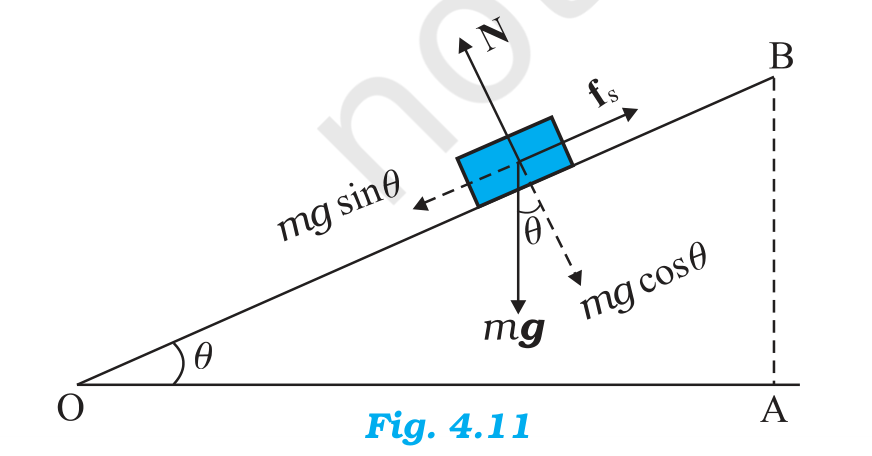
Exercise 4.21 gives a block on a rough inclined plane and asks for the maximum angle and the acceleration at a steeper angle. Exercise 4.22 applies the laws of friction to a vehicle on a banked road, and exercise 4.23 asks for the maximum speed with which a car can take a turn on a level road. Every one of these starts from a free body diagram and ends with the second law along the chosen axes.
A useful check on any friction answer is its limiting behaviour. When the friction coefficient goes to zero, the incline acceleration should become g sin theta and the safe road speed should become zero; when the angle of the incline goes to zero, the incline acceleration should go to zero. Answers that fail these checks usually carry a sign error or a missing component.
Exam
For a banked road, resolve along the surface and perpendicular to it, not along horizontal and vertical. The two equations then separate cleanly into the normal reaction and the centripetal condition.