

Concepts: inertia and Newton's laws of motion
Laws of Motion22 min readLesson 2 of 7
2.1 From Aristotle to inertia
Everyday experience suggests that a moving object stops once the push stops. That observation supports the older view that a force is needed just to keep a body moving. The view fails once friction is reduced: a puck on ice, a trolley on a smooth rail and a ball rolling on a polished surface all travel much farther than the same object on a rough floor. The force is needed to overcome friction, not to maintain motion.
Galileo argued from such experiments that a body left alone keeps its velocity, and the modern statement of that idea is Newton's first law. A body keeps its velocity unchanged, either staying at rest or moving uniformly along a straight line, as long as no net external force acts on it. The tendency to resist a change of velocity is called inertia, and the mass of a body measures it. A loaded truck has more inertia than a bicycle, so stopping it for the same change of velocity needs a larger force.
2.2 The second law
Newton's second law states that the net force on a body equals the rate of change of its momentum. For constant mass this becomes force equals mass times acceleration. The law is a vector relation, so it holds separately along each chosen axis, and a force at an angle is resolved into components before the equations are written. That is why an inclined plane problem is easier with axes along and perpendicular to the slope than with horizontal and vertical axes. It also defines the unit of force: one newton is the force that gives a one kilogram mass an acceleration of one metre per second squared.
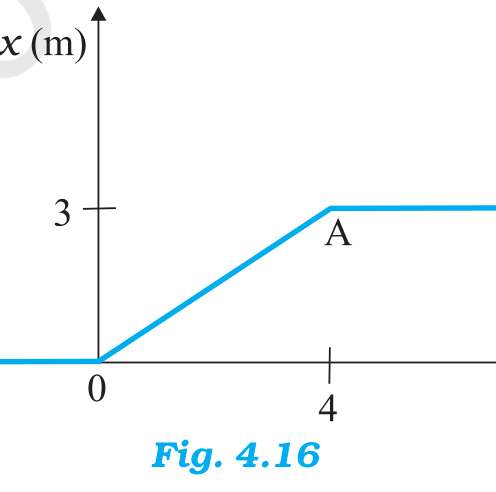
A constant net force produces a constant acceleration, so the kinematics of uniform acceleration applies directly to force problems. If the force varies with time, the acceleration varies in the same way, and the change in velocity comes from integrating the force. The graph in the figure below shows a position-time graph used in the exercises: the slope changes at a point, so the velocity changes, and a force must have acted during that change.
2.3 The third law and the pairs of forces
When body A pushes body B, body B pushes back on A with a force equal in magnitude and opposite in direction. The two forces act on different bodies and are of the same type: if the first is gravitational, the second is gravitational, and if the first is a contact push, the second is a contact push. The law explains walking, swimming, the recoil of a gun and the lift of a rocket.
The pairs never cancel in a free body diagram because each diagram contains only one body. A book on a table experiences its weight downward and the table's normal reaction upward, and these two are not a third law pair: the reaction to the weight is the pull of the book on the Earth, while the reaction to the normal is the push of the book on the table. This distinction is a favourite examination question.
2.4 Worked example: apparent weight in a lift
Take a 60 kg person standing on a scale inside a lift, with upward taken as positive. When the lift accelerates upward at 2 metres per second squared, the scale reads the normal reaction N, and the second law along the vertical gives N minus the weight equal to mass times acceleration. So N equals 60 times the sum of 10 and 2, that is 720 N, and the scale reports the apparent weight 720 N instead of 600 N.
When the lift accelerates downward at the same rate, the equation gives N equal to 60 times the difference, 480 N. If the cable breaks and the lift falls freely, the acceleration is g and the normal reaction becomes zero, so the person floats in the lift and the scale reads zero. The apparent weight is the normal reaction, never the true weight, and the difference between the two is the effect of the frame's acceleration. A lift is therefore the standard classroom example of a non-inertial frame, and the same idea explains the feeling of lightness in a descending aircraft and the extra pressure on the feet when a lift starts upward. The reading changes during the acceleration but returns to the true weight once the lift moves at constant velocity. Only the acceleration matters, not the speed, so a fast lift at steady speed shows the true weight, while a lift at rest and a lift in free fall differ completely.
Common mistake
Writing reaction pairs as forces on the same body is logically wrong and numerically destructive. Check every pair you draw: do the two forces belong to two different bodies? If not, they are not a Newton's third law pair.