

Concepts: kinetic and potential energy and the conservation of mechanical energy
Work, Energy and Power24 min readLesson 3 of 6
3.1 Kinetic energy
Kinetic energy measures the motion energy of a body, and it equals half the mass multiplied by the square of the speed. The value is a scalar and can never be negative. Because the speed is squared, doubling the speed quadruples the kinetic energy, and that is why a fast vehicle needs a much longer distance to stop than a slow one.
The kinetic energy of a system is the sum of the kinetic energies of its parts when the parts move in the same frame. For a body that can both translate and rotate, the total kinetic energy includes the rotational part as well, but for a point mass the translational term is all there is. The work-energy theorem is the direct link between work and this energy.
Momentum and kinetic energy are different measures of motion. A heavy slow body and a light fast body can have the same momentum but very different kinetic energies, because kinetic energy is quadratic in the speed. This distinction matters in collision problems where momentum is conserved but kinetic energy is not.
3.2 Conservative forces and potential energy
A force is conservative when the work it does around any closed path is zero, which is the same as saying its work depends only on the two endpoints. Gravity and the spring force are conservative; friction is not, because dragging a block around a closed loop against friction always consumes energy. Only conservative forces have an associated potential energy.
Potential energy is energy stored in the configuration of the system. For gravity near the Earth's surface the potential energy rises by m g h when the body rises by h, and for a spring it rises by half k x squared when the extension grows to x. The reference level for potential energy can be chosen anywhere, because only differences matter in the energy equations; the zero for gravity is usually the ground and the zero for a spring is its natural length.
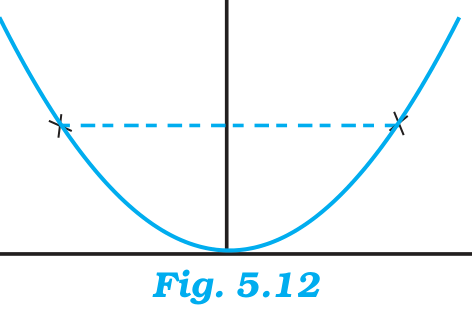
The potential energy curve is a useful picture. The force is the negative slope of the curve, so a body moves toward lower potential energy. A minimum of the curve is a stable equilibrium point, and a maximum is unstable. A particle of total energy E can only reach the region where the potential energy is below E, and the turning points are where the two are equal.
Slideshow, slide 1 of 3. Use the left and right arrow keys to change slides and the space bar to play or pause.
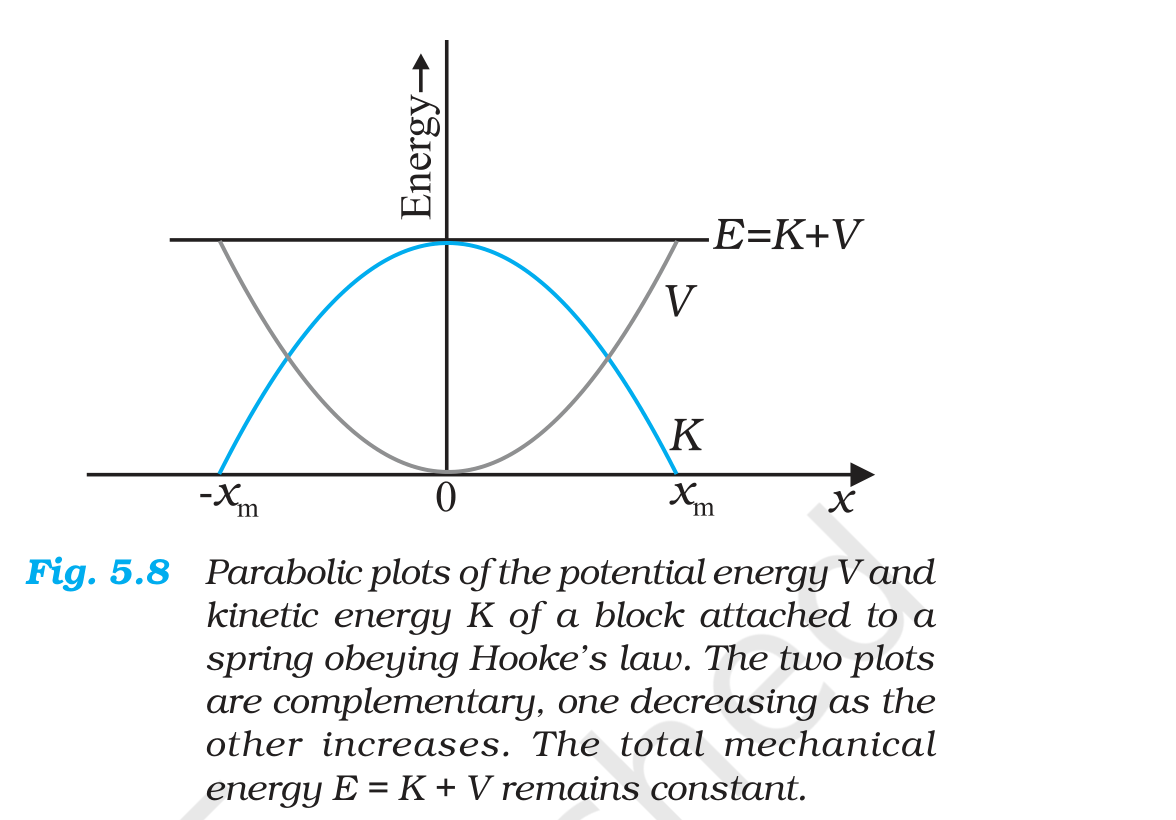
NCERT Figure 5.8: parabolic plots of the potential energy and kinetic energy of a block on a spring, whose sum stays constant.
3.3 Conservation of mechanical energy
When only conservative forces act, the sum of kinetic and potential energy stays constant through the motion. The energy simply changes form: at the top of a swing the potential energy is maximum and the kinetic energy is zero, at the bottom the reverse is true, and the sum is the same at every point. This lets a speed be found from a height without any force analysis.
In the figure above the two energy curves are shown for a block on a spring, and the sum is a horizontal line. The potential curve is a parabola opening upward, the kinetic curve is the complementary upside down parabola, and their sum is constant. At the endpoints of the motion all the energy is potential and the block is momentarily at rest.
Friction and other non conservative forces break the conservation. Then the final mechanical energy is less than the initial by the work done against friction. Writing the lost energy explicitly as a friction term keeps the equation honest and lets it be used for surfaces with known friction coefficients.
3.4 Worked examples
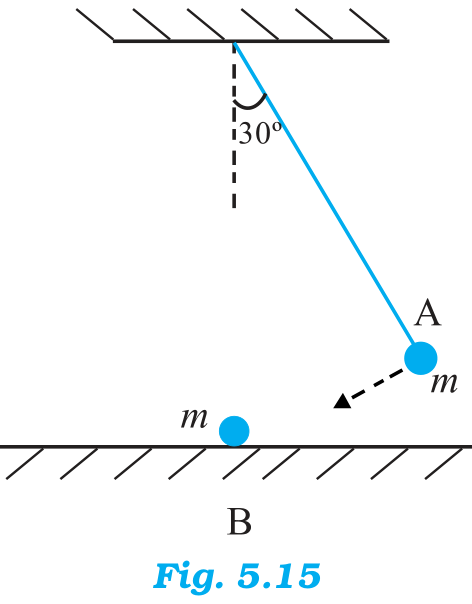
A ball is dropped from a height of 20 m. With g equal to 10, the speed at the ground follows from m g h equalling half m v squared, so v squared is 400 and v is 20 m per second, the same answer as the kinematic equation and quicker. A pendulum bob released from rest at 60 degrees to the vertical has a height difference of L times 1 minus cos 60, and the speed at the lowest point follows from that height.
A block slides down a rough incline. Gravity converts a height h of potential energy, friction removes mu m g cos theta times the distance s, and the remainder is the kinetic energy. If the numbers give a negative final kinetic energy, the block never reaches the bottom: the initial energy was not enough to overcome friction, and the physical conclusion is that the block stops partway.
The spring case is equally direct. A block of mass m compresses a spring of constant k by x from a speed v, so half k x squared equals half m v squared. The same relation gives the launch speed of a spring gun and the maximum compression of a buffer. In every case the equation is between the states where the energy is easy to write.
Warning
A spring has the same potential energy for a compression and for an equal extension, because the energy depends on x squared. Do not put a minus sign on the spring energy for a compression; the sign belongs to the force, not to the energy.