

Concepts: work, the work-energy theorem and power
Work, Energy and Power22 min readLesson 2 of 6
2.1 Work is a scalar product
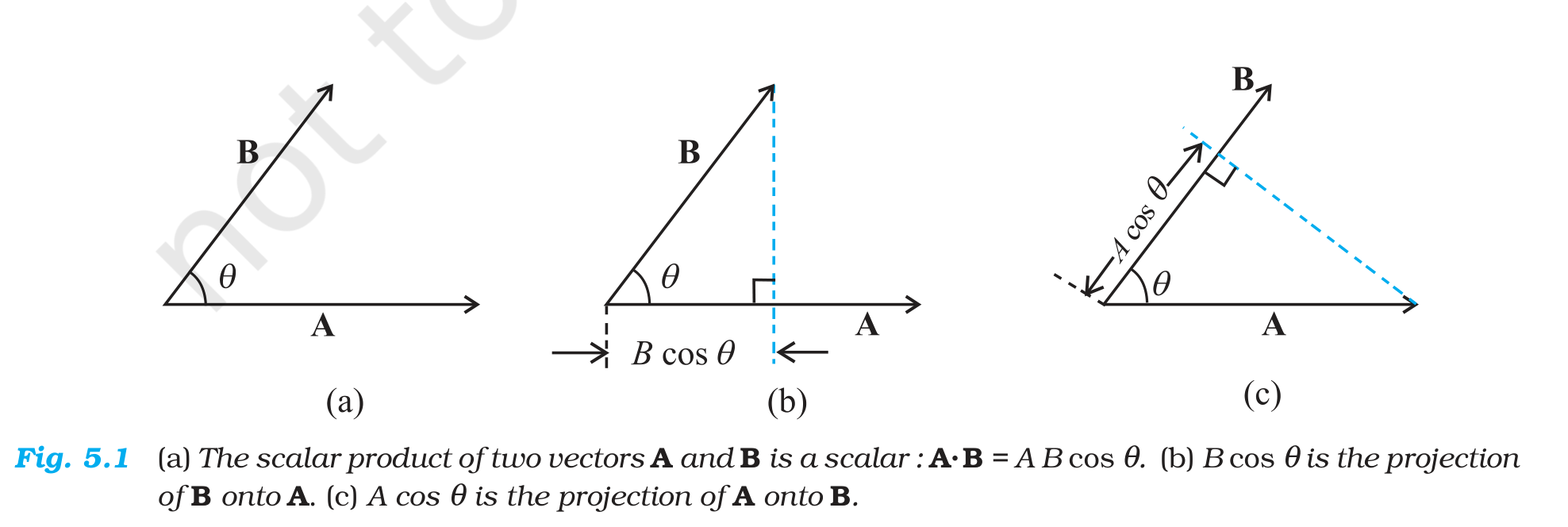
When a constant force moves a body through a displacement, the work done is the product of the force, the displacement and the cosine of the angle between them. This is the scalar product of the two vectors, so the result is a scalar with a sign. A force along the displacement does positive work, a force opposite to the displacement does negative work, and a force at right angles does no work at all.
The figure shows the scalar product geometrically. The quantity F cos theta is the projection of the force on the displacement, or d cos theta is the projection of the displacement on the force, and the work is the product of one full vector with the projection of the other. A block pushed along a floor with a force at an angle therefore has work Fd cos theta, with only the horizontal part of the push counted.
Work can be negative, and that is not a mistake. Friction on a sliding block does negative work, gravity does negative work when a body rises, and a braking force does negative work. Negative work means the force removes energy from the body, and positive work means the force adds energy.
2.2 A varying force and the graph
When the force changes along the path, the work is found by adding the contributions of small displacements. The force is nearly constant over each small step, so each contribution is the force times that step, and the sum becomes the integral of force with respect to displacement. On a force-displacement graph that integral is the area under the curve, with area below the axis counted as negative work.
The area method is used constantly in this chapter. A spring force that grows linearly with extension gives a triangular area, which is half the base times the height and produces the familiar half k x squared. A graph that rises, stays flat and falls gives a total work equal to the signed area, and the net work is the area above the axis minus the area below it.
A worked case: a force of 10 N acts along a displacement of 4 m, so the work is 40 J. If the same force acts at 60 degrees to the displacement, the work falls to 10 times 4 times 0.5, that is 20 J. The component of the force perpendicular to the motion does nothing, which is why carrying a bag horizontally at constant speed does no work against gravity on the bag.
2.3 The work-energy theorem
The net work on a body equals its change in kinetic energy. For a constant force the proof is one line: the kinematic relation v squared minus u squared equals 2 a s, multiplied by mass over two, gives the work as the change in half m v squared. For a varying force the same result follows by integrating the second law with respect to displacement.
The theorem is useful because it connects forces to speeds without needing the time. A car braking from a speed u to rest over a distance s has the work done by friction equal to minus half m u squared, which gives the stopping distance as u squared over twice the friction acceleration. Doubling the speed therefore quadruples the stopping distance, a result worth remembering for safety.
The theorem also clarifies the role of friction. When a block slides down a rough incline, gravity does positive work, friction does negative work, and the difference is the kinetic energy gained. Writing the three terms explicitly prevents the sign errors that come from treating the friction as an energy source.
2.4 Power
Power measures how quickly work is done. The average power is the work divided by the time, and the instantaneous power is the scalar product of force and velocity. A constant force at constant speed gives the simple product F v. The unit is the watt, and a kilowatt hour is the energy delivered at one kilowatt for one hour, equal to 3.6 million joule.
A pump that lifts water to a height is the standard numerical. If it raises a mass m through a height h in time t, the useful power is m g h over t. The actual power drawn from the supply is larger because the pump is not perfectly efficient, and the efficiency is the useful power divided by the input power. A motor of 70 percent efficiency drawing 2 kW delivers 1.4 kW of useful power.
Power also appears in mechanics through F v. A car engine at a given power can produce a large force only at low speed, because the product of force and speed is fixed by the power. This is why a vehicle accelerates harder in a low gear, where the same power produces a larger driving force at the wheels.
Common mistake
Work depends on the angle, not just on the magnitude of the force. A force at 90 degrees to the displacement does no work, and two students who push the same box with the same force at different angles do different amounts of work.