

Concepts: measurement, the SI system and significant figures
Units and Measurements22 min readLesson 2 of 5
2.1 Measurement needs a standard
Comparing two lengths only makes sense when both are compared with the same reference. A unit is that reference, chosen by agreement, and a physical quantity is reported as a numerical value multiplied by its unit. The earliest systems grew from the body and from trade, which is why the foot, the pound and the second existed side by side in the FPS system, while centimetre, gram and second formed the CGS system and metre, kilogram and second formed the MKS system.
Modern work uses one system, the Systeme International d'Unites, built on seven base quantities. The definitions have been rewritten over time. The metre is now fixed by the speed of light in vacuum, the kilogram by the Planck constant, the second by the caesium hyperfine transition and the ampere by the elementary charge. The practical effect for a school problem is small, but the definitions show why the metre, the second and the ampere are not independent of each other any more.
2.2 Base quantities and derived quantities
The seven base quantities are length, mass, time, electric current, temperature, the amount of substance and luminous intensity. Every other quantity is derived from them. Area is length squared, speed is length divided by time, force is mass times acceleration. A derived unit can be written as a combination of base units, and some combinations get a special name, such as the newton for force, the joule for energy and the watt for power.
The complete set of base units plus derived units is called a system of units. The SI is decimal throughout, so converting between multiples and submultiples is a matter of moving the decimal point by the prefix. That simplicity was a large part of why the SI replaced the earlier systems in scientific and industrial work.
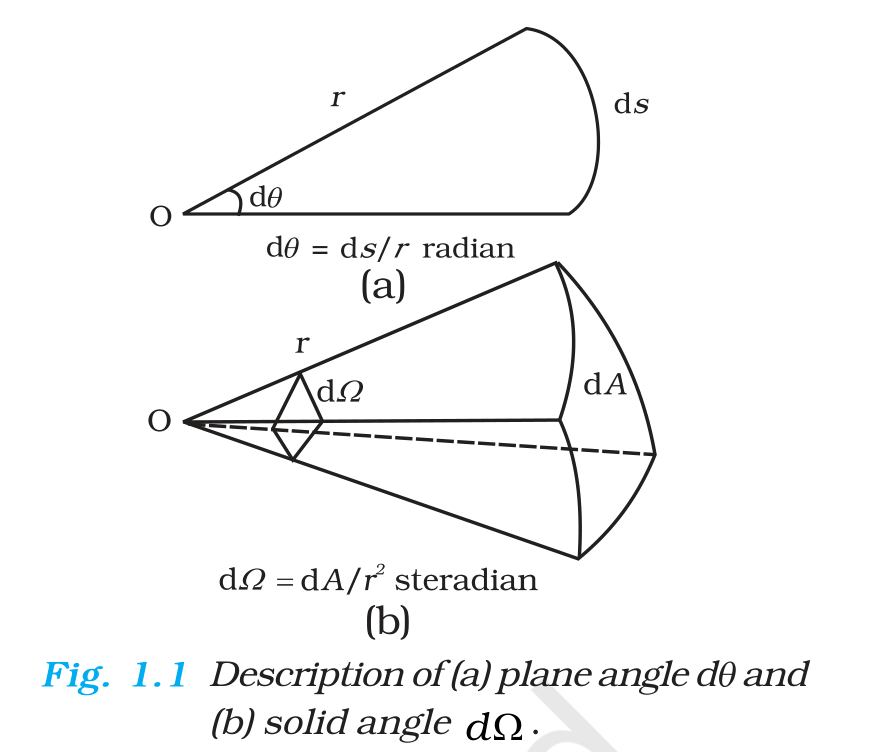
2.3 Angles need a unit too
Plane angle and solid angle are measured quantities, so they also carry units, but the radian and the steradian are defined as ratios of two lengths and of an area to a length squared. A ratio of two lengths carries no dimension, so both units are dimensionless and are best called supplementary units rather than base units. One complete turn is 2 pi radians, and a full sphere is 4 pi steradians.
The plane angle in radians equals the arc length divided by the radius. The solid angle in steradians equals the intercepted area on a sphere divided by the square of its radius. These definitions are why trigonometry can take an angle in radians without caring about units, and why the radian is absent from every dimensional formula.
2.4 Counting significant figures
A measured length of 1.62 s has three significant figures, two reliable and one uncertain. Keeping more digits suggests a precision the instrument does not have. The count is the number of digits that carry information about the measurement, and it does not change when the unit changes.
Work through these cases. In 2.308 cm the digits 2, 3, 0 and 8 are significant, so the count is four. In 0.02308 m the leading zeros after the point are place holders, not measurements, so the count is still four. In 0.06900 the zeros after 69 are significant, so the count is four. In 123 m written without a decimal point the trailing zero is not significant, so the count is three. In 3.500 the trailing zeros do carry precision, so the count is four. In 4.700 m change the unit to 4700 mm and the count must remain four, which is a good reason to write the value as 4.700 x 10^3 mm.
Scientific notation removes the ambiguity. Every number is written as a value between 1 and 10 multiplied by a power of 10. All the zeros in that leading value are significant, and the power of ten has no effect on the count. The order of magnitude is the nearest power of 10, so 1.28 x 10^7 m has order of magnitude 7 while 1.06 x 10^-10 m has order of magnitude -10.
2.5 Accuracy, precision and the two kinds of error
Accuracy says how close a reading lies to the true value. Precision says how closely repeated readings agree with each other. A device can be precise and still inaccurate if it has a zero error, and it can be accurate on average while its readings scatter. The least count sets the precision: a screw gauge of least count 0.001 cm can never report a length more precisely than that.
A systematic error pushes readings the same way every time. Incorrect zero of a vernier, an instrument that reads high by a fixed amount, and a flawed method all produce systematic errors, and repeating the measurement does not remove them. A random error varies unpredictably between readings. Changes in temperature, parallax and human reaction time produce random errors, and averaging many readings does reduce their effect. Gross errors are simply mistakes in reading or recording.
2.6 Worked example: rounding a computed density
A cube has each side measured as 7.203 m. The number of significant figures in the side is four, so the computed surface area and volume must keep four as well. Surface area is 6(7.203)^2 = 311.299254 m^2, which rounds to 311.3 m^2. Volume is (7.203)^3 = 373.714754 m^3, which rounds to 373.7 m^3. Writing the extra digits would claim precision that the original measurement never had.
A second case is a value with mixed inputs. If 5.74 g of a substance occupies 1.2 cm^3, the mass carries three significant figures and the volume only two, so the density is limited to two: 5.74 / 1.2 = 4.8 g cm^-3. The division itself gives a longer decimal, and the rule about the least significant input is the only thing that stops it being reported.
Common mistake
The most common slip is to apply the multiplication rule to an addition. For 12.9 g - 7.06 g the arithmetic gives 5.84 g, but the input with the fewest decimal places is 12.9, one place, so the answer is 5.8 g. Significant figure count is the wrong rule for sums and differences.