

Formula sheet: Units and Measurements
Units and Measurements14 min readLesson 1 of 5
1.1 Units and the SI system
A measurement is a number attached to a unit, and every calculation carries the units along. The SI is built on a small set of base quantities, and every other unit is assembled from them, which is why a dimensional check can catch many errors before a number is computed.
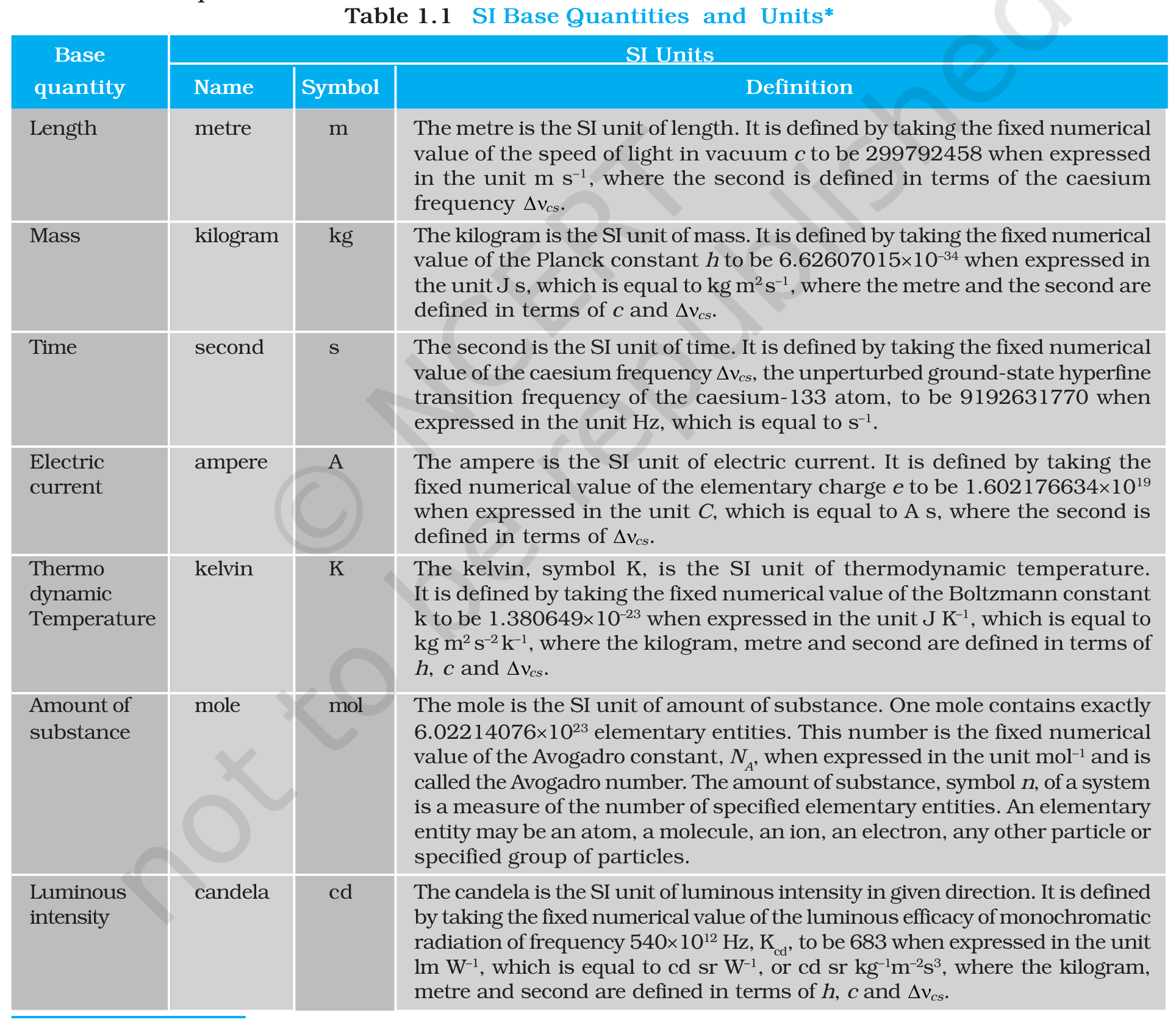
The official base unit table is reproduced below. Each unit is now fixed by a defined constant rather than by a physical artefact, so length, mass and time trace back to the speed of light, the Planck constant and the caesium transition.
| Prefix | Symbol | Factor | Prefix | Symbol | Factor |
|---|---|---|---|---|---|
| tera | T | 10^12 | centi | c | 10^-2 |
| giga | G | 10^9 | milli | m | 10^-3 |
| mega | M | 10^6 | micro | mu | 10^-6 |
| kilo | k | 10^3 | nano | n | 10^-9 |
| deci | d | 10^-1 | pico | p | 10^-12 |
Significant figures are the reliable digits of a measured value plus the first uncertain one. Every non-zero digit counts, zeros between non-zero digits count, and trailing zeros after a decimal point count. Zeros written before the leading non-zero digit carry no information, and trailing zeros in a whole number without a decimal point do not either unless the value is written in scientific notation. A change of unit never changes the count, so 2.308 cm, 0.02308 m and 23.08 mm each carry four significant figures.
| Situation | Rule | Example |
|---|---|---|
| Multiplication or division | Keep the smallest number of significant figures among the inputs | 4.237 g / 2.51 cm^3 = 1.69 g cm^-3 |
| Addition or subtraction | Keep the smallest number of decimal places among the inputs | 436.32 + 227.2 + 0.301 = 663.8 g |
| Exact numbers | Treated as having unlimited significant figures | the 2 in 2 pi r, the 6 in 6 a^2 |
| Rounding, digit above 5 | Increase the last kept digit | 2.746 to 2.75 |
| Rounding, digit exactly 5 | Keep the last kept digit even | 2.745 to 2.74, 2.735 to 2.74 |
1.2 How errors combine
For a sum or a difference the absolute errors add, for a product or a quotient the relative errors add, and for a power the relative error is multiplied by the power. These three rules cover most numericals.
| Operation | Result | Error to quote |
|---|---|---|
| Z = A + B or Z = A - B | best value | Delta Z = Delta A + Delta B |
| Z = A B or Z = A / B | best value | Delta Z / Z = Delta A / A + Delta B / B |
| Z = A^n | best value | Delta Z / Z = n (Delta A / A) |
| Z = k A, k exact | best value | Delta Z = k Delta A |
1.3 Dimensions
A dimensional formula records the powers of the base dimensions in a quantity. Mechanics needs only mass, length and time, and only quantities with the same dimensions can be added, subtracted or equated.
| Quantity | Dimensional formula | SI unit |
|---|---|---|
| Area | [M^0 L^2 T^0] | m^2 |
| Volume | [M^0 L^3 T^0] | m^3 |
| Density | [M L^-3 T^0] | kg m^-3 |
| Speed, velocity | [M^0 L T^-1] | m s^-1 |
| Acceleration | [M^0 L T^-2] | m s^-2 |
| Force | [M L T^-2] | N |
| Work, energy, torque | [M L^2 T^-2] | J |
| Power | [M L^2 T^-3] | W |
| Pressure, stress | [M L^-1 T^-2] | Pa |
| Momentum, impulse | [M L T^-1] | kg m s^-1 |
| Angular momentum, Planck constant | [M L^2 T^-1] | J s |
| Frequency, angular velocity | [M^0 L^0 T^-1] | Hz, rad s^-1 |
| Gravitational constant | [M^-1 L^3 T^-2] | N m^2 kg^-2 |
| Surface tension | [M L^0 T^-2] | N m^-1 |
1.4 Units that turn up in the exercises
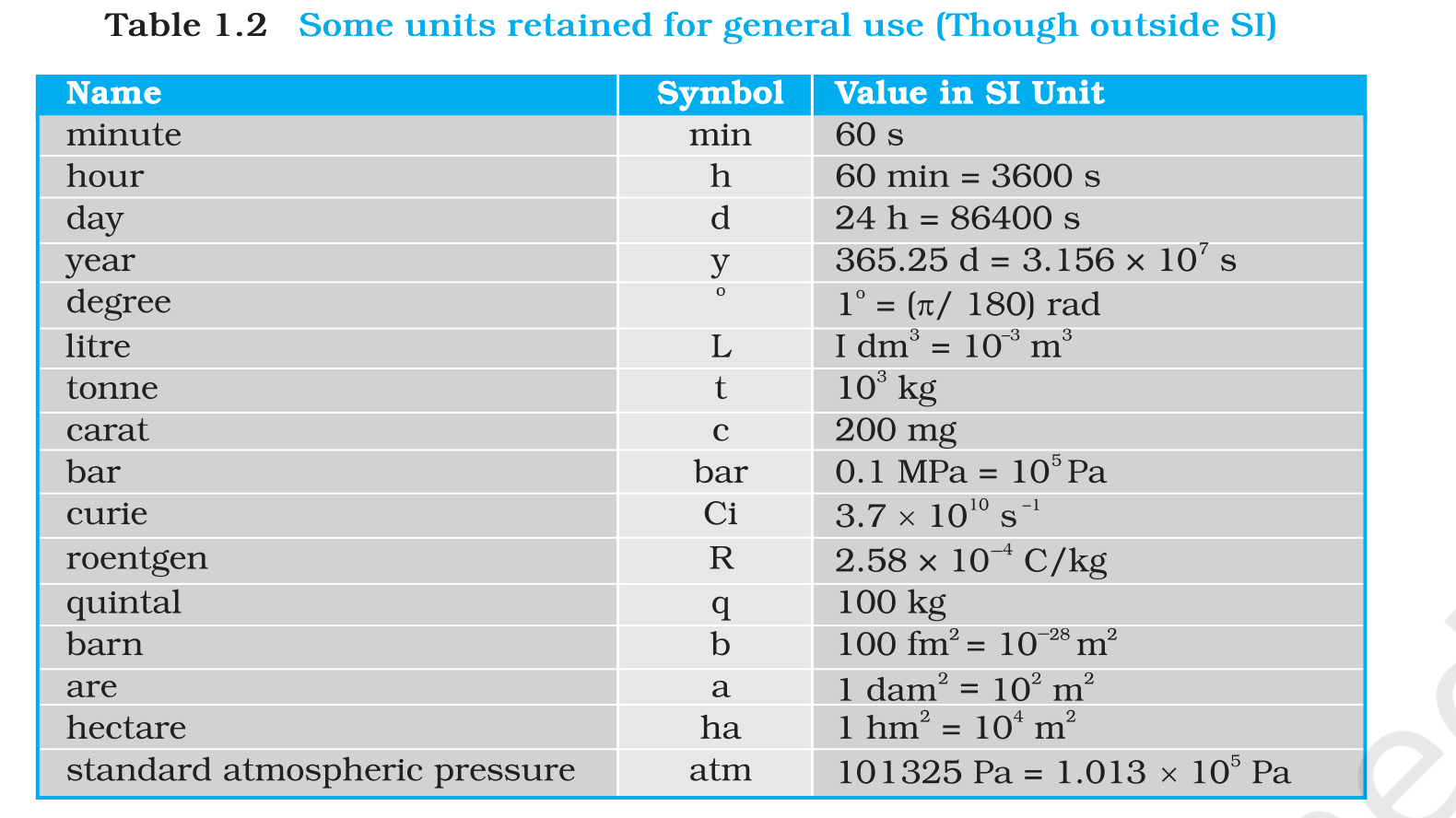
A light year is the distance light covers in one year, about 9.46 x 10^15 m. One astronomical unit is the mean Earth to Sun distance, about 1.496 x 10^11 m, and one parsec is about 3.26 light years.
Exam
Two checks settle most one mark questions. Terms that do not share dimensions make an equation wrong, so a mismatch rules it out at once. A dimensionally correct equation is not necessarily right, so the test can reject but never confirm.