

Concepts: rotational dynamics and angular momentum conservation
System of Particles and Rotational Motion22 min readLesson 5 of 8
5.1 The rotational second law
For rotation about a fixed axis, the net torque equals the moment of inertia times the angular acceleration. This is the exact analogue of force equals mass times acceleration, with torque replacing force, moment of inertia replacing mass and angular acceleration replacing linear acceleration. The moment of inertia must be taken about the same axis as the torque and the angular acceleration.
The equation is used in two directions. Given the forces, it gives the angular acceleration and then, by kinematics, the angular velocity and angle after a time. Given a required angular acceleration, it gives the torque that a motor must supply. The rotational kinematics for constant angular acceleration mirror the linear equations: omega equals omega nought plus alpha t, theta equals omega nought t plus half alpha t squared, and omega squared equals omega nought squared plus twice alpha theta.
A pulley with a mass is the standard example. The tension on the two sides differs because the pulley needs a net torque to accelerate, and the difference of the two tensions times the radius equals the moment of inertia times the angular acceleration. Ignoring the pulley's mass would make the two tensions equal, which is the idealisation used in the simpler problems.
5.2 Rotational kinetic energy and work
The kinetic energy of a rotating body is half the moment of inertia times the square of the angular velocity. For a body that translates and rotates at the same time, the total kinetic energy is the translational term for the centre of mass plus the rotational term about the centre of mass. For a rolling body both terms are present and both matter.
The work done by a torque is the torque times the angular displacement, and for a varying torque it is the integral of torque with respect to angle. This is the rotational version of work equals force times distance, and the work-energy theorem takes the same form with rotational kinetic energy. A braking torque does negative work and removes rotational energy.
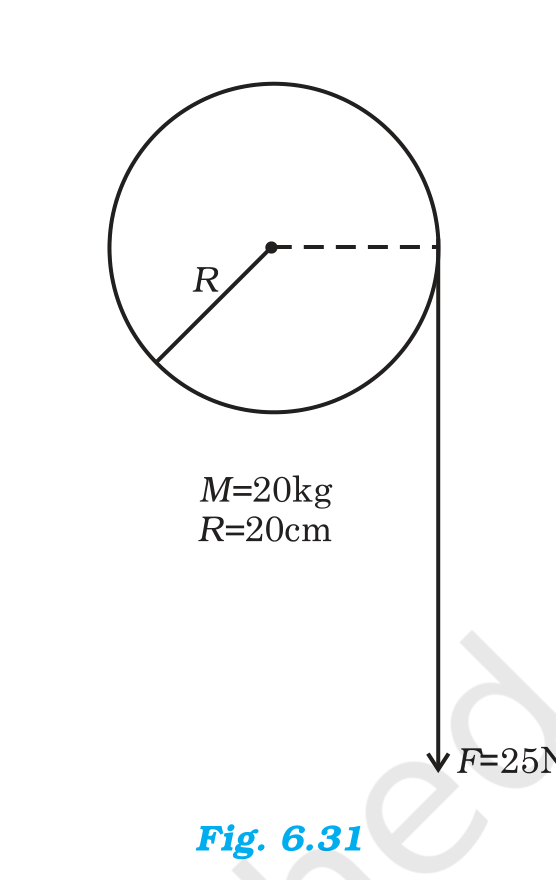
The figure below shows a falling mass connected to a pulley. The falling mass loses potential energy, the pulley gains rotational kinetic energy and the mass gains translational kinetic energy, and the energy equation ties the three together. A check is that the final speed is smaller than for a massless pulley, because part of the energy goes into spinning the pulley.
5.3 Conservation of angular momentum
When the net external torque about an axis is zero, the total angular momentum about that axis is constant. This is a vector statement, so it applies to each component separately, and it is the rotational analogue of momentum conservation. A figure skater, a diver and a cat use it to change their spin by changing their moment of inertia.
A skater with arms out has a large moment of inertia and spins slowly. Pulling the arms in reduces the moment of inertia, and since the product of moment of inertia and angular speed is fixed, the angular speed rises. No external torque about the vertical axis acts during this, so the total angular momentum is constant even though the kinetic energy rises; the extra energy comes from the work the skater's muscles do in pulling the arms in.
A person jumping on or off a rotating merry go round is another example. The angular momentum of the system is conserved about the vertical axis, so the final angular speed follows from the change in moment of inertia. Complicated as the motion looks, the single conservation equation solves it.
5.4 Worked example: a spinning disc
A disc of moment of inertia 2 kg metre squared spins at 10 radian per second. A second disc with moment of inertia 3 kg metre squared is dropped gently on it and the two rotate together. The initial angular momentum is 2 times 10, which is 20. The final moment of inertia is 5, so the common angular speed is 4 radian per second. The initial kinetic energy is 100 J and the final kinetic energy is half of 5 times 16, which is 40 J, so 60 J is lost to friction between the discs.
A mass of 2 kg hung on a string wound on a pulley of moment of inertia 0.5 kg metre squared and radius 0.2 m falls from rest. The energy equation gives the mass times g times h equal to half m v squared plus half I omega squared, with omega equal to v over R. Substituting v squared equal to 4 times omega squared and solving gives the speed after a given fall, and the same answer follows from the torque equation with the tension.
These worked cases show the method: identify the axis and the conserved quantity, write the equation, then compute the energy if the question asks for it. Never assume kinetic energy is conserved in an inelastic rotational collision; the energy can decrease even though the angular momentum is conserved.
Common mistake
Angular momentum conservation needs a zero external torque, not a zero external force. A force acting along the line through the axis can change the linear momentum and produce no torque, so angular momentum can be conserved in situations where linear momentum is not.