

Concepts: torque, angular momentum and rotational equilibrium
System of Particles and Rotational Motion22 min readLesson 3 of 8
3.1 Angular quantities
At any instant all the points of a rigid body share one angular velocity, since the body cannot change shape. Angular velocity measures the rate at which the body turns, in radian per second, and its direction is along the axis of rotation. Angular acceleration is the rate of change of angular velocity, and for a fixed axis both are simple scalars with signs.
The linear velocity of a point is the cross product of the angular velocity and the position of the point from the axis, which gives the speed as omega times the perpendicular distance from the axis. Points farther from the axis move faster, which is why the rim of a rotating wheel moves faster than a point near the centre even though the angular velocity is the same for both.
The figure shows the geometry of rotation about a fixed axis, with a point P of the body moving in a circle about the axis and its velocity tangent to that circle. The angle swept out is the same for every particle, so the angular description is the natural one for a rigid body.
Slideshow, slide 1 of 3. Use the left and right arrow keys to change slides and the space bar to play or pause.
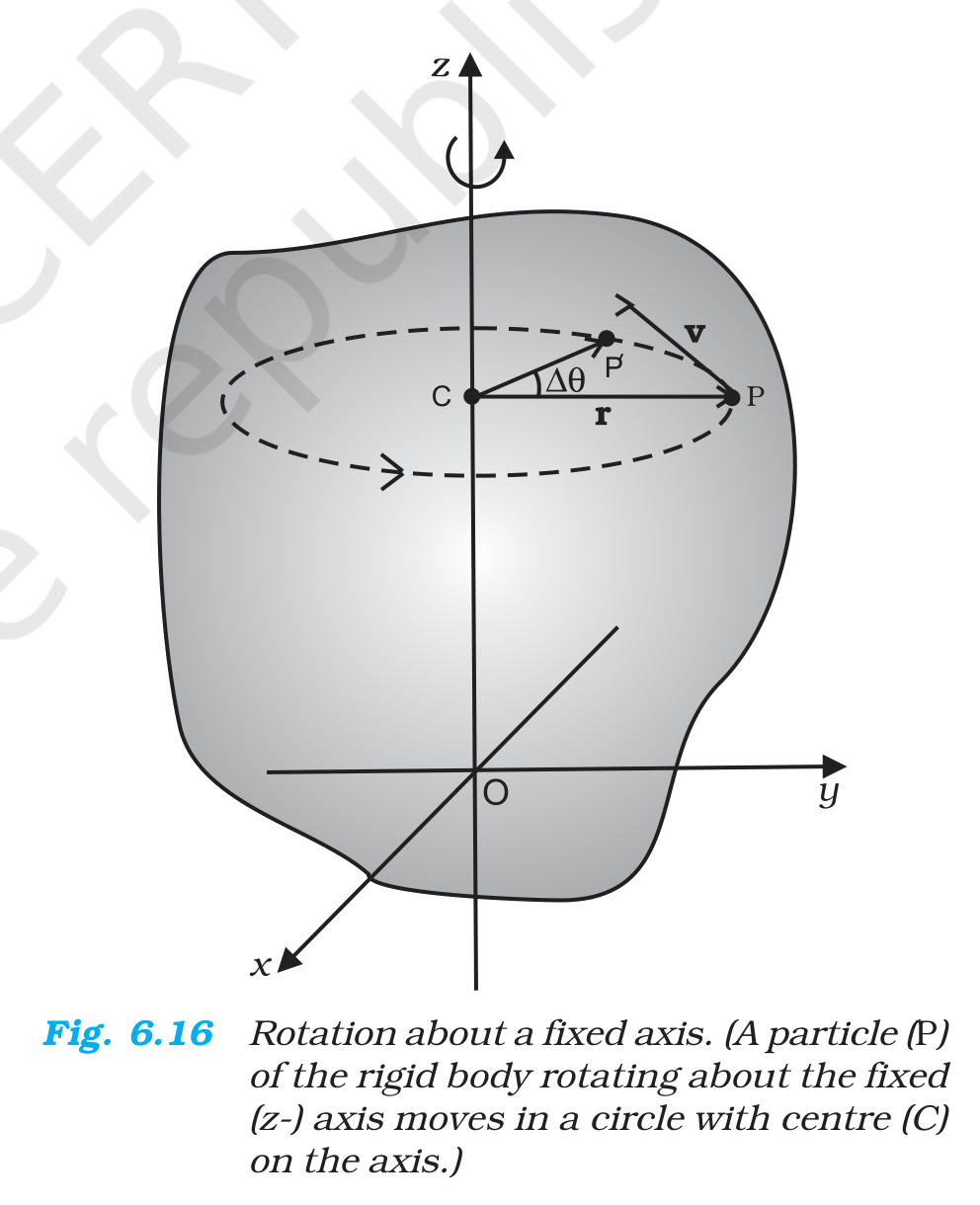
NCERT Figure 6.16: a rigid body rotating about a fixed z-axis, with a particle P moving in a circle whose centre C lies on the axis.
3.2 Torque
Torque is the turning effect of a force and is the cross product of the position vector of the point of application with the force. Its magnitude is the product of the force and the perpendicular distance from the axis, and its direction is found from the right hand rule. A force applied along the line through the axis produces no torque, however large it is, because the perpendicular distance is zero.
The lever is the classic example: a small force applied far from the pivot balances a large force applied near it, because the perpendicular distances adjust the torques. A door handle placed far from the hinge works for the same reason. The unit of torque is the newton metre, which is dimensionally the same as the joule but is not called a joule because torque is not energy.
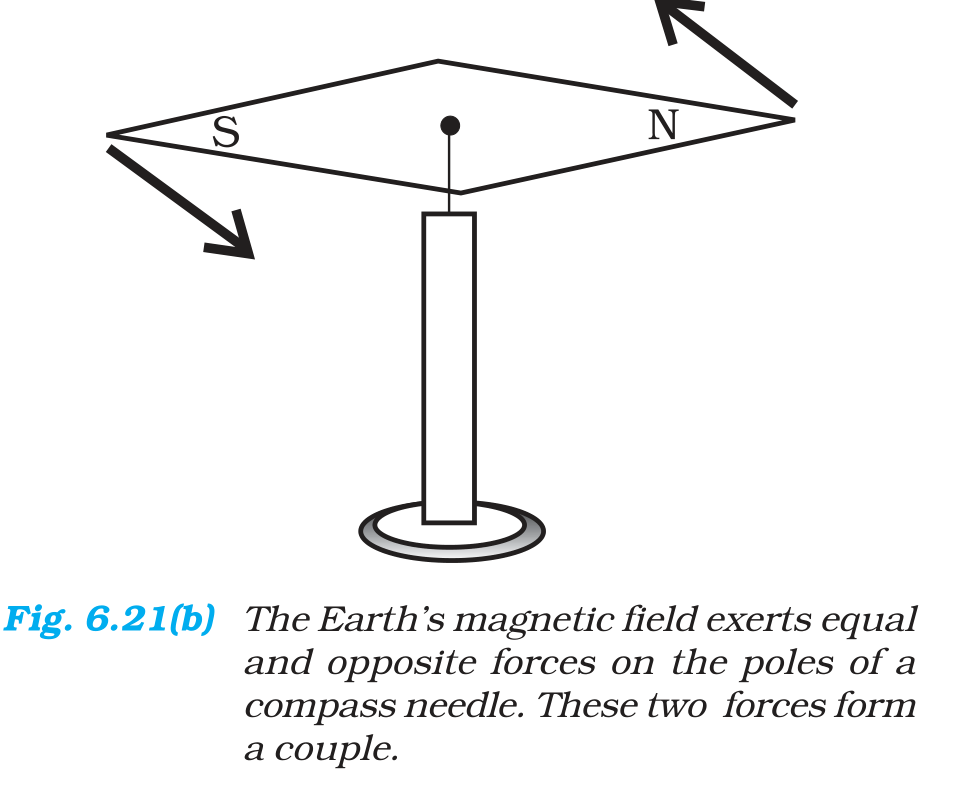
Torque changes angular momentum, not linear momentum, and a net torque on a system about an axis produces angular acceleration about that axis. A couple is a pair of equal and opposite forces whose lines of action are different, and it produces a pure torque without any net force. The forces on the two poles of a compass needle form a couple, as the figure shows.
3.3 Angular momentum
The angular momentum of a particle about a point comes from the cross product of its position with its linear momentum. For a rigid body spinning about a fixed axis, the component along that axis is the moment of inertia times the angular velocity, directed along the axis. The torque on a body equals the rate of change of its angular momentum, which is the rotational analogue of the second law.
Angular momentum is conserved when the net external torque is zero, and this explains a wide range of phenomena. A figure skater who pulls the arms inward reduces the moment of inertia and so spins faster, because the product of the moment of inertia and angular speed stays constant. A planet sweeps equal areas in equal times for the same reason, since the gravitational force acts along the line to the sun and produces no torque about it.
In a collision that is not head on, angular momentum about a suitable point can be conserved even though the linear momentum also needs the external force to vanish. A bullet embedding in a disc mounted on a fixed axis is the standard example: the linear momentum is changed by the axis force, but the angular momentum about the axis is conserved during the embedding.
3.4 Equilibrium of a rigid body
A rigid body is in equilibrium when the net external force is zero and the net external torque about any point is zero. The two conditions are independent, and both must be satisfied. A book resting on a table satisfies both, while a body pulled by two equal and opposite forces along the same line also satisfies both, though a couple of equal and opposite forces on different lines leaves the net force zero but gives a non-zero torque.
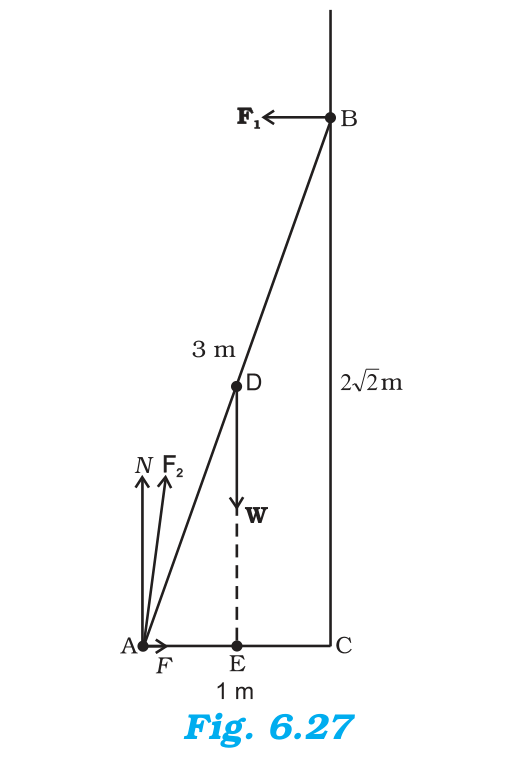
The ladder problem is a standard case. The weight of the ladder, the weight of a person on it, the normal reaction from the ground, the friction from the ground and the normal reaction from the wall act on the ladder. Two force equations and one torque equation are enough to find the unknowns, and the torque is taken about the point where two unknowns act so that they drop out.
Choosing the point for the torque equation is the main skill. Take it at the point where the most unknown forces act, because the torque of a force whose line passes through that point is zero. A diagram with all the forces and their distances marked is worth more than a page of algebra in these problems.
Warning
Angular momentum is a vector along the axis. In a problem where the axis can change, such as a spinning top or a gyroscope, the direction of the angular momentum changes even when its magnitude is constant, and the torque needed for that change must be accounted for.