

Concepts: change of state, heat transfer and Newton's law of cooling
Thermal Properties of Matter26 min readLesson 4 of 6
4.1 Change of state and latent heat
When a solid is heated, its temperature rises until it reaches the melting point, then stays constant while the solid turns into liquid. The heat supplied during this plateau is the latent heat of fusion; for ice it is about 3.34 x 10^5 J kg^-1. The same happens at the boiling point, where the latent heat of vaporisation is much larger, about 22.6 x 10^5 J kg^-1 for water, because the molecules must be completely separated. The heat goes into changing the arrangement of molecules, not into raising the temperature. Figure 10.9 shows the heating curve of ice, and Figure 10.12 shows the same information as temperature against the heat supplied.
4.2 Melting, boiling and the effect of pressure
The melting point of a substance changes with pressure. For most substances, increasing the pressure raises the melting point; ice is the famous exception, because water is denser than ice, so increasing the pressure lowers the melting point. That is why ice skates glide on a thin film of water and why a pressure cooker raises the boiling point of water and cooks food faster. Boiling happens when the saturated vapour pressure of the liquid equals the external pressure, so the boiling point falls on a mountain where the atmospheric pressure is lower. Evaporation differs from boiling: it happens at any temperature from the free surface, and it cools the remaining liquid because the fastest molecules leave.
Slideshow, slide 1 of 3. Use the left and right arrow keys to change slides and the space bar to play or pause.
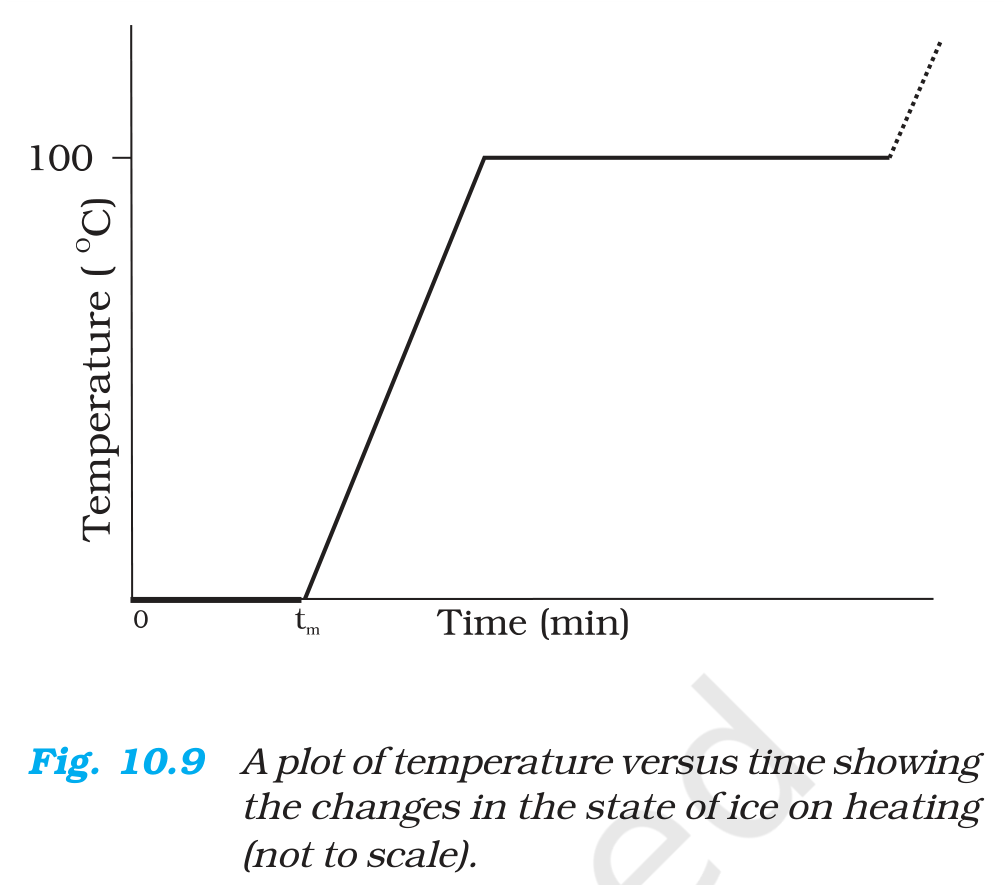
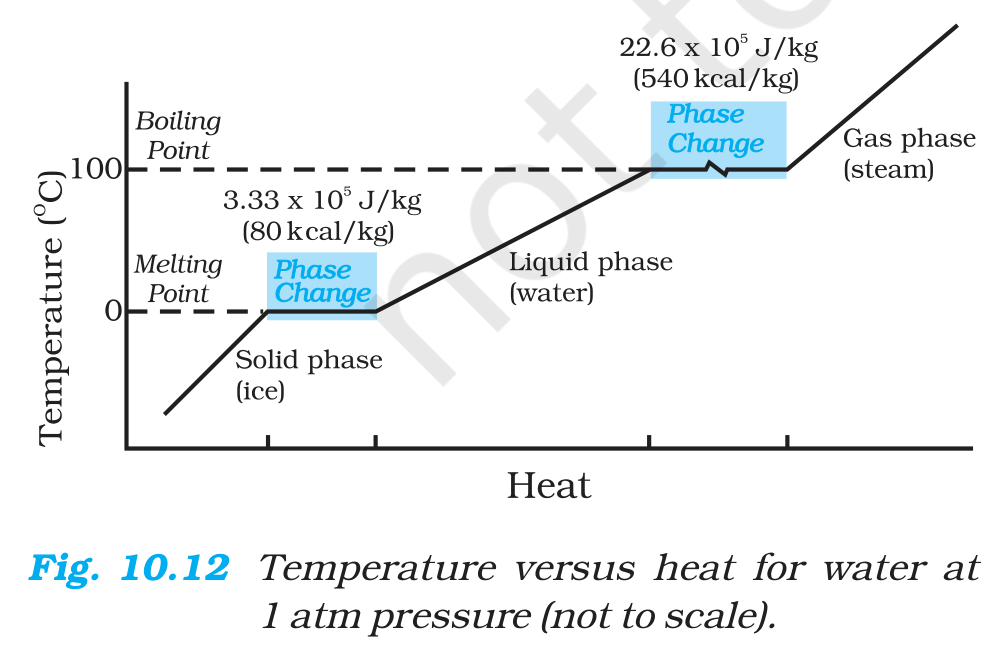
NCERT Figure 10.9: temperature against time while ice is heated, with plateaus at the melting and boiling points.
4.3 Conduction
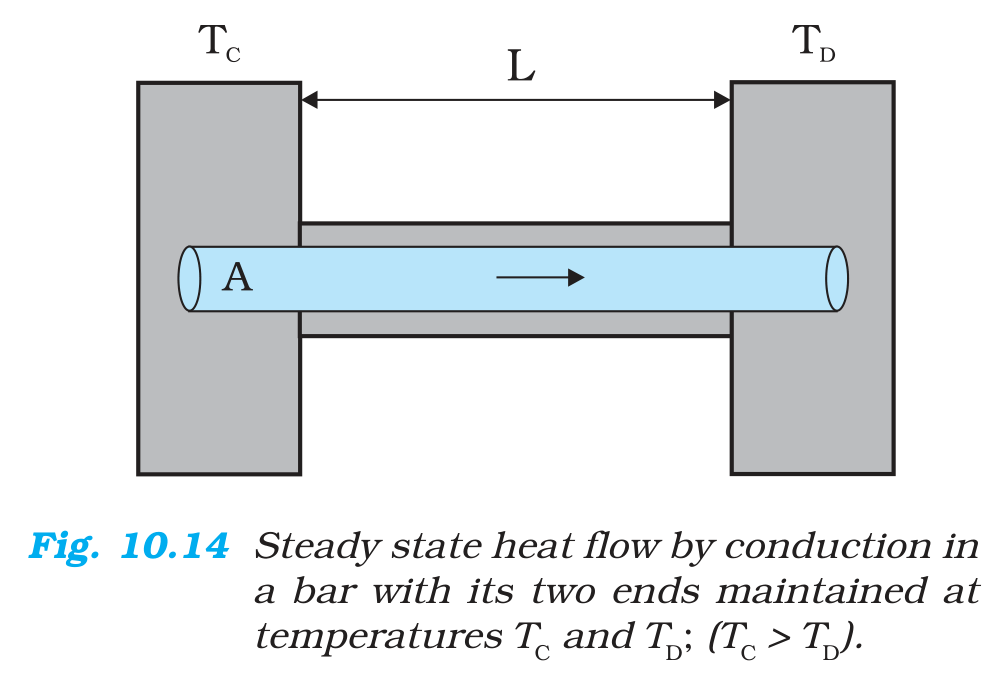
Conduction is heat transfer through a material without the material itself moving. In a slab of thickness L and area A, with the two faces held at temperatures T1 and T2, the heat crossing per second in steady state is k A (T1 - T2)/L, where k is the thermal conductivity. Metals have large k because free electrons carry energy; wood, wool and air have small k and are used as insulators. The ratio kL is called the thermal resistance of the slab, and slabs in series add their resistances, just as electrical resistors in series do. Figure 10.14 shows steady heat flow along a bar whose ends are kept at fixed temperatures.
4.4 Convection and radiation
Convection carries heat by the bulk movement of a fluid. In natural convection, warmer fluid becomes less dense and rises, while cooler fluid sinks, which drives sea breezes and room heaters. In forced convection, a pump or fan drives the flow, as in a car radiator or a water-cooled engine. Radiation is the transfer of heat by electromagnetic waves and needs no medium, which is how the Sun warms the Earth through space. Every body radiates power proportional to the fourth power of its absolute temperature, and good absorbers are also good emitters. A black body is the best absorber and emitter at every wavelength, and the Stefan-Boltzmann law gives its radiated power as sigma A T^4.
4.5 Newton's law of cooling
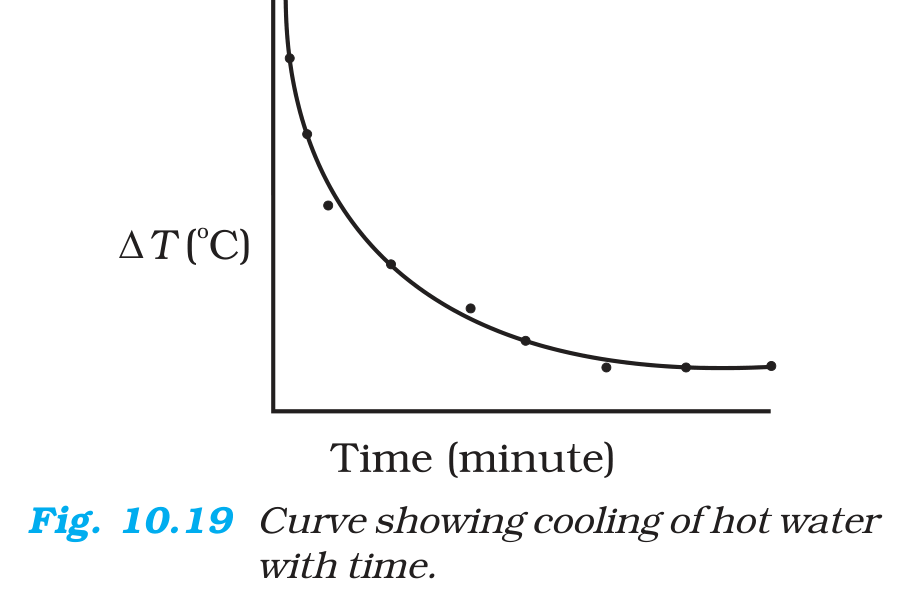
When a hot body is placed in cooler surroundings, it loses heat by radiation and by contact with the air, and the rate of loss is proportional to the difference between its temperature and the surroundings, provided that difference is small. This is Newton's law of cooling, and it gives an exponential fall of temperature with time, not a straight line. The law is verified by plotting the temperature difference against time on semilog paper, or by taking cooling curves for different excess temperatures and showing that the initial slopes are proportional to the excess temperature. For larger temperature differences, the T^4 radiation term matters and the simple law becomes approximate.
4.6 Exercise practice: NCERT questions worked in short
10.1 For neon the triple point arrives at 24.57 K and for carbon dioxide at 216.55 K. Using t_C = T - 273.15 and t_F = (9/5)t_C + 32, neon sits at -248.58 degrees C or -415.4 degrees F, and carbon dioxide sits at -56.60 degrees C or -69.9 degrees F. 10.9 A brass wire of length 1.8 m at 27 degrees C is clamped at both ends and cooled to -39 degrees C, a change of 66 K. The prevented contraction is alpha delta T times the length, so the thermal strain is 2.0 x 10^-5 x 66 = 1.32 x 10^-3 and the tension is Y A alpha delta T = 0.91 x 10^11 x 3.14 x 10^-6 x 1.32 x 10^-3 = 377 N. 10.11 For glycerine with gamma = 49 x 10^-5 K^-1 and a 30 K rise, the fractional change in density is gamma delta T = 0.0147, so the density falls by about 1.5 percent. The other exercises 10.2 to 10.8 and 10.10 to 10.20 apply the same formulas to other data and are listed for practice.
Exam
In a heating curve, the flat parts are the state changes. The heat supplied there is Q = mL and the temperature does not change, so never use mc delta T on a plateau.