

Concepts: thermal expansion, specific heat and calorimetry
Thermal Properties of Matter26 min readLesson 3 of 6
3.1 Thermal expansion of solids
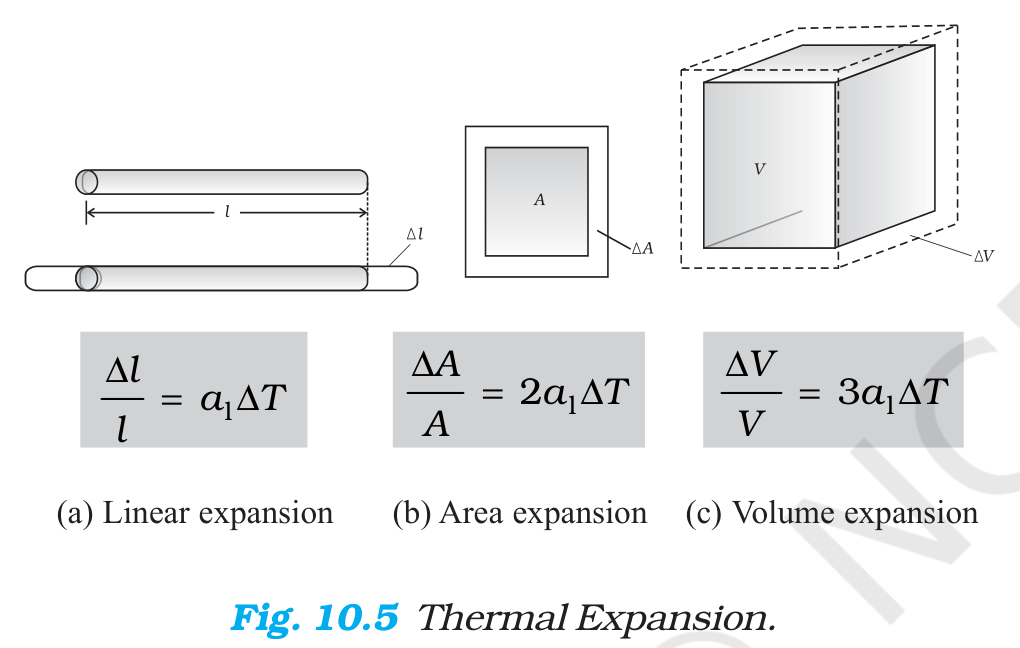
Most solids expand when heated because the average separation between atoms increases with temperature. For a rod of length L, a rise delta T changes the length by L alpha delta T, where alpha is the coefficient of linear expansion. A square plate expands in both directions, so its area grows by 2 alpha A delta T, and a cube grows in all three directions, so its volume grows by 3 alpha V delta T. The relation beta = 2 alpha and gamma = 3 alpha follows from these counts. The coefficients are small, of the order of 10^-5 K^-1 for metals, but over long structures the changes matter: railway rails need expansion gaps, bridges sit on rollers, and a bimetallic strip bends because two metals expand by different amounts. The hole in a heated plate also expands, as if it were made of the same metal, because every linear dimension of the plate scales by the same factor.
3.2 Expansion of liquids and the container
A liquid has no fixed shape, so only its volume expansion matters. When a liquid is heated in a vessel, the vessel also expands, and the rise seen in the neck is the apparent expansion. The real expansion of the liquid must be corrected for the expansion of the vessel: gamma_real = gamma_apparent + gamma_vessel. This is why a liquid can appear to fall first when a container is warmed gently, and then rise as the liquid catches up. Water is unusual: between 0 and 4 degrees C it contracts on heating and reaches its maximum density at 4 degrees C. That is why ice forms at the surface of a pond and fish survive below it, and why water at the bottom stays at 4 degrees C through the winter.
3.3 Specific heat capacity
The heat needed to raise the temperature of a body depends on its mass, its material and the temperature change. For a small change, Q = m c delta T, where c is the specific heat capacity, the heat needed per kilogram per kelvin. Water has a large specific heat, about 4200 J kg^-1 K^-1, so it heats and cools slowly; this is why coastal places have a milder climate than inland places and why water is used as a coolant. The molar specific heat capacity C = M c is the heat per mole per kelvin, and for gases its value depends on the process, with C_p greater than C_v because at constant pressure the gas also does work. For solids and liquids the difference between the two is small, so a single specific heat is usually quoted.
3.4 Calorimetry and the method of mixtures
A calorimeter is an insulated vessel used to measure heat changes. In the method of mixtures, a hot sample is dropped into a colder liquid and the final steady temperature is noted. The heat lost by the hot body equals the heat gained by the cold liquid and the calorimeter, so the unknown specific heat can be calculated. The calorimeter's own heat capacity, often written W, is the product of its mass and specific heat, and it is included as W delta T on the gain side. Careful experiments keep the final temperature close to the room temperature to reduce heat loss to the surroundings.
3.5 Worked example: fitting a wheel on a shaft
A steel wheel is to be shrunk onto a steel shaft. At 27 degrees C the shaft has diameter 8.70 cm and the hole in the wheel has diameter 8.69 cm, so the wheel cannot slip on when both are at that temperature. The shaft is cooled with dry ice. For the hole to clear the shaft, the hole must shrink to 8.70 cm, a change of 0.01 cm on 8.69 cm, which is a fractional change of 1.15 x 10^-3. With alpha = 1.20 x 10^-5 K^-1, the required temperature drop is 1.15 x 10^-3/1.20 x 10^-5 = 96 K, so the wheel must be cooled to about 27 - 96 = -69 degrees C before it slips on. On warming back to room temperature the wheel grips the shaft tightly, which is the usual way of fixing gear wheels and bearings.
3.6 Worked example: a calorimetry problem
A 100 g copper block at 200 degrees C is dropped into 150 g of water at 20 degrees C in a calorimeter of heat capacity 20 J K^-1. Taking c_copper = 390 J kg^-1 K^-1 and c_water = 4200 J kg^-1 K^-1, the heat lost by the copper as it cools to the final temperature T is 0.100 x 390 x (200 - T), and the heat gained by the water and calorimeter is (0.150 x 4200 + 20) x (T - 20). Setting them equal gives 39(200 - T) = 650(T - 20), so 7800 - 39T = 650T - 13000, which gives T = 30.3 degrees C. The result is close to room temperature, which is why the method works well.
Tip
In every calorimetry problem, write the heat lost and heat gained as separate lines before equating them. Include the calorimeter's heat capacity as an extra term on the gaining side when the data give it.