

Concepts: degrees of freedom, specific heats and mean free path
Kinetic Theory26 min readLesson 3 of 5
3.1 Degrees of freedom
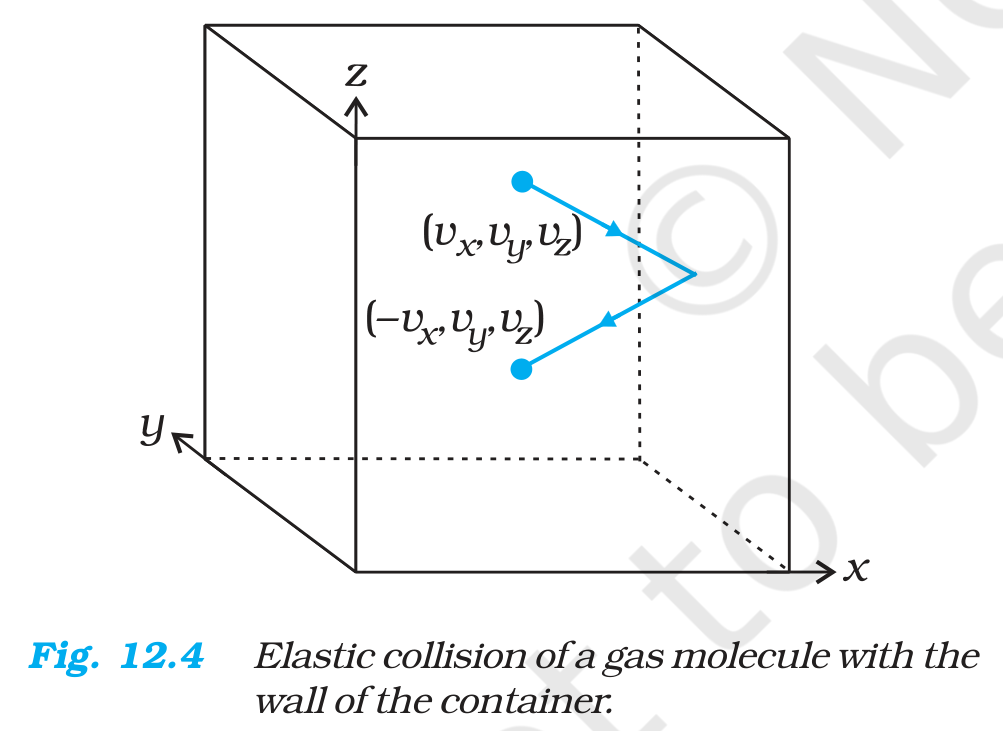
The number of independent ways in which a molecule can move or store energy is its number of degrees of freedom. A monatomic molecule such as helium can translate in three directions, so f = 3. A diatomic molecule such as oxygen can translate in three directions and rotate about two axes perpendicular to its bond, so f = 5 at ordinary temperatures; rotation about the bond axis carries negligible energy because the moment of inertia is tiny. At high temperature the bond can also vibrate, adding two more degrees of freedom, one kinetic and one potential. A polyatomic molecule has three translational and three rotational degrees of freedom, so f = 6 at ordinary temperatures.
3.2 The law of equipartition of energy
In thermal equilibrium, each quadratic degree of freedom carries the same average energy, (1/2)k_BT per molecule. This is the law of equipartition, and it applies to translational, rotational and vibrational modes alike, as long as the mode is fully excited. The internal energy of n moles of an ideal gas is therefore (f/2)nRT. The law explains why the specific heat of a gas is a fingerprint of its molecular structure: more degrees of freedom mean a larger internal energy for the same temperature and a larger specific heat.
3.3 Specific heats from degrees of freedom
At constant volume all the heat goes into internal energy, so C_V = (f/2)R. At constant pressure the gas also does work, and C_P = C_V + R = (f/2 + 1)R. The ratio gamma = C_P/C_V = 1 + 2/f follows at once. For a monatomic gas f = 3, so C_V = 3R/2, C_P = 5R/2 and gamma = 5/3, about 1.67. For a rigid diatomic gas f = 5, so C_V = 5R/2, C_P = 7R/2 and gamma = 7/5, about 1.40. These numbers match the measured values for helium and for air at room temperature, which is strong evidence for the model. At very high temperature, vibration raises f and the specific heats rise; at very low temperature, rotation may freeze out for hydrogen and the specific heat falls.
3.4 Mean free path and collisions
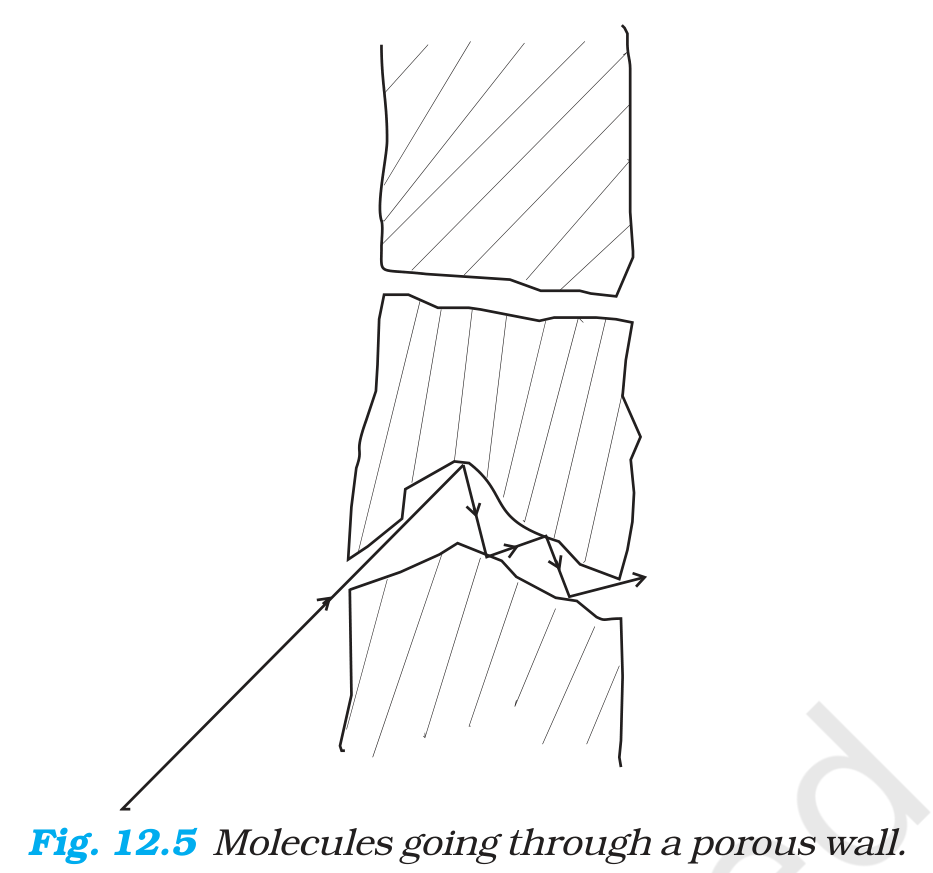
Molecules do not travel in straight lines forever; they collide with one another. The average distance between two successive collisions is the mean free path, lambda. A molecule of diameter d sweeps out a cylinder of radius d as it moves, and a collision happens whenever the centre of another molecule falls inside that swept tube. With n molecules in every cubic metre, the distance between collisions works out as lambda = 1/(sqrt(2) pi d^2 n). The factor sqrt(2) accounts for the motion of the target molecules. At ordinary temperature and pressure, lambda for air is of the order of 10^-7 m, far larger than the molecular diameter, which is why the ideal-gas picture works so well. The mean free path falls in proportion to the density, so gases at high pressure have very short mean free paths.
3.5 Worked example: mean free path and collision frequency
Estimate the mean free path of air molecules at 1 atm and 300 K, taking d = 3.0 x 10^-10 m. The number density at STP is about 2.5 x 10^25 m^-3, so lambda = 1/(1.414 x 3.14 x 9.0 x 10^-20 x 2.5 x 10^25) = 1/(1.0 x 10^7) = 1.0 x 10^-7 m. The average speed of air molecules is about 500 m s^-1, so the average time between collisions is lambda/v = 2 x 10^-10 s. The collision frequency is therefore about 5 x 10^9 collisions per second, which is enormous even though each free flight covers a good many molecular diameters.
3.6 Exercise practice: NCERT questions worked in short
12.1 A vessel contains a mixture of one mole of oxygen and one mole of nitrogen. The total number of moles is 2, and the total number of molecules is 2 N_A. 12.2 At 300 K the mean translational kinetic energy of one molecule is (3/2)k_BT = 6.2 x 10^-21 J, and that value does not depend on the gas. 12.4 For a monatomic gas gamma = 5/3, so the molar specific heats are C_V = 3R/2 and C_P = 5R/2; for a diatomic gas they are 5R/2 and 7R/2. 12.6 The rms speed of a gas at temperature T is proportional to sqrt(T/M), so doubling the temperature multiplies the speed by about 1.41 and changing the gas to one with four times the molar mass halves the speed. The remaining exercises 12.3, 12.5, 12.7 and 12.8 apply the same formulas to other data and are listed for practice.
Tip
In specific-heat questions, count the degrees of freedom first. Then use C_V = fR/2, C_P = C_V + R and gamma = 1 + 2/f; the numbers follow without memorising each gas separately.