

Concepts: molecular picture, temperature and the gas laws
Kinetic Theory24 min readLesson 2 of 5
2.1 Why a gas exerts pressure
A gas fills its container because its molecules move freely in all directions. Each molecule that hits a wall bounces back, and its momentum changes; the wall therefore receives an impulse. Adding the impulses of all the collisions per unit time gives the average force on the wall, and dividing by the area gives the pressure. The result of this argument is P = (1/3)(mN/V) <v^2>, where m is the mass of one molecule, N the number of molecules and <v^2> the mean square speed. The derivation assumes that the molecules are point-like, that collisions are elastic and that the motion is random, so that one third of the mean square speed belongs to each axis. Real gases approach this model at low pressure, where the molecules are far apart.
2.2 Kinetic interpretation of temperature
Combining the kinetic expression for pressure with the ideal gas equation gives the central result of the chapter: the mean translational kinetic energy of one molecule is (3/2) k_B T. So the reading of a thermometer is fixed by how much translational kinetic energy the molecules carry on average; it says nothing directly about the total internal energy of the gas. The result has two immediate consequences. First, at a fixed temperature all gases, whatever their molecular mass, have the same average translational kinetic energy per molecule. Second, the root mean square speed is larger for lighter molecules, because the same kinetic energy divided by a smaller mass gives a larger speed. That is why hydrogen escapes from the top of the atmosphere more easily than nitrogen or oxygen.
2.3 The gas laws seen from molecules
The ideal gas equation PV = Nk_BT contains all the classical gas laws. At constant temperature the product PV is fixed, which is Boyle's law. At constant pressure the volume is proportional to the absolute temperature, which is Charles's law. At constant volume the pressure varies with absolute temperature, which is Gay-Lussac's law. Equal volumes at the same temperature and pressure contain equal numbers of molecules, which is Avogadro's law. Molecular theory explains each one: the number of collisions per second and the impulse per collision together decide the pressure, and both depend on the number density and the temperature in the way the equation says.
2.4 Worked example: comparing molecular speeds
At 300 K, find the ratio of the rms speeds of hydrogen and oxygen molecules. The molar masses are 2 g mol^-1 and 32 g mol^-1, so the ratio is the square root of 32/2 = 4. Hydrogen molecules move about four times faster than oxygen molecules at the same temperature. Their average translational kinetic energies are identical, because that quantity depends only on temperature. This difference in speed explains why hydrogen leaks through small openings and escapes the atmosphere more easily, and why lighter gases diffuse faster through a porous barrier at the same temperature. The same square-root dependence appears in Graham's law of diffusion, so a gas with four times the molar mass diffuses at half the rate of the lighter gas under the same conditions.
Slideshow, slide 1 of 3. Use the left and right arrow keys to change slides and the space bar to play or pause.
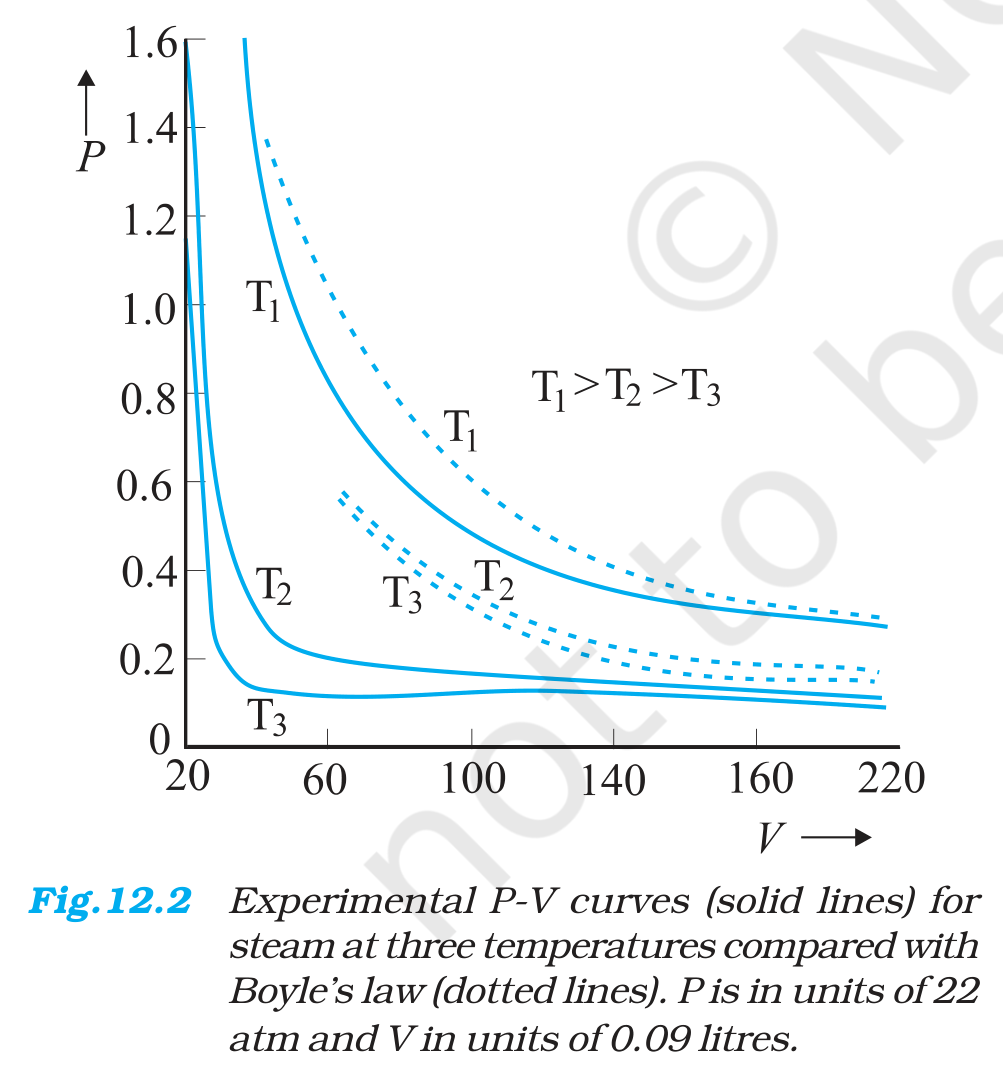
NCERT Figure 12.2: experimental P-V curves for steam at three temperatures compared with the dotted Boyle's law curves.
2.5 Real gases and the limits of the model
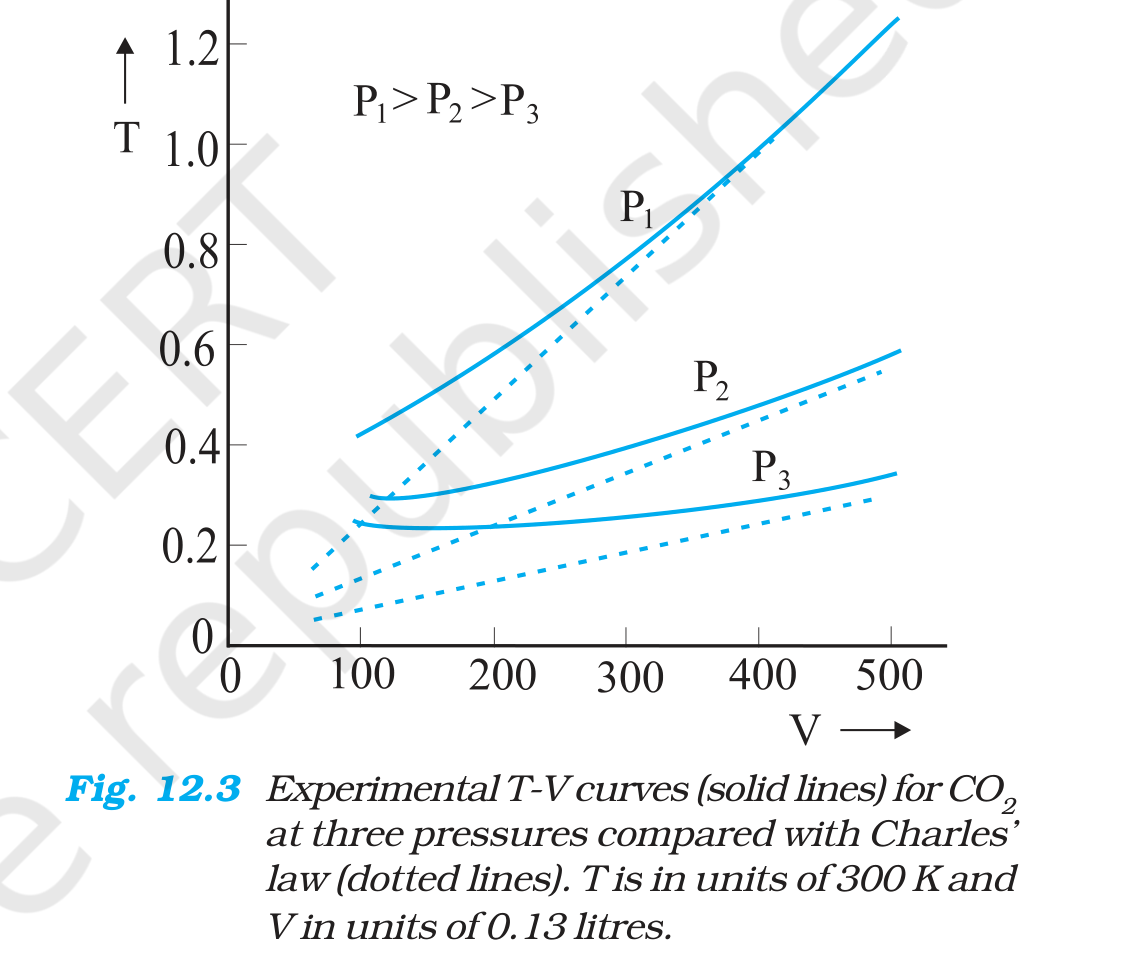
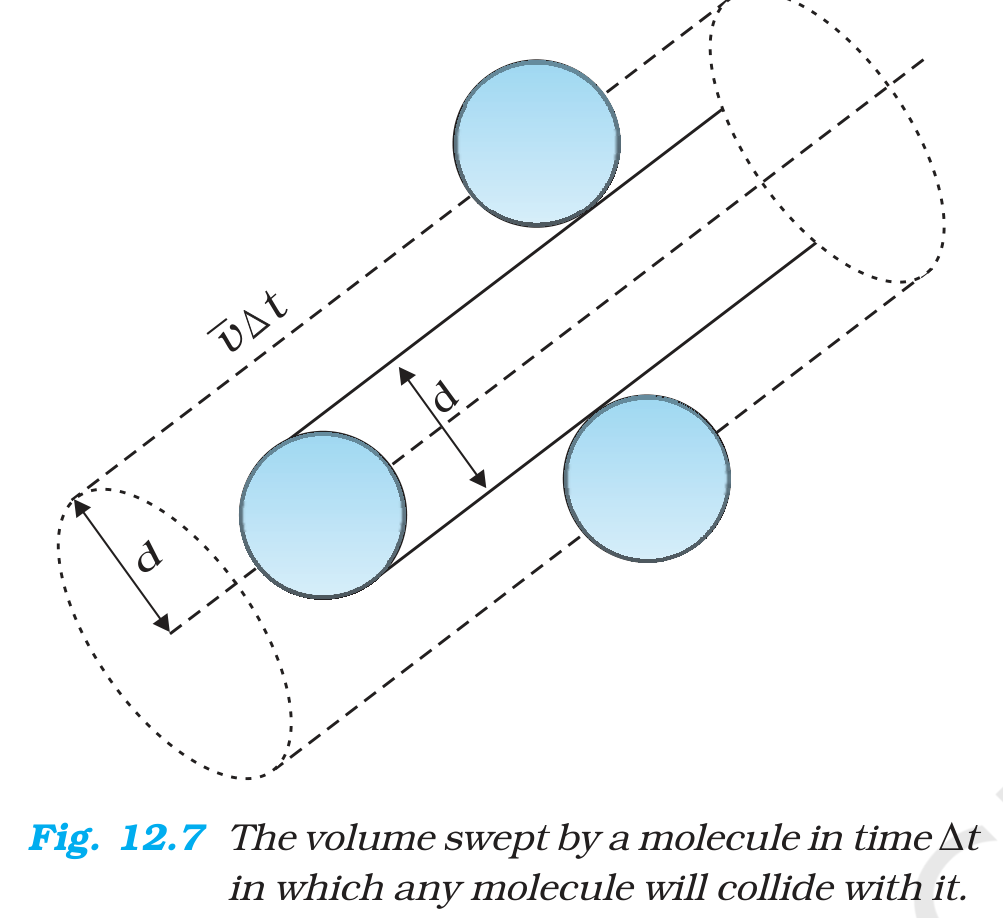
The ideal model works when the molecules are far apart, which means low pressure and high temperature. At high pressure the number density rises, the molecules occupy a noticeable fraction of the volume, and the free volume is smaller than the container volume. At low temperature the attractive forces between molecules matter, and they pull the molecules together, reducing the pressure below the ideal value. Figures 12.2 and 12.3 show the deviation: the measured isotherms of steam and of carbon dioxide flatten and bend near the condensation region instead of following the ideal hyperbola. The mean free path also becomes very small at high density, because a molecule collides much more often.
2.6 Worked example: speed, energy and temperature
Find the rms speed of nitrogen molecules at 300 K, taking the molar mass as 28 g mol^-1. Using v_rms = sqrt(3RT/M) = sqrt(3 x 8.31 x 300/0.028) = sqrt(2.67 x 10^5) = 517 m s^-1. The average translational kinetic energy of one molecule is (3/2)k_BT = 1.5 x 1.38 x 10^-23 x 300 = 6.2 x 10^-21 J. The same temperature for hydrogen, with M = 2 g mol^-1, gives an rms speed four times larger, about 1930 m s^-1, because the mass is 14 times smaller and the speed scales as the square root of the inverse mass.
Common mistake
Average kinetic energy per molecule depends only on temperature, but the rms speed depends on mass as well. Two gases at the same temperature do not have the same molecular speed.