

Concepts: elastic moduli, stress-strain curves and exercise practice
Mechanical Properties of Solids26 min readLesson 3 of 5
3.1 Stress-strain curves are material fingerprints
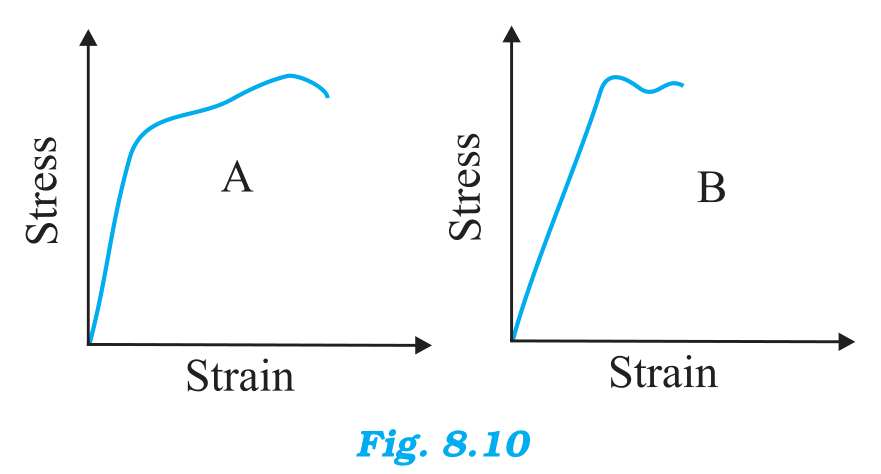
Two metals that look alike can behave very differently under load, and the stress-strain curve shows the difference at once. Steel has a straight line up to a large stress, so its Young's modulus is large and it barely stretches in a bridge cable. The elastic tissue of the aorta has a steep curve only after an initial gentle toe region; that shape lets the artery expand when the heart pushes blood and then recoil. The initial region of the aorta curve is flexible, while later the tissue stiffens. Engineers compare materials by the slope in the straight part, by the peak stress the material can reach, and by how much plastic strain it tolerates before breaking. Figure 8.10 shows two curves drawn to the same scale; the steeper initial line belongs to the stiffer material, and the curve with the taller peak belongs to the stronger one.
Slideshow, slide 1 of 3. Use the left and right arrow keys to change slides and the space bar to play or pause.
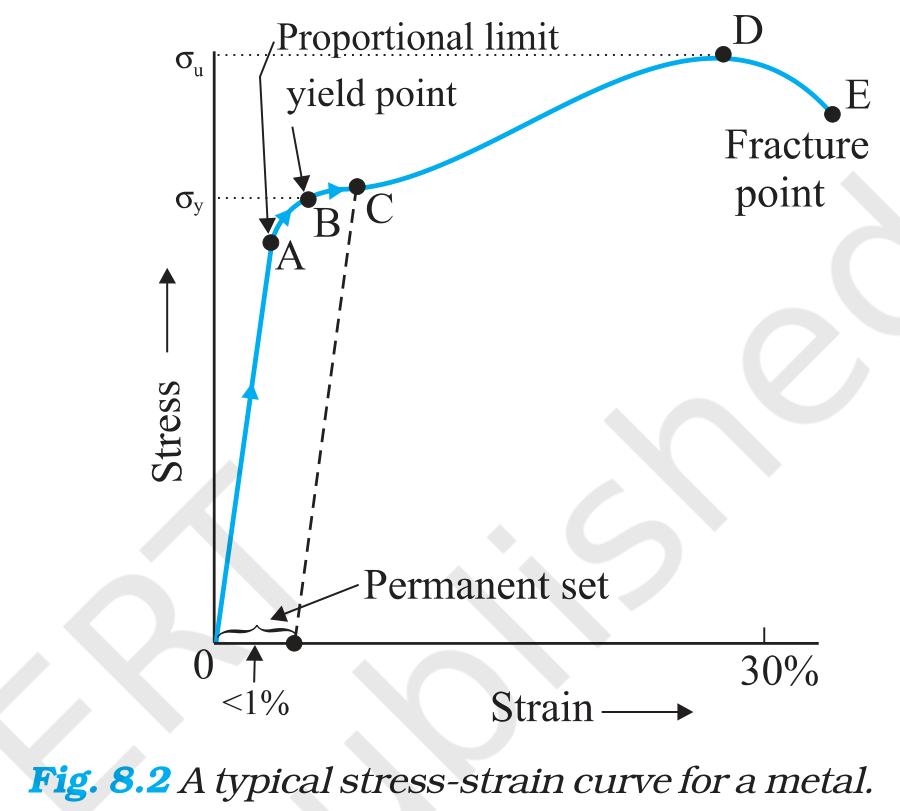
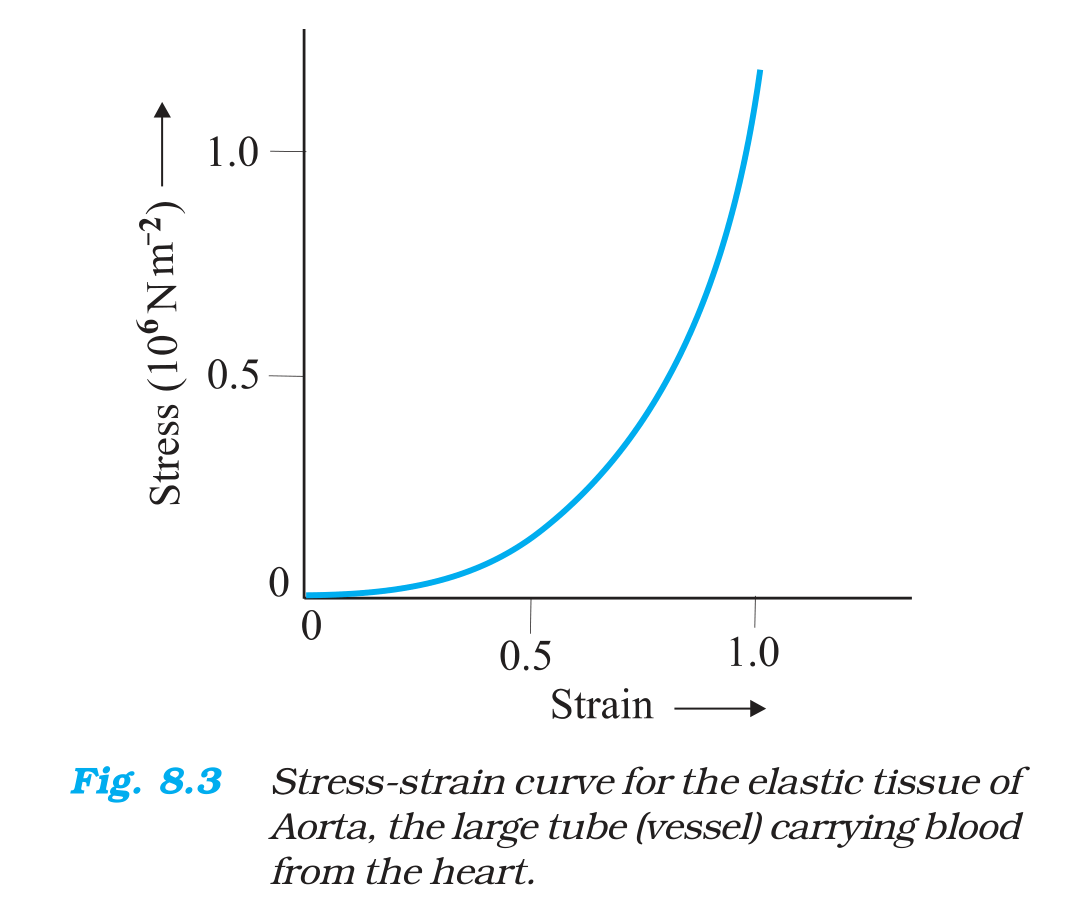
NCERT Figure 8.2: a typical stress-strain curve for a metal, marked with proportional limit, yield point, ultimate stress and fracture point.
3.2 Young's modulus and its meaning
Take a wire of original length L and cross-sectional area A, and hang a load F at its free end. The load makes the wire longer by delta L. Since the stress is F/A and the longitudinal strain is delta L/L, the ratio of the two is Y = (F/A)/(delta L/L) = FL/(A delta L). This quantity is a property of the material and not of the sample: a thick wire and a thin wire cut from the same steel give the same Y. The units of Y are N m^-2. Steel has Y about 2 x 10^11 Pa, so a steel wire of length 1 m and area 1 cm^2 needs a force of 2 x 10^7 N to stretch by 0.1 percent, which shows why steel cables carry suspension bridges. Young's modulus measures stiffness, not strength. A stiffer material deforms less for the same stress; a stronger material survives a larger stress before breaking.
3.3 Shear modulus and bulk modulus
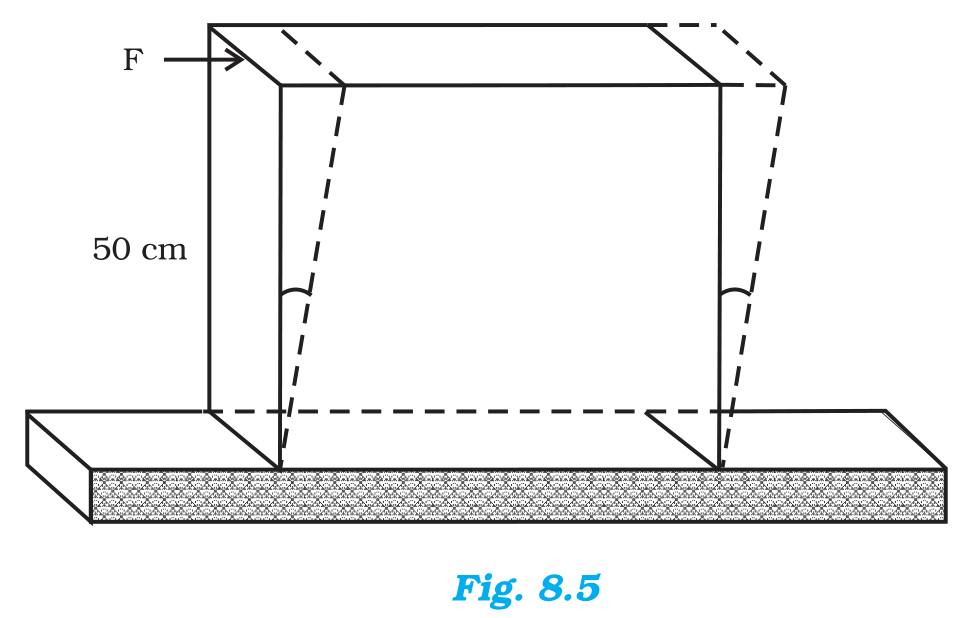
For a block whose bottom face is fixed and whose top face is pushed parallel to itself by a force F, the shear stress is F/A and the shear strain is the sideways displacement divided by the block height. The ratio is the shear modulus G, also called the modulus of rigidity. Liquids and gases have G equal to zero because they flow instead of holding shape. For a solid compressed uniformly, the pressure P and the fractional volume change give the bulk modulus B = -P/(delta V/V), with a minus sign because volume decreases when pressure increases. The reciprocal 1/B is called compressibility. Metals have a very large B, so a metal block barely changes volume under pressure; water has a much smaller B than steel but a far larger one than air.
3.4 Worked example: stretching a steel rod
A structural steel rod of radius 10 mm and length 1.0 m is stretched by a 100 kN force along its length. The area is pi r^2 = 3.14 x 10^-4 m^2, so the stress is (100 x 10^3)/(3.14 x 10^-4) = 3.18 x 10^8 N m^-2. With Y = 2.0 x 10^11 N m^-2, the elongation is FL/(AY) = (100 x 10^3 x 1.0)/(3.14 x 10^-4 x 2.0 x 10^11) = 1.59 x 10^-3 m, and the strain is 0.16 percent. A useful check: the stress is far below the yield strength of structural steel, so the rod returns to its original length when the load is removed.
3.5 Worked example: the circus human pyramid
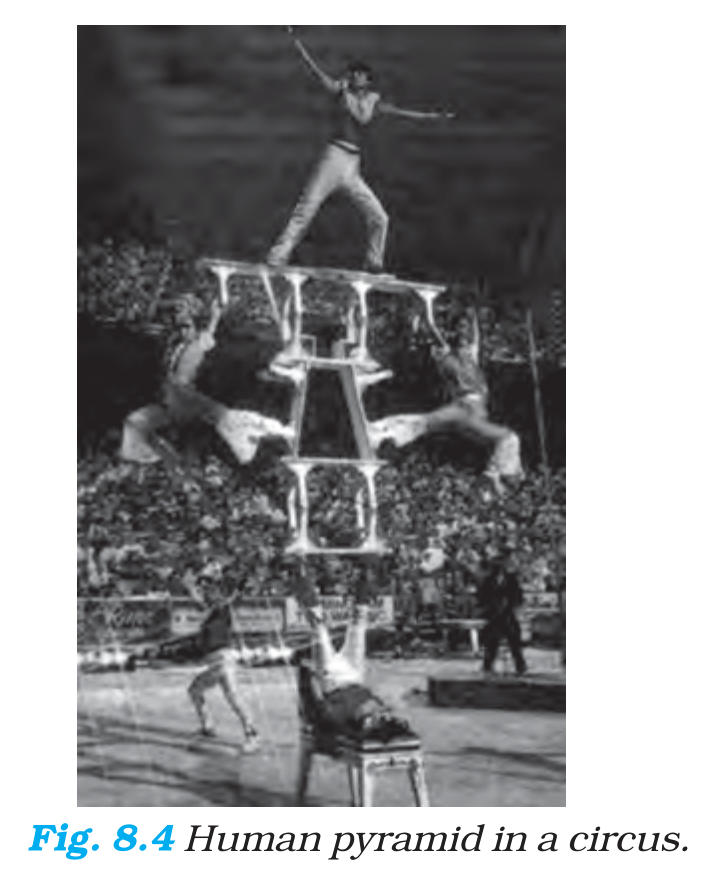
In the NCERT example, a performer lies on his back while a pyramid of people stands on him. The combined mass of the performers and the tables is 280 kg, and the performer at the bottom has a mass of 60 kg. Each thighbone has length 50 cm and effective radius 2.0 cm, and the bone carries only the extra load, not the person's own weight. The extra weight supported is (280 - 60) x 9.8 = 2156 N, shared by two legs, so each femur carries about 1078 N. Taking Y for bone as 9.4 x 10^9 N m^-2, the compression is F L/(A Y) with A = pi r^2 = 1.26 x 10^-3 m^2, which comes to about 4.55 x 10^-6 m, roughly 0.005 mm. The tiny value explains why a well-practised pyramid works: bone is stiff, and the load per unit area is small.
3.6 Exercise practice: NCERT questions worked in short
8.1 Two wires carry the same load and lengthen by an identical amount. The steel one is 4.7 m long with area 3.0 x 10^-5 m^2, while the copper one is 3.5 m long with area 4.0 x 10^-5 m^2. Ask for the ratio of their Young's moduli. Equal forces and equal extensions give L_s/(A_s Y_s) = L_c/(A_c Y_c), so Y_s/Y_c = (L_s A_c)/(L_c A_s) = (4.7 x 4.0)/(3.5 x 3.0) = 1.8. 8.6 An aluminium cube of edge 10 cm has one face fixed and a 100 kg mass hung on the opposite face. The shear stress is (100 x 9.8)/(0.01) = 9.8 x 10^4 Pa, the shear strain is stress/G = 9.8 x 10^4/(25 x 10^9) = 3.9 x 10^-6, and the deflection is strain times edge = 3.9 x 10^-7 m. 8.16 For water compressed by 0.10 percent, the pressure needed is B x (delta V/V) = 2.2 x 10^9 x 0.001 = 2.2 x 10^6 Pa, which is about 22 atmospheres. Questions 8.2 to 8.5 and 8.7 to 8.15 in the exercise set repeat the same three tools with different numbers, so practise them with the formula sheet at hand.
Tip
In a two-wire or composite problem, write the extension of each part and add the extensions. The force may be the same in both parts when they are in series, while the stress changes when the areas differ.