

Concepts: stress, strain and Hooke's law
Mechanical Properties of Solids22 min readLesson 2 of 5
2.1 Why a solid pushes back
A solid has a definite shape because its atoms sit in ordered positions and hold each other in place. When an outside force changes that arrangement, the solid pushes back. The push-back per unit area inside the material is called stress. It is not a vector in the strict sense, because on a chosen face it has a single direction, yet the value depends on which face you choose. For a wire carrying a load F, every cross-section carries the same force F, so the tensile stress is F/A. Doubling the diameter divides the stress by four, because the area grows as the square of the radius.
2.2 The three ways to deform a solid
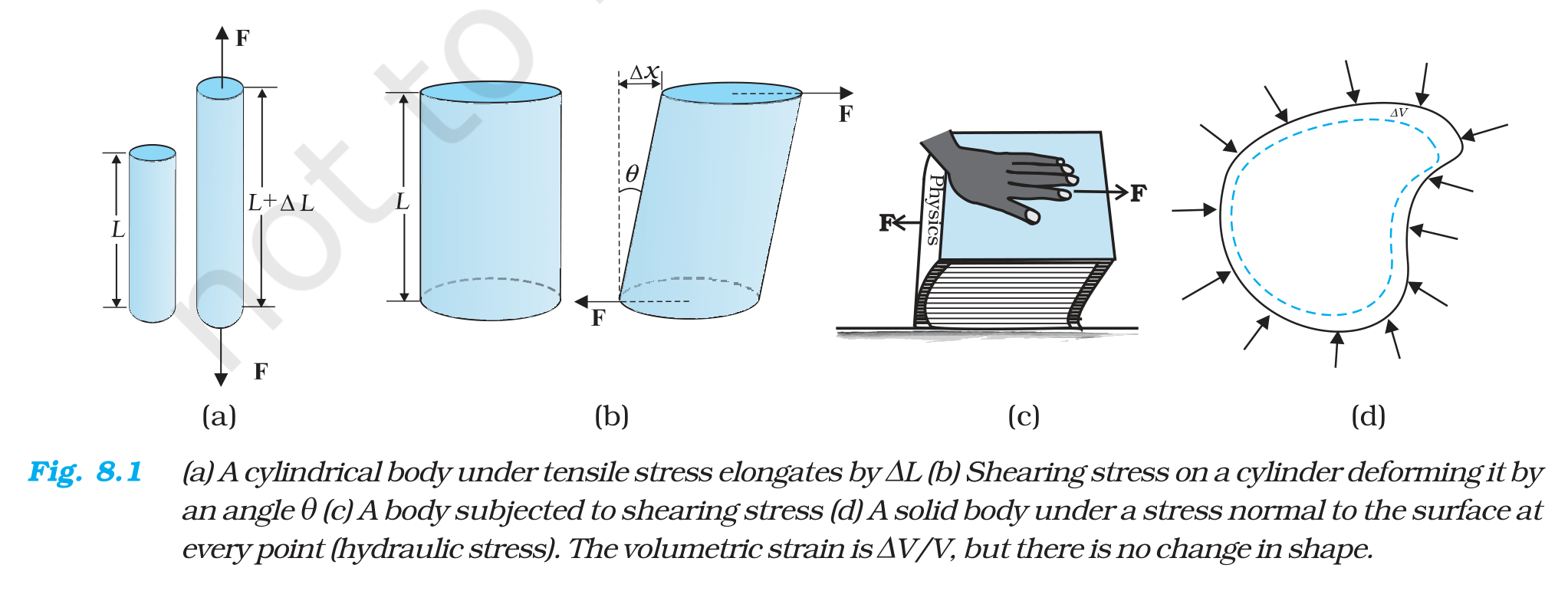
Pulling a rod along its length produces longitudinal stress. The rod becomes longer and thinner. Pushing the same rod along its length produces longitudinal stress in the opposite sense and the rod shortens. A force applied parallel to a face, with the opposite face held fixed, produces shearing stress; the layers slide over one another but the volume stays the same. A body inside a fluid at rest feels pressure on every face, and that hydraulic stress changes the volume without changing the shape. Figure 8.1 puts the four cases side by side. The same pushing force can therefore cause longitudinal, shear or bulk deformation depending on how it is applied.
2.3 Defining strain
Longitudinal strain is the change in length divided by the original length. It is a pure number and is often quoted as a percentage. Shear strain is the displacement of one face divided by the perpendicular distance between the faces; for a small angle it equals the angle in radians. Volume strain, or volumetric strain, is the change in volume divided by the original volume. In every case the strain is small in this chapter, because the material has to remain recoverable when the load is removed.
2.4 Hooke's law and the proportional region
Robert Hooke found that for small deformations, stress is proportional to strain. The constant of proportionality is the modulus of the material, and its value differs from one material to another. The law is not universal. It holds only up to the proportional limit, which is a short part of the stress-strain curve for metals such as steel. After that the curve bends, the material begins to yield, and the deformation is no longer fully recoverable. A small rubber band can be stretched many times its length and still return, so for elastomers the elastic region is long and the curve shows a hysteresis loop when the load is removed slowly.
2.5 Reading a stress-strain test
A tensile testing machine pulls a specimen and records the load and the extension, then converts them to stress and strain. For a ductile metal the curve shows five marked regions. The straight line from the origin is the proportional region, whose slope is Young's modulus. At the end of that line the specimen reaches the proportional limit. A little beyond it the curve shows a yield point or yield plateau, where the material keeps straining with little extra stress. Then the stress rises again with strain up to the ultimate tensile strength, the highest point of the curve. After that the specimen necks down and finally fractures at the fracture point. Ductile materials have a long plastic region; brittle materials such as glass break soon after the proportional region ends, with very little plastic strain. The area under the whole curve measures the toughness, the work done per unit volume before fracture.
2.6 Worked example: a wire hanging under its own weight
A wire of length L, area A and density rho hangs from a fixed support. At a distance x below the support, the part of the wire below that point has weight rho A (L - x) g, so the tension at that section is rho A (L - x) g and the stress is rho (L - x) g. The stress is largest at the top and falls to zero at the free end, so the strain is not uniform along the length. Take a small element of length dx at distance x: its extension is stress times dx divided by Y, which is rho (L - x) g dx/Y. Adding the extensions of all elements from x = 0 to x = L gives the total extension rho g L^2/(2Y). This result is exactly half of what the same total weight would produce if it hung at the free end, because the average tension along the wire is half of the weight. The example shows why a long vertical cable must be designed with the stress at the top in mind.
Common mistake
Do not read Young's modulus from the whole curve. It is the slope of the straight part only. A common mistake in graph questions is to divide the highest stress by the highest strain, which mixes the plastic region into a purely elastic constant.