

Concepts: equilibrium, heat, work and the first law
Thermodynamics24 min readLesson 2 of 5
2.1 Thermal equilibrium and the zeroth law
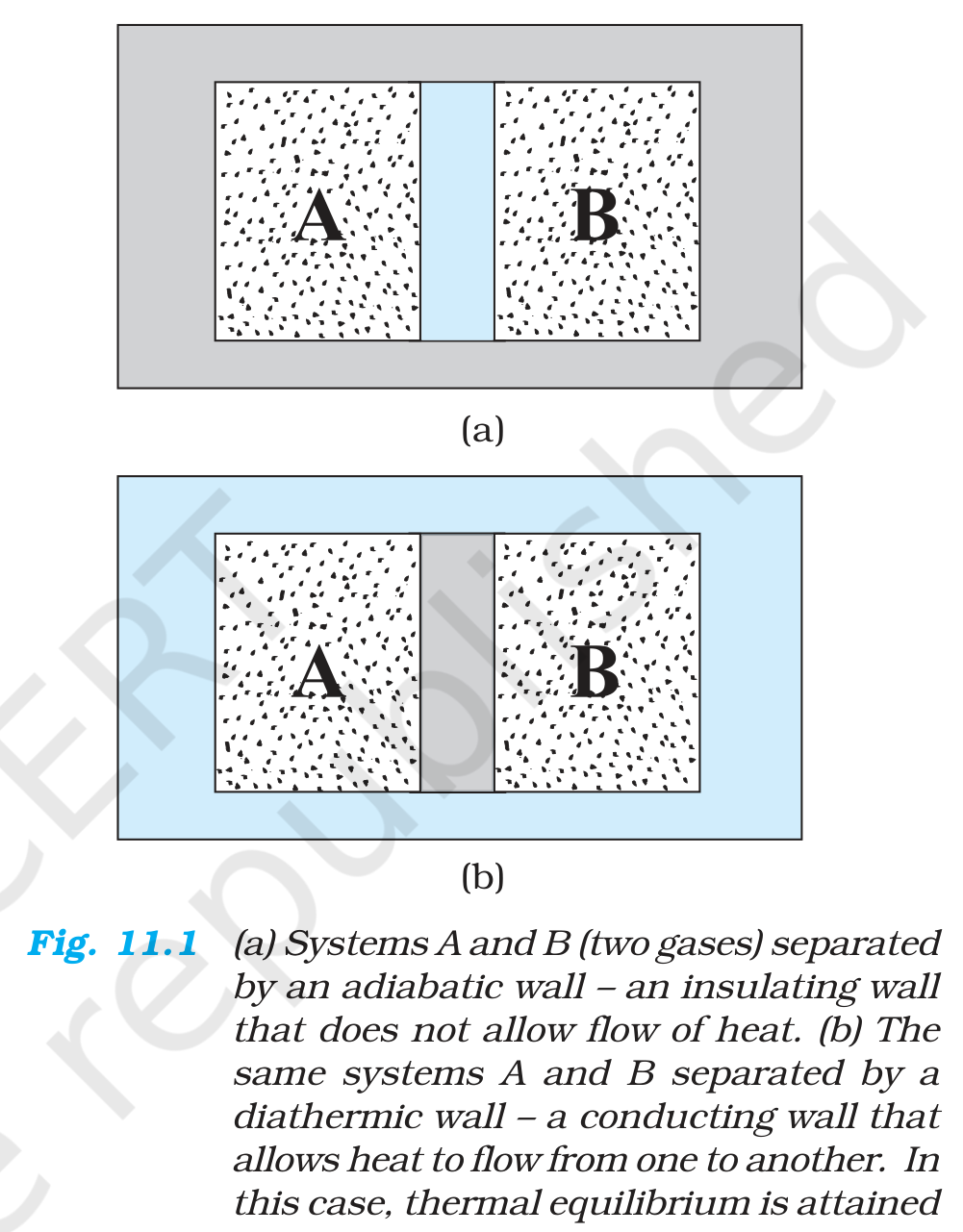
Put two bodies at different temperatures in contact and energy moves from the warmer body to the cooler one. Energy keeps moving until no further net transfer is possible; at that stage the two bodies read the same temperature and are in thermal equilibrium. The zeroth law says that when A shares equilibrium with C, and B also shares equilibrium with C, then A and B share equilibrium with one another. That statement is the reason a thermometer works: the instrument is the third body, and its reading gives the temperature that two otherwise disconnected systems would share. Insulating walls block the exchange, while diathermic walls allow it, which is why a metal cup warms quickly and a thermos flask keeps its contents hot.
2.2 Heat, work and internal energy
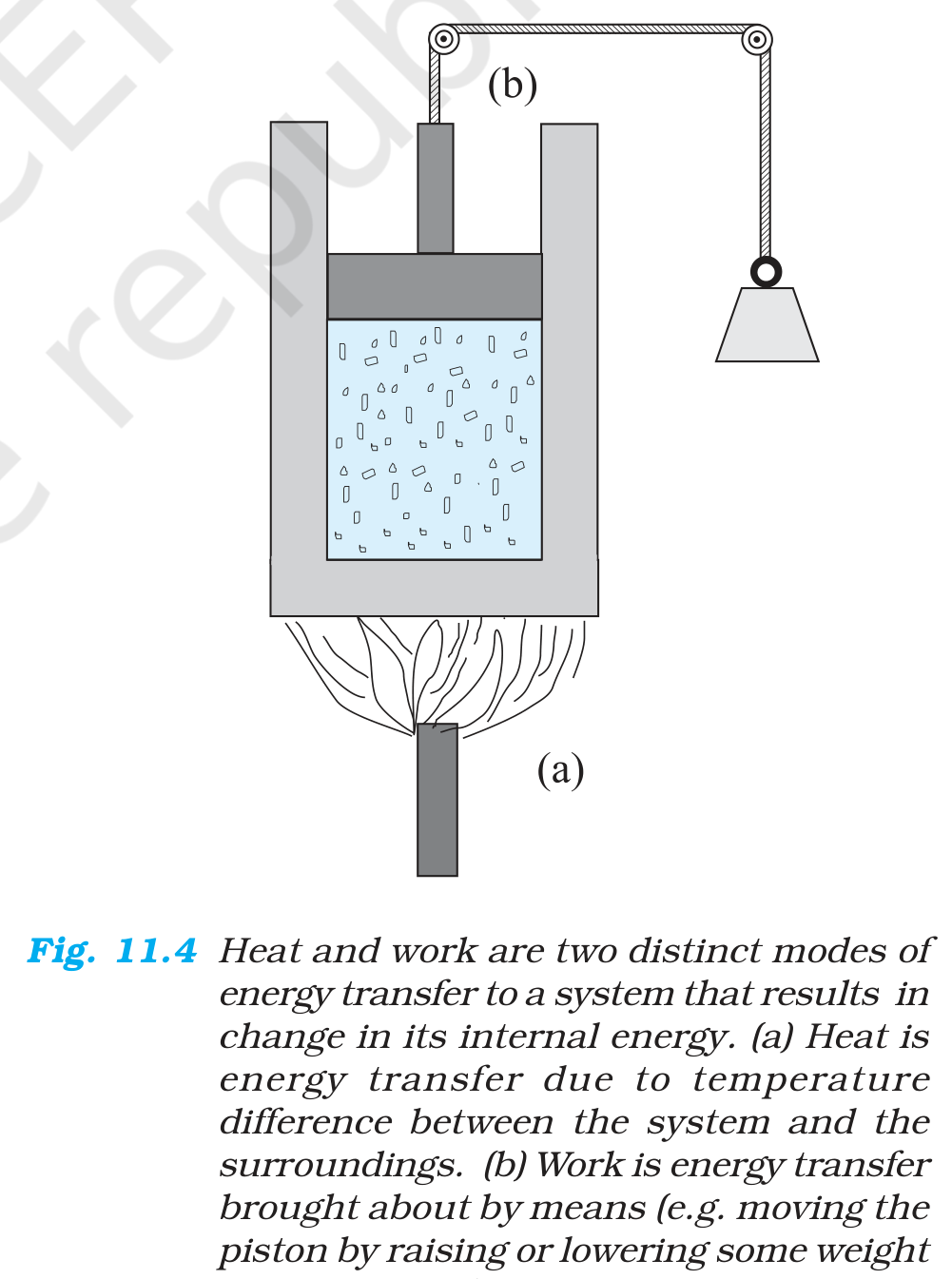
Heat and work are processes that carry energy across the boundary of a system, and neither of them is stored inside the system. The internal energy U is the energy that the molecules possess, and it is a state function: once the state of the system is fixed, U is fixed, whatever path the system took to reach that state. Work done on the system raises its internal energy, work done by the system lowers it, and heat may flow in or out at the same time. A gas in a cylinder can be warmed by a flame, which is heat flowing in, or squeezed by moving the piston, which is work flowing in, and the first law keeps the bookkeeping of the two separate.
2.3 The first law of thermodynamics
The first law is the energy balance for a thermodynamic system: dQ = dU + dW, where dQ is the heat supplied to the system, dU the change in internal energy and dW the work done by the system. The law extends conservation of energy to include heat. It does not say in which direction a process can go; that is the job of the second law. A system that returns to its original state has dU = 0 for the cycle, so the net heat supplied equals the net work done. This is why a cyclic engine can convert heat into work only by returning the working substance to its initial state each cycle. The same balance explains why a gas warms up when it is compressed quickly and cools when it is allowed to expand suddenly.
2.4 Applications of the first law
Two simple cases show how the law works. In an insulated container, no heat enters, so dQ = 0 and the work done by the gas equals the fall in its internal energy; a gas expanding into a vacuum does no work and its temperature does not change, which is the free expansion seen in the next chapter. In a process at constant volume, no work is done, so all the heat supplied raises the internal energy. In a process at constant pressure, the gas does work P delta V and the rest of the heat raises the internal energy. These three cases build the whole algebra of the first law.
2.5 Worked example: a first-law balance
A gas in a cylinder absorbs 800 J of heat and expands, doing 300 J of work against the piston. The first law gives dU = dQ - dW = 800 - 300 = 500 J, so the internal energy rises by 500 J and the temperature of the gas rises with it. If the same 800 J were supplied at constant volume, no work would be done and the whole 800 J would raise the internal energy. This pair of cases shows how the split between internal energy and work depends on the process even when the heat supplied is the same. The temperature rise can then be found from dU = nC_V delta T once the number of moles and the gas are known. Keeping the sign convention fixed avoids the most common error in first-law problems, where heat in and work out are given opposite signs by mistake.
2.6 Specific heat capacities of gases
For a gas, the heat needed to change the temperature depends on whether the volume or the pressure is held constant. At constant volume, no work is done and all the heat goes into internal energy, so C_V = dQ/dT at constant volume. At constant pressure, the gas expands and does work, so more heat is needed for the same temperature rise, which makes C_P larger than C_V. For one mole of an ideal gas C_P - C_V = R. The ratio gamma = C_P/C_V is about 1.67 for a monatomic gas and 1.4 for a diatomic gas at room temperature, because the extra rotational degrees of freedom divide the energy between more modes. These values decide which P-V curves are steeper: an adiabatic curve is steeper than an isothermal one through the same point.
Common mistake
Do not use C_P for a constant-volume process or C_V for a constant-pressure one. Read the process condition first, then pick the specific heat that matches it.