

Concepts: processes, the second law and the Carnot engine
Thermodynamics26 min readLesson 3 of 5
3.1 Quasi-static and reversible processes
A quasi-static process goes through a series of equilibrium states so slowly that the system is always almost in equilibrium with its surroundings. Each intermediate state can be described by a pressure and a volume on the P-V diagram, which is why the work can be read as the area under the curve. A reversible process is one that can be reversed without leaving any trace on the surroundings, and it needs the process to be quasi-static and free of friction, viscosity and other dissipative effects. Real engines have irreversible processes such as sudden expansion, friction and heat flow across a finite temperature difference, so their efficiency is always below the reversible limit. The reversible Carnot cycle is an idealised benchmark, not a practical engine.
Slideshow, slide 1 of 3. Use the left and right arrow keys to change slides and the space bar to play or pause.
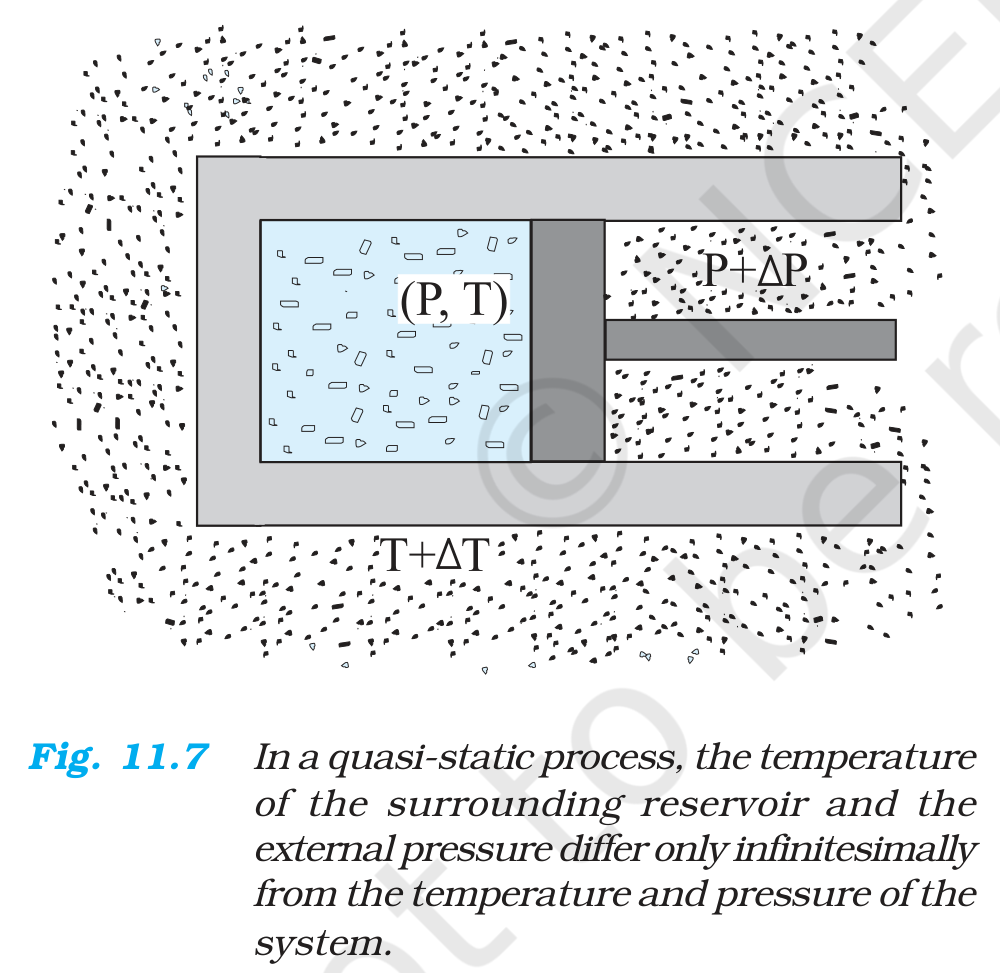
NCERT Figure 11.7: a quasi-static process in which the surrounding reservoir and the external pressure differ only infinitesimally from the system.
3.2 The four standard processes
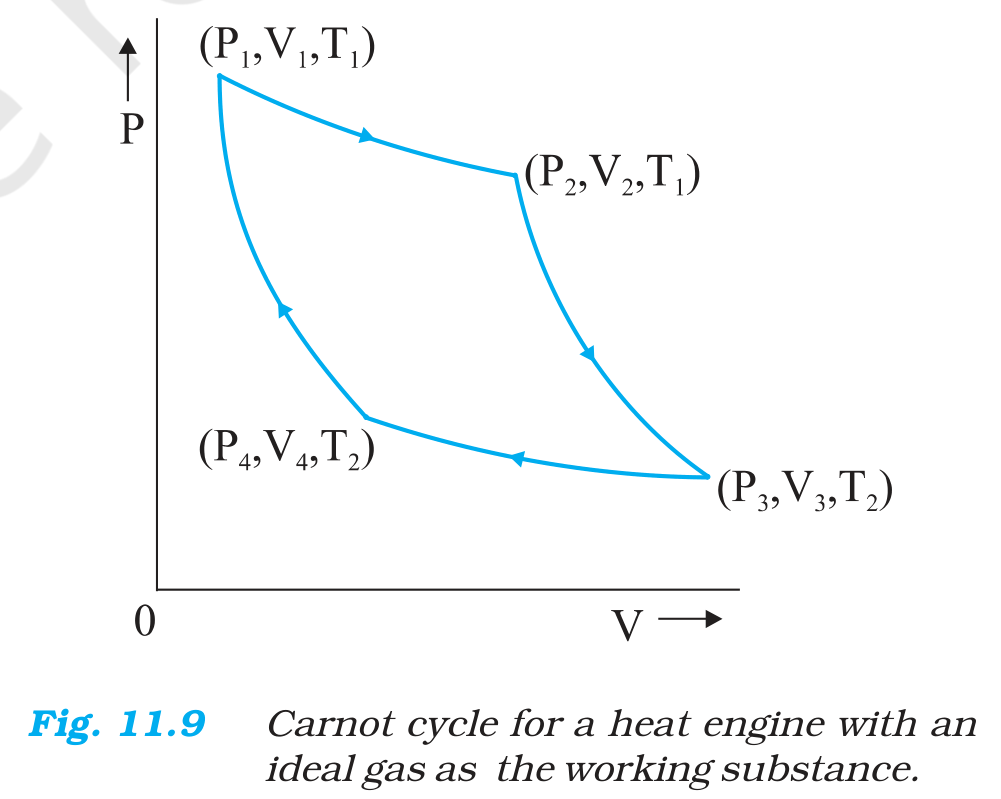
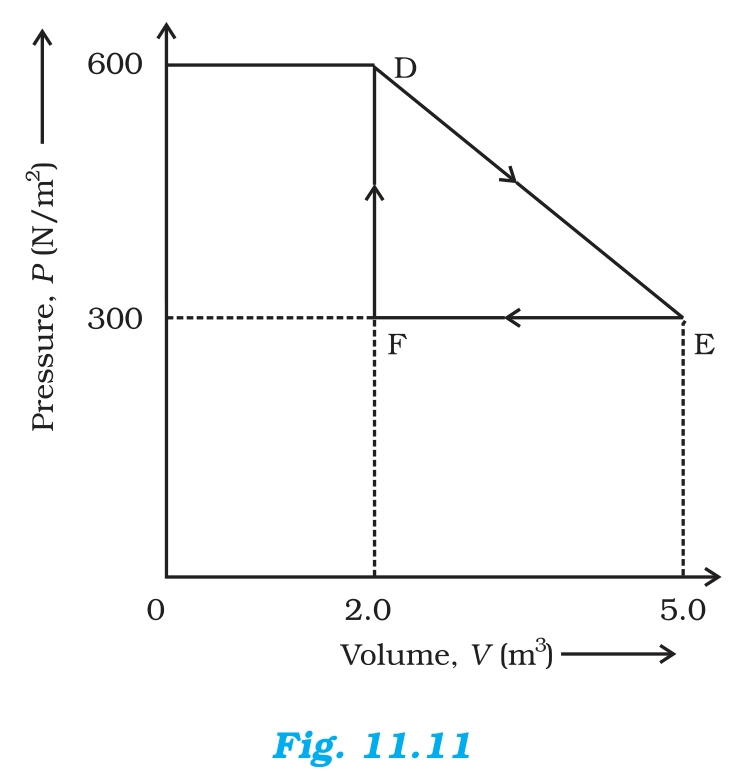
Four processes are named by what is held constant. In an isothermal process the temperature stays fixed, PV is constant and the curve is a hyperbola. In an adiabatic process no heat enters or leaves, PV^gamma is constant and the curve is steeper. In an isobaric process the pressure is fixed, so the work is simply P delta V and the graph is a horizontal line. In an isochoric process the volume is fixed, no work is done and the graph is a vertical line. Every process can be followed on the P-V diagram, and the work done by the gas is the area under the path, with a positive sign when the volume increases. For a closed cycle the net work is the area enclosed by the loop, taken with a sign that depends on the direction of travel.
3.3 The second law of thermodynamics
The first law allows many processes that never happen. A cup of tea cools, but a cool cup never heats itself by taking heat from the room, although that would conserve energy. The second law gives the direction. One statement says heat cannot flow by itself from a colder body to a hotter body, which is why a refrigerator needs a compressor and a motor. Another statement, due to Kelvin and Planck, says no engine can convert heat completely into work in a cycle. The two statements are equivalent, and both introduce the idea of entropy, which measures the disorder of a system and never decreases in a spontaneous process of an isolated system. The second law is what limits engine efficiency to the Carnot value.
Exam
An engine can never reach 100 percent efficiency between two reservoirs at different temperatures. If an option or an answer gives efficiency equal to 1 for a real cycle, check whether it is a limiting case or an error.
3.4 Carnot engine and refrigerator
The Carnot engine is a reversible cycle of four steps on an ideal gas: isothermal expansion at T1, adiabatic expansion from T1 to T2, isothermal compression at T2, and adiabatic compression back to T1. Its efficiency depends only on the two absolute temperatures, eta = 1 - T2/T1, and it is the largest possible efficiency for any engine working between those temperatures. A refrigerator works the cycle in reverse: it extracts heat Q2 from the cold space, receives work W and deposits heat Q1 at the higher temperature. Its coefficient of performance is beta = Q2/W, which for a reversible refrigerator is T2/(T1 - T2). A heat pump uses the same cycle and is described by the heat delivered at the hot end, so its performance coefficient is one more than that of the refrigerator.
3.5 Worked example: comparing two engines
An engine absorbs 4 kJ from a reservoir at 600 K, rejects 2.4 kJ to a sink at 300 K and does 1.6 kJ of work. Its efficiency is 1.6/4 = 0.40. The Carnot efficiency between the same temperatures is 1 - 300/600 = 0.50, so this engine is below the reversible limit, as every real engine must be. If the engine were reversible it would reject only 2.0 kJ for the same 4 kJ absorbed, leaving 2.0 kJ of work. The gap between 1.6 kJ and 2.0 kJ comes from irreversible losses such as friction and heat flow across a finite temperature difference, which is exactly what the second law warns about.
3.6 Exercise practice: NCERT questions worked in short
11.1 A geyser heats 3.0 litres of water per minute from 27 to 77 degrees C. The heat rate is 3.0 x 4200 x 50 = 6.3 x 10^5 J per minute, that is 1.05 x 10^4 J s^-1. With a fuel of heat of combustion 4.0 x 10^4 J g^-1, the fuel rate is 1.05 x 10^4/(4.0 x 10^4) = 0.26 g s^-1. 11.5 In the adiabatic step, 22.3 J of work is done on the gas, so its internal energy rises by 22.3 J. In the second process 9.35 cal = 39.2 J of heat is absorbed, so the net work by the gas is 39.2 - 22.3 = 16.9 J. 11.7 An electric heater supplies 100 W while the system does work at 75 W, so the internal energy rises at 25 W. The remaining exercises 11.2 to 11.4 and 11.6 to 11.8 apply the same laws to other data and are listed for practice.