

Concepts: pressure, Pascal's law and buoyancy
Mechanical Properties of Fluids24 min readLesson 2 of 6
2.1 Pressure inside a fluid
A fluid at rest presses on every wall it touches. The force on a small area is always normal to that area, because a fluid cannot hold a tangential force at rest. The pressure at a point is the normal force per unit area, P = F/A, and it is a scalar. The same pressure acts in every direction at that point, which is why a diver feels it in the ears and a submarine hull must be built from thick plates. The unit is the pascal, 1 Pa = 1 N m^-2, and atmospheric pressure at sea level is about 1.01 x 10^5 Pa, the same as the pressure of about 76 cm of mercury.
2.2 Pressure changes with depth
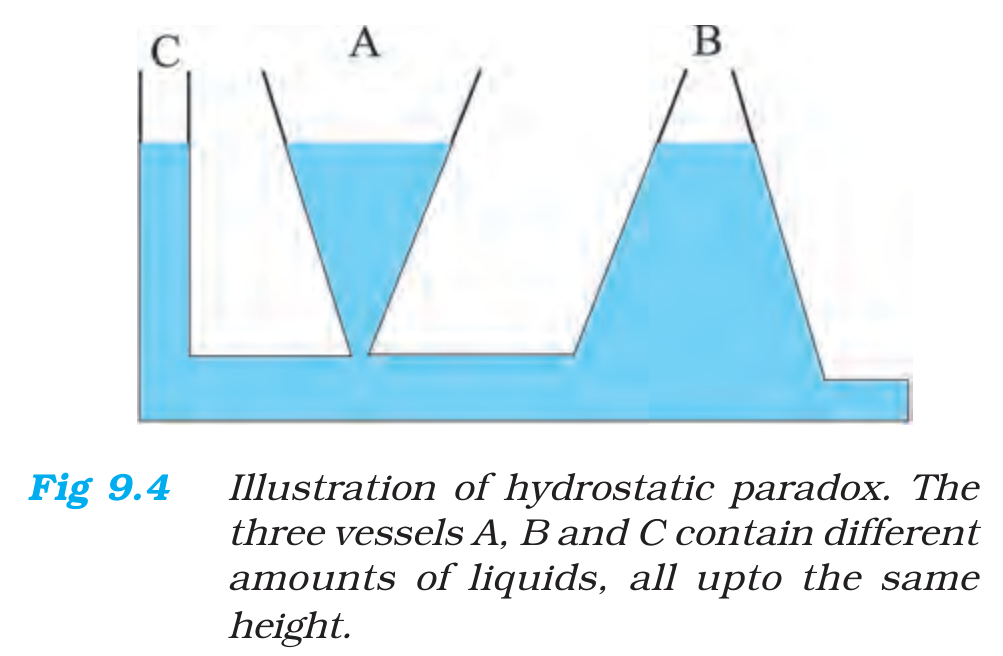
Consider a cylindrical column of liquid of height h and cross-sectional area A. The liquid below the column supports the weight rho A h g of the column, so the extra pressure at the bottom is rho g h. Adding the pressure P0 at the free surface gives P = P0 + rho g h. The result is independent of the shape of the vessel, which is why a narrow tube and a wide tank filled to the same height give the same pressure at the bottom. Two consequences follow at once: all points at the same depth in a connected liquid at rest have the same pressure, and the pressure at a point depends only on the depth below the free surface, not on the amount of liquid to one side. Figure 9.4 shows three vessels of very different shapes holding different amounts of liquid yet producing the same pressure at the bottom, an old puzzle called the hydrostatic paradox.
2.3 Pascal's law and hydraulic machines
Pascal's law states that a pressure applied to an enclosed liquid is transmitted undiminished to every part of the liquid and to the walls of the container. A hydraulic lift uses this idea: a small force on a small piston produces a large force on a large piston, because the pressure is the same and the force is pressure times area. If the small piston has area a and the large piston area A, the force is magnified A/a times, while the small piston moves a distance larger by the same ratio, so the work done is unchanged. A hydraulic brake works the same way. The same law explains why a small pressure on a sealed bottle of liquid can produce a large force on the cork.
2.4 Measuring pressure
To read atmospheric pressure, a long glass tube sealed at the top is first filled with mercury and then its open end is placed in a mercury dish. The mercury column settles at a height where the pressure at the dish level equals the atmospheric pressure, so P0 = rho g h, with h about 76 cm of mercury at sea level. An open tube manometer measures the pressure of a gas: the gas pushes on one arm, the atmosphere pushes on the other, and the height difference of the liquid column gives the gauge pressure. A pressure gauge on a gas cylinder reads gauge pressure, the difference between inside and outside pressure, so the absolute pressure is the gauge value plus atmospheric pressure. In every numerical, convert the height of a liquid column into pressure using rho g h, and remember that mercury is about 13.6 times denser than water.
2.5 Worked example: a hydraulic lift
In a garage lift, the pump piston has area 5.0 cm^2 and the lifting piston has area 0.25 m^2. A force of 200 N on the small piston creates a pressure of 200/(5.0 x 10^-4) = 4.0 x 10^5 Pa. The same pressure acts on the large piston, so the upward force available is 4.0 x 10^5 x 0.25 = 1.0 x 10^5 N, enough to raise a car of about 10 tonnes. The price of this force multiplication is distance: to lift the car by 10 cm, the pump piston must move about 500 times farther, that is 50 m, which is why a hydraulic lift needs repeated pumping or a long ram.
2.6 Buoyancy and floatation
A body wholly or partly inside a liquid feels an upward buoyant force equal to the weight of the liquid it displaces. The result, called Archimedes' principle, follows directly from the difference in pressure on the bottom and top faces of the body. A body sinks when its weight is greater than the maximum buoyant force it can get, floats when the two are equal, and comes to equilibrium with the fraction submerged equal to the ratio of the body density to the liquid density. An iceberg, for example, floats with about nine tenths of its volume below water because ice is only slightly less dense than water. A hydrometer uses the same rule to read the density of a liquid from the depth to which it sinks.
Common mistake
Do not confuse gauge pressure with absolute pressure. A tyre pressure of 2.2 units usually means gauge pressure, and absolute pressure is that value plus atmospheric pressure. In pressure at depth P = P0 + rho g h, P0 is the pressure at the free surface, not zero.