

Concepts: streamline flow and Bernoulli's principle
Mechanical Properties of Fluids24 min readLesson 3 of 6
3.1 Streamline and turbulent flow
In a steady flow, every particle arriving at a given point moves along the same path, and the picture of streamlines stays unchanged with time. Such a flow is called streamline or laminar flow. In streamline flow the lines do not cross, and the tangent at any point gives the direction of the liquid velocity there. When the speed grows large or the tube is rough, the flow becomes turbulent, with irregular eddies and sudden changes in velocity. The Reynolds number tells the two apart: it is the ratio of inertial to viscous forces, Re = rho v d/eta, and for pipe flow a value below about 1000 indicates laminar motion, while a value above about 2000 indicates turbulence.
3.2 The equation of continuity
In steady flow of an incompressible fluid through a tube, the mass crossing each section per unit time must be the same. Since density is constant, the volume crossing each section is constant: A1v1 = A2v2. The product A v is the volume flow rate, measured in m^3 s^-1. A river slows down when it widens and speeds up over rapids, and a water jet from a nozzle comes out faster than the water inside the hose. The continuity equation is an application of conservation of mass and applies to gases only when the density change can be ignored.
3.3 Bernoulli's equation
For an ideal fluid (incompressible, non-viscous) in steady flow along a streamline, the work done by the pressure at the two ends produces a change in kinetic energy and in potential energy. Applying the work-energy theorem to a small volume element gives P + (1/2) rho v^2 + rho g h = constant along a streamline. The three terms are called pressure head, velocity head and elevation head. The equation assumes steady, laminar flow with no energy loss to viscosity. Where the fluid moves faster the pressure falls, and where it moves slower the pressure rises. That single consequence explains most of the applications in the chapter.
3.4 Applications of Bernoulli's principle
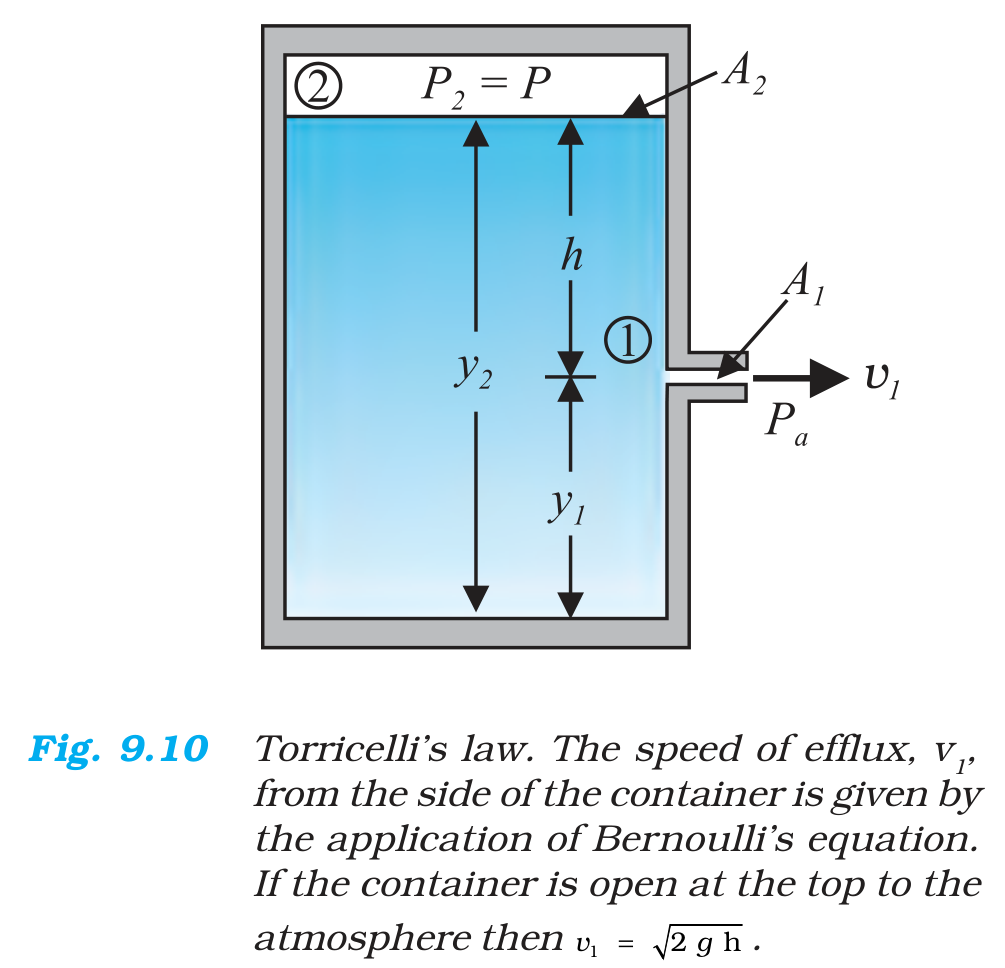
Torricelli's law is the first application. A tank with a small hole at depth h below the free surface has liquid leaving with speed v = sqrt(2gh); the result is the same as the speed of free fall from the same height. A Venturi meter uses the pressure difference between a wide section and a narrow throat to measure the flow rate. The atomiser or spray pump uses the low pressure in a fast air stream to lift liquid through a tube. A spinning ball curves because the air speed differs on the two sides, and a roof can be lifted by a high wind for the same reason. In each case, the question to ask is: where is the fluid moving fastest, and therefore where is the pressure lowest?
3.5 Worked example: efflux from a tank
A tank open to the atmosphere holds water to a height of 1.8 m above a small tap. The pressure at the free surface and at the issuing jet are both atmospheric, so Bernoulli's equation between the surface and the jet gives v = sqrt(2gh) = sqrt(2 x 9.8 x 1.8) = 5.94 m s^-1. If the tap has a cross-section of 0.5 cm^2, the volume flow rate is A v = 0.5 x 10^-4 x 5.94 = 2.97 x 10^-4 m^3 s^-1, which is about 0.3 litre per second. The range of the jet is largest when the hole is halfway down, because the horizontal range is proportional to sqrt(h(H - h)).
3.6 Worked example: the Venturi meter
A horizontal pipe of area A1 narrows to area A2 at its throat, where the pressure is lower. Comparing the wide section and the throat with Bernoulli's equation, and using continuity to eliminate v1, gives the throat speed v2 = A1 sqrt(2 delta P/(rho (A1^2 - A2^2))). A typical water Venturi with A1 = 20 cm^2, A2 = 10 cm^2 and a pressure drop of 1.2 x 10^4 Pa gives v2 = 20 x 10^-4 x sqrt(2 x 1.2 x 10^4/(1000 x 3 x 10^-4)) = 20 x 10^-4 x 8.94 = 0.0179 m^3 s^-1 of volume flow, which is about 18 litres per second. Venturi meters are used in carburettors and in industrial flow measurement because they have no moving parts.
Slideshow, slide 1 of 4. Use the left and right arrow keys to change slides and the space bar to play or pause.
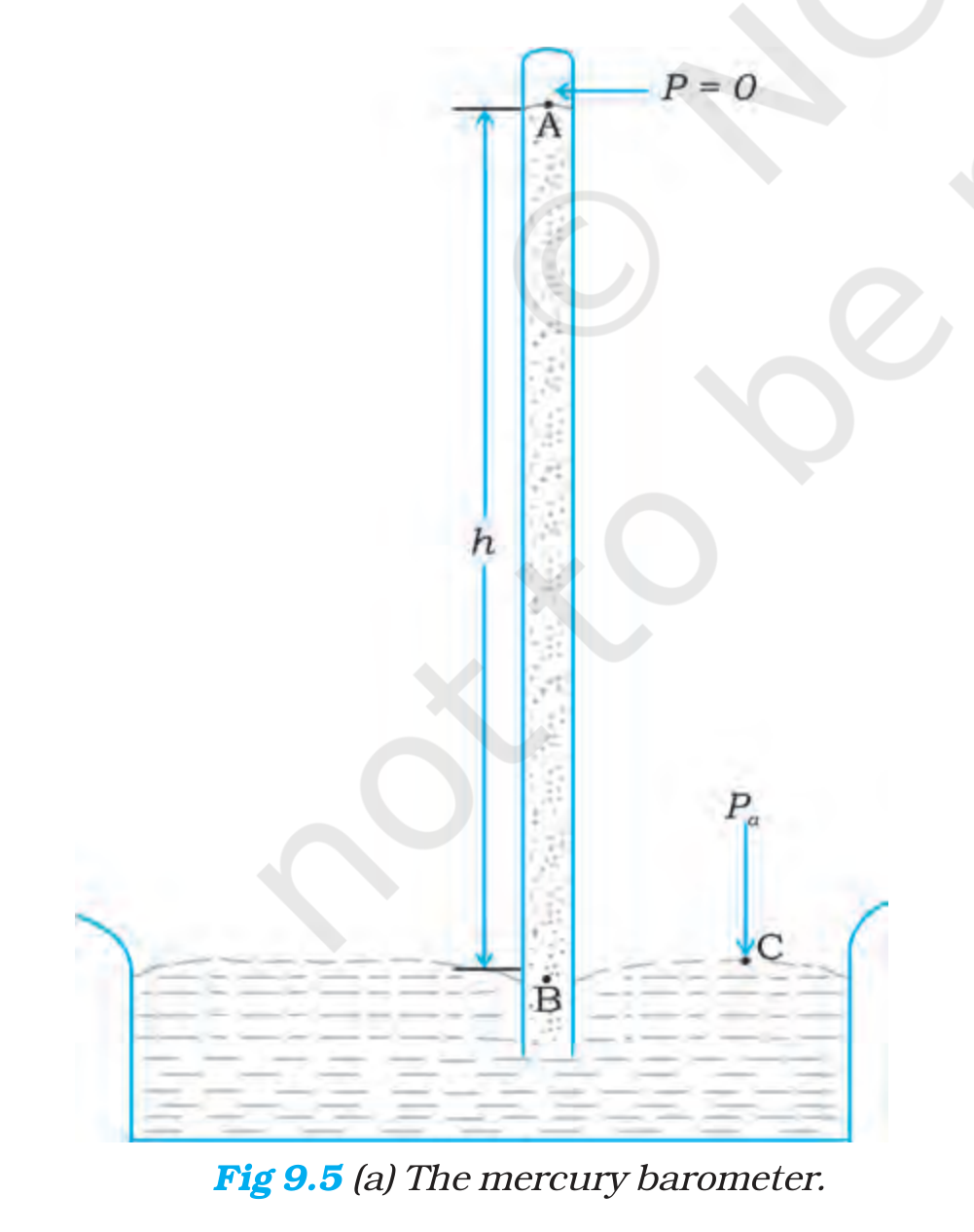
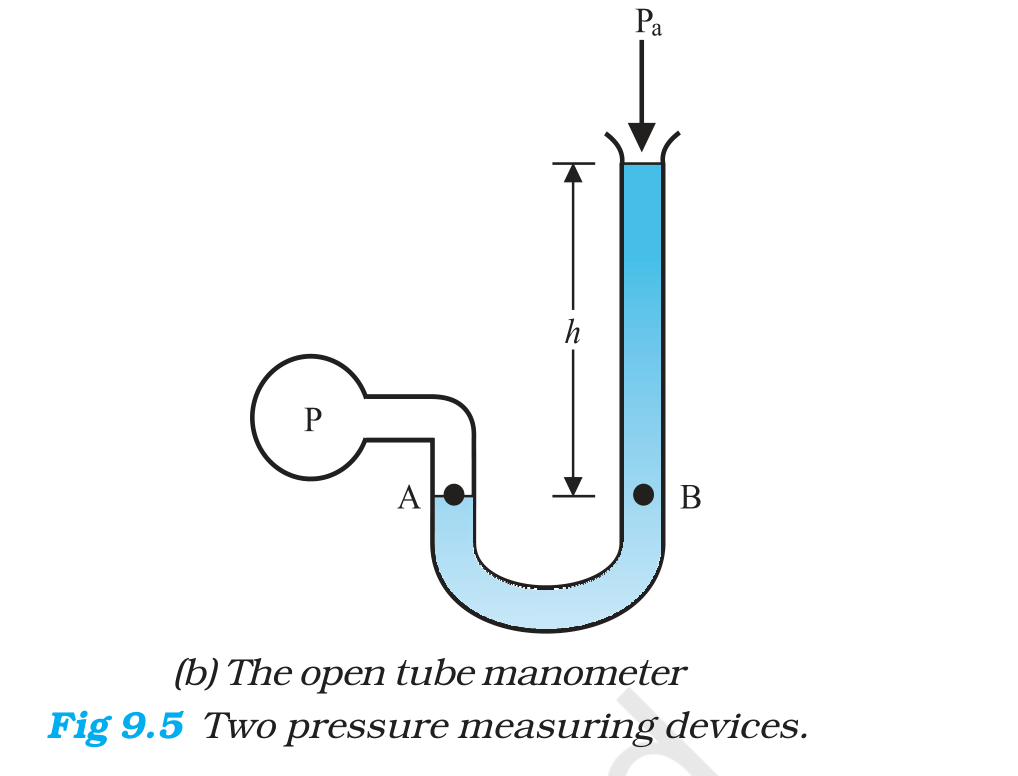
NCERT Figure 9.5(a): the mercury barometer, with a mercury column of height h balancing the atmospheric pressure.
3.7 Limits of Bernoulli's equation
The equation is an energy statement for an ideal fluid, so it fails where viscosity or turbulence takes energy out of the flow or where the fluid is compressible. In a real pipe the pressure falls along the flow even when the height and speed do not change, because viscous friction converts mechanical energy into heat. Aerodynamic lift and the curve of a spinning ball involve more than the simple equation, because the air flows around a body and the streamlines are curved. For exam questions, use Bernoulli only where the flow is steady and the fluid is treated as ideal, and use the continuity equation separately for the speeds.
Tip
In any Bernoulli problem, list the two points first and compare their heights and speeds. Pressure at a free surface and at a jet open to the atmosphere is the same, P0, so those terms cancel and the work is short.