

Concepts: Biotechnological applications in medicine
Biotechnology and its Applications18 min readLesson 2 of 5
2.1 Why recombinant medicines matter
Recombinant DNA methods changed healthcare by making it possible to mass produce therapeutic proteins that are safe and more effective. A recombinant therapeutic is identical, or nearly identical, to the human protein, so it does not provoke the unwanted immune reactions that products taken from other animals often triggered. About 30 recombinant therapeutics are approved for human use around the world, and India markets 12 of them.
2.2 Genetically engineered insulin
Adult-onset diabetes is managed by taking insulin at regular intervals. Before genetic engineering, insulin came from the pancreas of slaughtered cattle and pigs. That insulin worked, but being a foreign protein it made some patients allergic or caused other reactions. The problem to solve was supply and safety together.
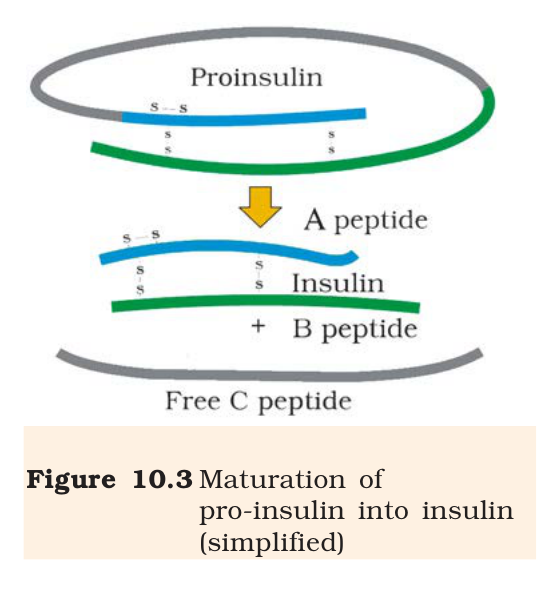
Human insulin is first built as a pro-hormone. Processing is needed before this precursor turns into the mature, working hormone. It carries an extra stretch called the C peptide, which is cut out during maturation, so mature insulin has no C peptide. Insulin itself is two short polypeptide chains, A and B, held together by disulphide bridges (Figure 10.3).
The main difficulty in making insulin by recombinant DNA methods was getting the two chains assembled correctly. In 1983 an American company, Eli Lilly, prepared two DNA sequences, one for the A chain and one for the B chain of human insulin. Each was put into a plasmid of Escherichia coli, and the two chains were produced separately. They were extracted and then joined by creating disulphide bonds, which gave human insulin.
2.3 Gene therapy
Some diseases are inherited, and gene therapy is an attempt to correct them. Gene therapy is a set of methods that correct a gene defect already found in a child or an embryo. Genes are inserted into a person's cells and tissues to treat the disease. A genetic defect is corrected by giving the person, or the embryo, a working copy of the gene that can do the job of the faulty one.
The first clinical gene therapy took place in 1990, on a four-year-old girl whose body could not make adenosine deaminase (ADA). ADA is an enzyme necessary for the immune system to work, and the disorder comes from deletion of the ADA gene. Bone marrow transplantation cures some children, and others receive enzyme replacement therapy by injection of working ADA, but neither approach is completely curative.
For gene therapy, the patient's lymphocytes are taken and multiplied in culture outside the body. A working ADA cDNA is then put into them through a retroviral vector, and the engineered lymphocytes are returned to the patient. These cells are not immortal, so the patient needs periodic infusions of newly engineered lymphocytes. If the ADA gene isolated from marrow cells could be introduced into cells at an early embryonic stage, the correction could be permanent.
2.4 Molecular diagnosis
Early diagnosis helps treatment, but ordinary tests such as serum and urine analysis cannot detect a disease at its start. Recombinant DNA technology, PCR and ELISA fill that gap. An infection is usually suspected only after symptoms appear, and by then the pathogen is already present in large numbers. A very low concentration of a bacterium or virus, present before symptoms show, can still be picked up by amplifying its nucleic acid with PCR. PCR is now used routinely to detect HIV in suspected AIDS patients, to look for gene mutations in suspected cancer patients, and to identify several genetic disorders.
A second method uses a probe. A single stranded DNA or RNA is tagged with a radioactive molecule and allowed to pair with its complementary sequence in a clone of cells. The spot is then read by autoradiography. A clone carrying a mutated gene does not appear on the film, because the probe cannot pair with that sequence. ELISA works on a different principle, the antigen-antibody reaction. It detects a pathogen either by the antigens it makes, such as proteins and glycoproteins, or by the antibodies the person's body has produced against it.
2.5 Exam pointers
For insulin, the sequence of facts matters: animal insulin caused reactions, human insulin has A and B chains linked by disulphide bonds, it is first made as a pro-hormone with C peptide, and in 1983 Eli Lilly made the two chains separately in E. coli and joined them. For gene therapy, say why lymphocytes need repeated infusions: they are not immortal. Do not mix gene therapy with enzyme replacement therapy; only the first changes the genetic material of cells.
Exam
Two three-mark answers repeat in boards: the stages of human insulin production, and gene therapy for ADA deficiency. Write both as numbered steps. For insulin, the sequence is animal insulin problems, A and B chains, pro-hormone and C peptide, then separate production in E. coli and joining by disulphide bonds. For ADA, the sequence is cause, lymphocyte culture, retroviral vector, return of cells, and periodic infusion.